Braking AIDS Ride is not a race. It’s a three-day, nearly 300-mile endurance ride, as well as what Housing Works’ President and CEO Charles King aptly calls “a civil rights march on wheels” because in addition to the crucial funding the ride raises for Housing Works and its many HIV/AIDS services, it also raises awareness of the disease and the remaining challenges associated with it. (Just this morning, when I rode in to work, I was wearing my brand-spanking-new Braking AIDS Ride jersey, and when I entered the lobby of my work building wearing it, a security guy who has known me for years as the chick who comes in wearing her bike gear stopped me and asked whether I had done the Boston-New York AIDS Ride, and we chatted about it for a few minutes.)

Me, riding in the pouring rain early Friday morning, Sept. 28, 2012, in Massachusetts, Day 1 of last year’s Braking AIDS Ride. This is what I look like when I ride and I am taking myself a little too seriously. Which, thankfully, is not 100% of the time… Photo courtesy of Alan Barnett.
The ride itself brings together cyclists of all shapes, sizes, and levels of fitness and biking experience, which is one of the things I love about it. Some people aren’t big cyclists at all, and they participate largely because they believe in the cause; they raise money and awareness, they train as much as they can, and on the ride, they show up to have a good time and put in whatever miles they’re able to put in. Some people are unbelievable athletes—racers, marathoners, multi-time triathletes and Ironmen/women, cyclists who can average 18 miles an hour all day long for 100 miles—and they do the ride even though it’s not a race and there’s no award for finishing each day first because they’re connected to the cause as well, and because whether we’re officially timing it or not, the ride itself is a physical challenge for everyone. Most riders, myself included, fall somewhere in between these two opposing ends of the Braking AIDS Ride cyclist spectrum.
Still, in the course of training all summer for this long ride, I sometimes tend to forget I’m not competing with anyone except myself and whatever personal physical goals I might have. I think it’s good to set the bar higher each time one reaches a goal, but I also tend to forget that means it gets harder the longer one works at something rather than easier. Now that I’m doing my fifth Braking AIDS Ride since 2008, I find I have to spend more time contemplating and recalibrating my goals and my expectations as to what “progress” is for myself. I tend to focus so much on what’s next, what the next target is, I forget to turn around once in a while and look back at how far I’ve come since I started all this. When I began training in 2008 for my first Braking AIDS Ride, I had never done a century ride (100 miles in a day), much less three back-to-back centuries. At the beginning of my training that season, I pedaled along at a humbling 12-13 miles per hour on flat road. By the time I did my second ride in September 2009, I had logged something like 4,500 miles on my bike, The Blue Streak, since purchasing it in June 2008, I had raised $20K for the cause over the previous two years, and I was a solid intermediate rider.
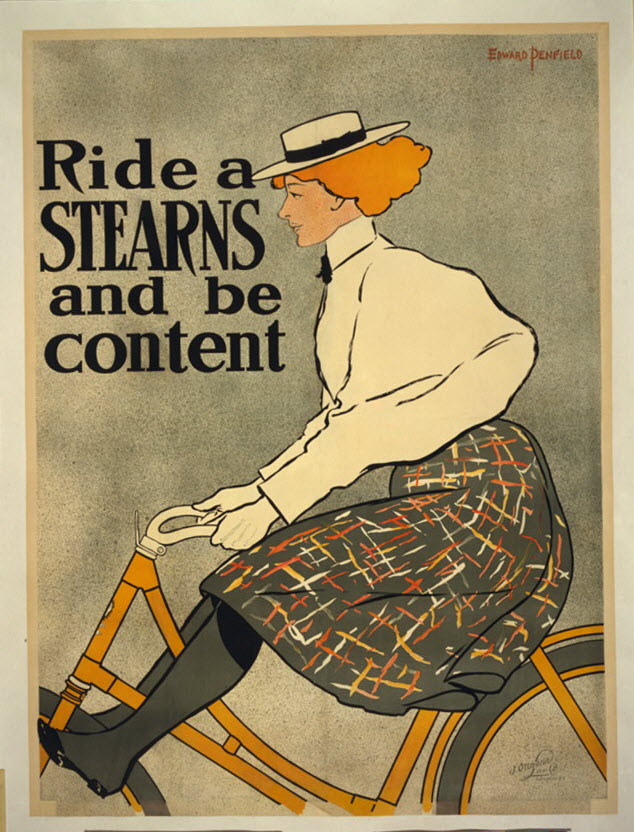
In my mind’s eye, I looked something like this when I first started training in 2008 as a novice cyclist. Every hill was a slog, every mile was an accomplishment. Image info: Ride a Stearns and Be Content, Edward Penfield, 1896. Courtesy of Artist Posters Collection, Library of Congress Prints and Photographs Division.
I’ve more or less stayed within that same rider classification category since then, with some years yielding some minimal athletic progress and others with minor but demoralizing setbacks. Each year, I struggle with training time and balancing other commitments, as well as with my own ego and competitive streak and some mild physical challenges, mostly related to breathing problems, including intermittent, exercise-induced asthma, which I wrote about in a post last season. The other breathing issues are manageable but chronic. I’ve broken my nose four times, the first time at the age of five. It has never been an aesthetic issue to me, so until I became serious about cycling and then tried cross-training one season—specifically some jogging and swimming, both sports that require more upper body work and strength than cycling—I didn’t realize that living with a perpetually deviated septum and therefore, a persistently stuffed nose was holding me back athletically. I kept bumping up against the limits of my own respiratory system on the road for three years until I finally saw an ENT guy for the first time last December to assess things and get some tests done. I hate going to the doctor even for base-level check-ups, so this appointment was a big deal for me, more or less three years in the making. (I know. It’s absurd. I’m working on this avoidance tendency and am getting a little better about this sort of self-maintenance as I get older.) The upshot of the ENT visits is that for walking around, leaving my nose as is is fine (no kidding, as that crunchy schnozz is what I’ve been living with for 35 years), but for hard-core cycling, surgery is likely to be the only thing that will really fix the problem or at least give it a run for its money. The doc gave me a prescription for Nasonex nasal spray, and that helps some—I breathe better when I use it once a day than I do without it—but the longer I train, the more I push up against the fact that even when I’m in decent shape and my muscles are strong enough to do their thing, my breathing feels like more work than it ought to be. The doctor called the surgery optional, a quality-of-life lifestyle choice, and in the grand scheme of things, he’s right. I’d do it in a heartbeat, but surgery is expensive and there’s a lot of unreassuring murkiness surrounding what insurance will cover. I just don’t have five figures to shell out right now for optional surgery so I can ride my bike a little faster and with less respiratory effort.
It’s unclear to me at this point whether I’ll ever get my nose fixed, about which I sometimes feel frustrated until I remind myself this is really a first-world inconvenience rather than a dire problem. Let’s keep it all in perspective, Mika: I am healthy, I am relatively young, I am gainfully employed. I have a fantastic spouse who is my best friend and who loves and support me in all I do. I can do most of what I want to do. Not everyone can say that. Several friends of mine who’ve died the past few years—most from illnesses completely unlinked to HIV or AIDS—obviously can’t say that. An old friend who’s my age and who’s been battling cancer (also not HIV-related) for the better part of three years can’t say that. Another friend with an injury from an accident can’t say that, at least not for the next month or two.
I’m going to type it again, for my own benefit, because I suspect I need the repetition when it comes to learning certain lessons and not taking my blessings and the gifts of my life for granted: I can do most of what I want to do. That’s lucky. Really lucky. Even on a day when I feel like shit or my self-esteem is in the toilet (whispering at me that I suck at everything I attempt; amazing how persistent that little devil is even with evidence to the contrary), I can still do most of what I’d like to do and most of what I attempt. Lucky.
With that in mind, I’m going to say here and now that while my primary goals for this ride season are the same base-level ones I have every year—to train as best I can (and yes, that includes riding faster and longer and on more challenging terrain if and when I can manage it), to raise as much HIV and AIDS awareness as I can, to meet if not exceed my ambitious $10,000 fundraising goal (insert shameless plug: Please donate early and donate often! As of this writing, I’m at 52% of my goal and every donation helps!), and to ride every mile of Braking AIDS Ride from Boston to New York this September—my other new goals are to keep my ego in check, to be a little more gentle with the internal self than I usually am, and to maintain some perspective about where my life is abundant and where it is challenging or disappointing whenever I feel that my darkest angels are chasing after me. If I can keep my eye on those goals for longer periods of time, that’ll be huge emotional progress for me.
I have no doubt I’ll still have days when I’ll be finding myself irritable at every advanced racer cyclist who whizzes past me on horizontal, easy terrain or who takes hills at 15mph like they’re pancake flat while I pant up them at a pace that feels excruciating to me. I’ll surely get pissed at myself again for not being able to drag my ass out of bed early enough to put in the ride time I’d like. But I also want to be able to let myself feel those things when they bubble up and then pull back enough to also decide not to purchase the permanent real-estate rights to that low, self-judging emotional space and build a house there, where I can sulk quietly and habitually in the living room of my own disappointment. I want to get more skilled at reminding myself of what I forget too often while I’m training: that the ride part of Braking AIDS Ride is a blast every year no matter how fast or how slow I am, no matter what physical challenges I may encounter. Every day on the road, rain or shine, is a good day. I want to also let myself look forward to the incredible people who I meet on the road every year, individuals who inspire me to be what I hope is my best, most authentic self. I want to know somewhere in the core of me that whether or not I achieve any of my personal goals, on Sunday, September 29, 2012, when all the Braking AIDS riders bike in together to closing ceremonies in New York and there’s a crowd of people waiting on the street cheering us on, many of them clients of Housing Works, and we hand over a check for six figures to support Housing Works, hopefully bringing the world a little closer to the end of HIV/AIDS, I feel like we’re all, every single one of us, number one at the finish line, and inside it feels like this:

Déesse 16, rue Halévy, Paris, Jean de Paleoloque, c. 1989. Courtesy of Library of Congress Prints and Photographs Division.