Housing Works Covid-19 Emergency Response, BRAKING AIDS® Ride 2020 & Me: Your Help Needed

This isn’t going to be my usual, annual AIDS Ride fundraiser. A lot has changed since last September. For five months and counting, we’ve been in the midst of a raging global pandemic of a potentially lethal and highly contagious virus, the likes of which none of us has known during our lifetimes, and we’re experiencing the economic and community upheaval that goes with that. We’re also seeing a huge wave of nationwide and global demands for long overdue racial and social justice. To say that our world is facing ongoing volatility and uncertainty is putting it mildly.

2020: Not Your Typical AIDS Ride Year

In my 12 years of doing this ride, I’ve often written about the importance of showing up over the long term for the important causes and ideals we believe in. With so many challenges amidst so much chaos, it’s been hard to know what showing up means and requires in our present circumstances. Here’s what it means to me right now: Together, we can still take some actions that assuage some of those uncertainties and help address some of the existing societal inequities that Covid-19 has illuminated more widely, and I hope you’ll consider helping and supporting me in that endeavor.

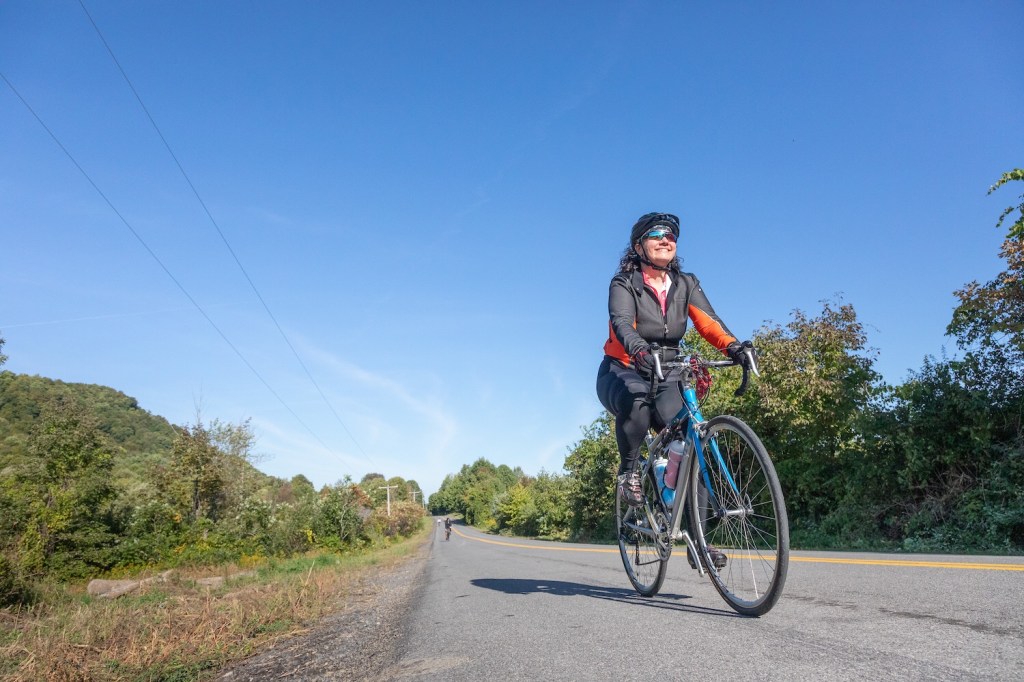
Me, riding with my friend Brian Carroll on Day 1 of last year’s BRAKING AIDS® Ride. Photo by Alan Barnett.

Housing Works & the Covid-19 Crisis

Since 2008, I have participated in BRAKING AIDS® Ride in memory of Dennis and Curtis, two family friends who died of AIDS-related illness in 1987 and 2003, respectively, and for many close friends who live with HIV. In that time, donations from people like you enabled me to raise over $125,000 and counting to support services for those living with HIV as well as its efforts toward ending the AIDS epidemic once and for all.The life-saving HIV services and healing community that Housing Works has provided to the most vulnerable among us are still crucial, but because of the tremendous progress we have made toward ending New York State’s AIDS epidemic, that need is a little less dire than it once was.

What is urgent, as you likely know from the headlines you see every day, is supporting those hit hard by Covid-19, particularly in the most vulnerable communities among us. Many of those communities are the same poor, disenfranchised populations that Housing Works, BRAKING AIDS® Ride’s beneficiary, has been serving since its founding 30 years ago in 1990—those who are homeless or incarcerated, and those struggling with severe physical illness, mental illness, and/or addiction. As with HIV/AIDS, these communities have been particularly vulnerable to Covid-19.

As someone who worked at Housing Works for five years, I know firsthand that when a new crisis arises, no matter how daunting, time and again, the organization rises to the occasion to meet that challenge right away. After the devastating 2010 earthquake in Haiti, Housing Works responded with immediate emergency aid, helping rebuild three health clinics for those displaced by the natural disaster. Throughout 2017 and 2018, Housing Works galvanized an ongoing national movement of concerned citizens to descend on the Capitol to save the Affordable Care Act and oppose the many GOP attempts to repeal it and eviscerate affordable health care for all.

So I wasn’t surprised that as soon as Covid-19 shut down New York this past March, Housing Works sprang into action and became a crucial player in the city’s coronavirus response.In addition to their ongoing work as the largest community-based AIDS service organization in the country—providing housing, healthcare, case management, substance use treatment, legal assistance, and job training—since the beginning of the COVID-19 pandemic, Housing Works has opened two COVID-19 homeless shelters and partnered with a major NYC-based PPE supply operation to distribute PPE to frontline workers.

Those who are interested in more details about Housing Works’ innovative interventions can check out this post.

What’s most important to understand is this:

None of these endeavors was in the budget. But it is essential emergency response work that needs to be done. These remarkable Covid-19 emergency initiatives were launched in a matter of weeks, all while Housing Works has simultaneously faced a massive revenue deficit—estimated at $8 million by the end of June—as a result of the need to shut down its retail locations, which provide so much of their financial support, as well as the April cancellation of its largest annual fundraising event, and the suspension of a number of revenue-generating programs.

How You and I Can Help

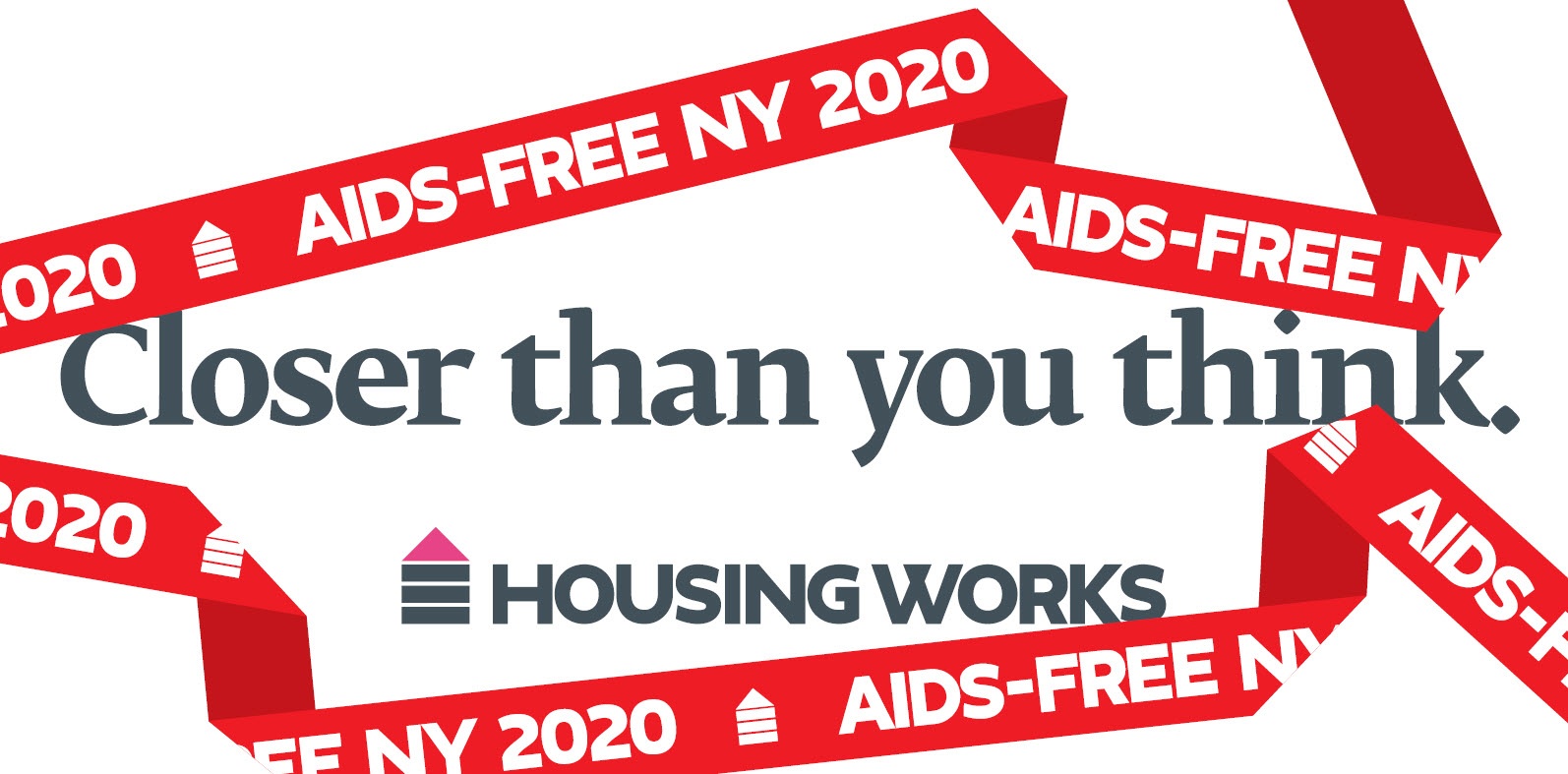
The Covid-19 crisis isn’t going anywhere anytime soon, and no doubt Housing Works will continue to provide emergency services for our most vulnerable residents. Housing Works doesn’t hesitate to act and provide solutions when new problems arise, and we shouldn’t either.As of this writing, for safety reasons, the biking portion of this year’s BRAKING AIDS Ride will likely only span one day—a 62-mile, masked and physically distanced group ride beginning and ending in Manhattan. In the week leading up to the ride, I am also committed to doing two 100-mile (century) rides on my own while I’m in Cape Cod. More important, whatever the physical ride does or doesn’t look like, between now and September, I remain committed to raising $20,000 to support Housing Works. The graphic below highlights what your generous donation can help to fund right now.

Please DONATE TODAY. Donations of all sizes are welcome, but a gift of $200 or more will go a long way toward reaching my $20,000 goal. $200 provides two weeks’ worth of gowns for five residence managers; $250 pays for emergency food for 10 Housing Works shelter residents for a week.

DONATE VIA MY FUNDRAISING PAGE: https://give.classy.org/mika2020

Ways to make giving easier, to make your donation go further & to help me reach my $20K goal sooner: 

• PLEASE CHECK WITH YOUR HR DEPT. & SEE IF YOUR COMPANY WILL MATCH YOUR DONATION! If so, then check the “YES” bullet in the Company Matching section of the online donation form, and fill out the related information. You may be able to double or even triple your contribution! In 2019, nearly $5K of the $24,000+ I raised came from company matches, so I cannot underscore enough how much this helps. 

• Recurring Monthly Gift: On the donation page, once you select a gift amount, click on the “Donate Monthly” option to set up a recurring donation of any amount over your desired period of time.I prefer to donate this way because I can give more with much smaller hit coming from my wallet each month.

• Cover Processing Costs:  Each donation incurs a processing fee that’s 4% of your gift. When the overall fundraising goal is $20K, 4% adds up: If everyone who gives covers the processing fee, that’s an additional $800 that goes straight to work at Housing Works. 

• Please forward this information to EVERYONE. Spread the word to your friends, family & colleagues! Forward this email letter or share my donation link with your own networks on Facebook, Twitter, Instagram & other social media.

Thank you in advance for your support for this important cause. I couldn’t do any of this without you.

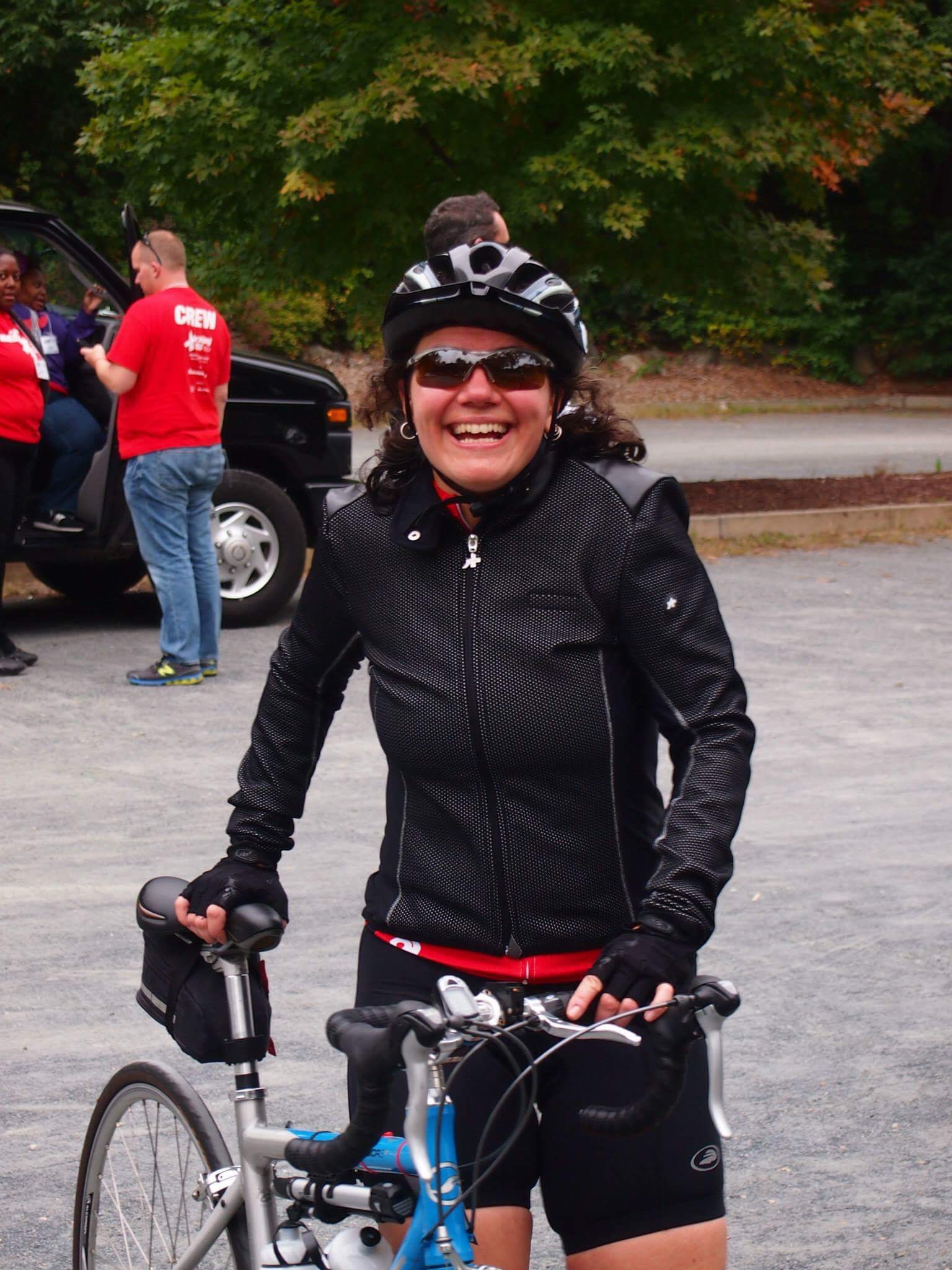
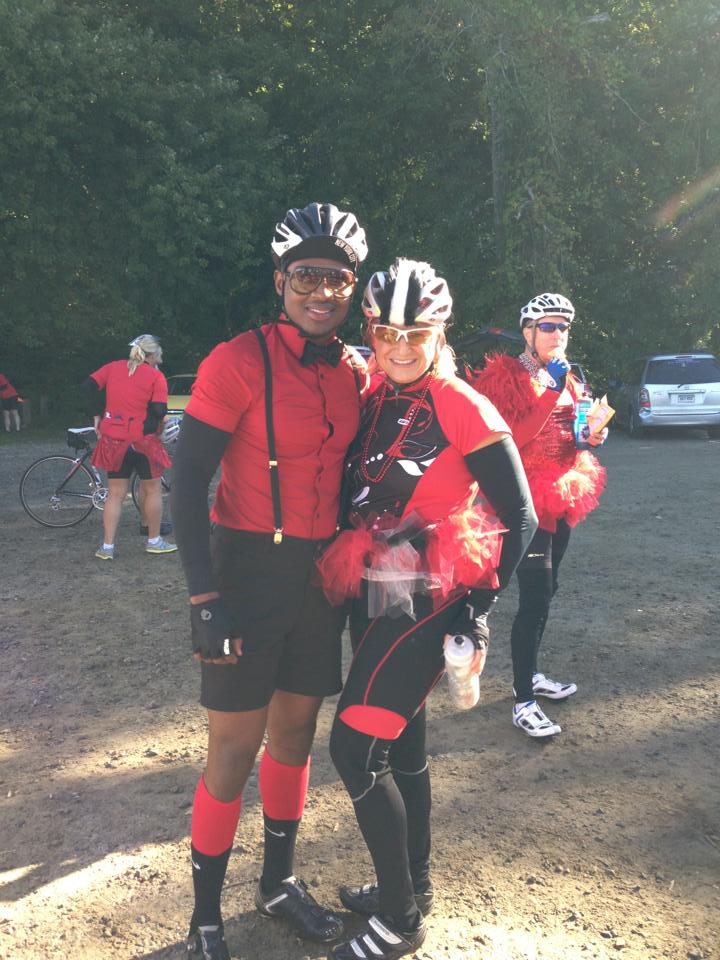
Me, on the morning of Day 1, Braking AIDS® Ride 2020. Photo by Alan Barnett.

Please support me & Housing Works by donating to Braking AIDS® Ride 2020 (Sun., 9/13)—Mika De Roo, Rider # 32. DONATE: BRAKING AIDS® Ride 2020

On Hope, Uncertainty, and an AIDS-Free NY by 2020

In less than two months, once again, I’ll be participating in BRAKING AIDS® Ride, a 300-mile bike from Cooperstown to NYC. Between now and mid-September, I have two objectives: to get into some semblance of shape for the physical challenge of the ride and to raise $20,000 to support the amazing advocacy and services provided by Housing Works, the ride’s beneficiary.

Since my first year doing this ride in 2008, individual donations from people like you have been essential in helping me raise over $100,000 and counting to support life-saving services for those living with HIV as well as its efforts toward ending the AIDS epidemic once and for all. I’m counting on the support of hundreds of individual donors again this year to raise at least another $20,000 to end AIDS as an epidemic in New York by 2020.

Photo: Me on Day 1 of BRAKING AIDS® Ride 2018, by fellow rider Kyle Cameron. The photo later appeared as the Contents photo spread in the Nov./Dec. issue of Positively Aware magazine, which was pretty fabulous. 

As someone who worked at Housing Works for five years, I have seen firsthand how its programs and services make a concrete difference. Since its 1990 founding, Housing Works has provided services to more than 20,000 homeless and low-income New Yorkers living with HIV/AIDS. Unlike many HIV service providers, which tend to focus on one or two primary areas of service, Housing Works offers a startling array of programs that help address the overlapping, intersectional issues faced by its clients: In addition to housing, services include primary healthcare, meals, case management, nutrition, substance use treatment, legal assistance, and job training, as well as relentless advocacy at the city, state, and federal levels to fight for funding and legislation that will help us end AIDS once and for all. It also offers those services with respect and compassion, a context that is essential to healing but all too rare.

I began doing this ride in 2008 in memory of two family friends who died of AIDS-related illness in 1987 and 2003, respectively, and for many close friends who live with HIV. For BRAKING AIDS 2019, I am riding in memory of two friends who died this past year whose lives epitomize compassion and citizenry in the best senses of both words.

My friend Dawn Grimmett (1975–2019), a pediatric nurse who lived in Alabama, died unexpectedly this last April from complications from pneumonia. If we hadn’t both participated in AIDS rides, I might never have met Dawn—and I am lucky to have known her. Dawn was funny and kind. A giver of tremendous hugs and fierce loyalty. One had to pity anyone foolish enough to say a bad word about the people Dawn loved; as she herself put it, “I might look nice, but I’ll cut a bitch!” She also led by example: She was open and candid that she struggled with depression, which even today comes with so much stigma despite how common it is. Without fail, every year since 2004, Dawn traveled across the country to dedicate two weeks’ vacation to being a volunteer nurse on the crew for two different AIDS Rides—California AIDS LifeCycle in June and BRAKING AIDS® in September—dispensing Advil, Band-Aids, Gatorade, ice packs, sunscreen, and whatever medical care was needed, along with unconditional love, and just the right amount of snark. Her life, which ended all too soon, two months shy of her 44th birthday, is a testament to the power of showing up. Dawn reminds me that some of the most important and significant gifts to fellow human beings and contributions to a movement are comprised of mundane, ordinary, and often quiet acts of kindness. The impact of those acts are cumulative, and a commitment to those compassionate acts is the stuff that long-term change is made of.

Photo: This year, I will be riding in memory of my friend Dawn Grimmett (1975–2019), who was a volunteer nurse on every BRAKING AIDS® Ride I have ever done.

My friend Andy Vélez (1939–2019), a longtime LGBTQ and ACT UP New York activist, passed away on May 14 at age 80 after a severe fall in his Greenwich Village building earlier this spring. Andy joined ACT UP in 1987, the year of its founding, back when AIDS was a death sentence to so many, the downward spiral of the illness itself was ugly and painful, treatments were toxic and few, and our government leaders had been ignoring the burgeoning epidemic for six years. Andy was a devoted and fierce activist for 32 years, and his passion for and tenacity in undertaking righteous lifetime activism inspired and continues to inspire countless individuals, myself included. The friendship we developed during a relatively finite number of years of coalition activism together was and remains dear to me, and I miss his kindness, his delicious stories, his wicked and bawdy humor, and his authenticity. To read more about Andy’s remarkable life, check out the tribute that appeared in the Los Angeles Blade, as well as this piece in PLUS, “Why We Still Need HIV Warriors.”

Photo: This year, I will also be riding in memory of my friend Andy Vélez, a longtime LGBTQ & HIV/AIDS activist who passed away in May. In June, ACT UP New York created these buttons, featuring a portrait of Andy by Bill Bytsura of The AIDS Activist Project, in honor of Andy’s lifetime of fierce, relentless activism.

You don’t show up for 32 years of activism unless you have some faith and hope that what you’re doing will make a difference, whether you yourself are able to see that difference or not. Andy’s life is a reminder of that for me. It’s a reminder to heed what writer Rebecca Solnit says about hope:

“Hope locates itself in the premises that we don’t know what will happen and that in the spaciousness of uncertainty is room to act. When you recognize uncertainty, you recognize that you may be able to influence the outcomes — you alone or you in concert with a few dozen or several million others. Hope is an embrace of the unknown and the unknowable, an alternative to the certainty of both optimists and pessimists. Optimists think it will all be fine without our involvement; pessimists take the opposite position; both excuse themselves from acting. It’s the belief that what we do matters even though how and when it may matter, who and what it may impact, are not things we can know beforehand. We may not, in fact, know them afterward either, but they matter all the same, and history is full of people whose influence was most powerful after they were gone.” [emphasis mine]

I’m not usually good with uncertainty. In fact, I struggle with it. All the time. But BRAKING AIDS® and the example of people like Dawn and Andy challenge me to challenge myself to find that “spaciousness” Solnit describes.

When asked what he wanted to be remembered for, Andy once said, “As someone who is able to help.” I’m riding again this year because I am able to, and in that same spirit, I am asking for your help to support my efforts. Together, we can end AIDS.

Please DONATE TODAY. Donations of all sizes are welcome, but a gift of $200 or more will go a long way toward reaching my $20,000 goal. A $200 gift feeds 100 homeless youths at Housing Works’ East New York Health Center.   

DONATE VIA MY FUNDRAISING PAGE: https://give.classy.org/mika2019 

Photo: Me, wearing the Japanese ACT UP “Silence + Death” tee-shirt that Andy Vélez gave me several years ago as a gift, with my wife Jennifer at the Dyke March for NYC Pride 2019, which was also the 50th anniversary of the Stonewall riots.

Help Me Raise $15K for Housing Works & an AIDS-Free NY 2020

It finally feels like summer in NYC again. For me, a June heatwave means it’s long past time that I jumpstart my training and my fundraising for BRAKING AIDS® Ride.

Over the past decade, past donations from hundreds of generous souls have been essential in helping me raise over $90,000 and counting to support Housing Works’ many life-saving services for those living with HIV as well as its efforts toward ending the AIDS epidemic once and for all. 

I’m counting on that support again this year to raise at least $15,000 to end AIDS as an epidemic in New York by 2020.

WHY I KEEP RETURNING TO BRAKING AIDS® RIDE


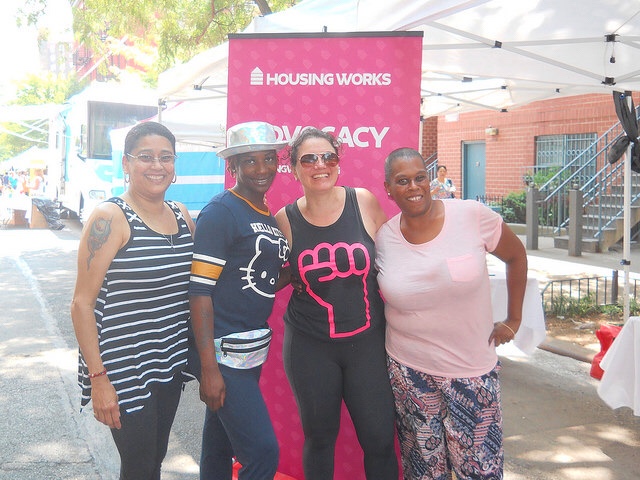
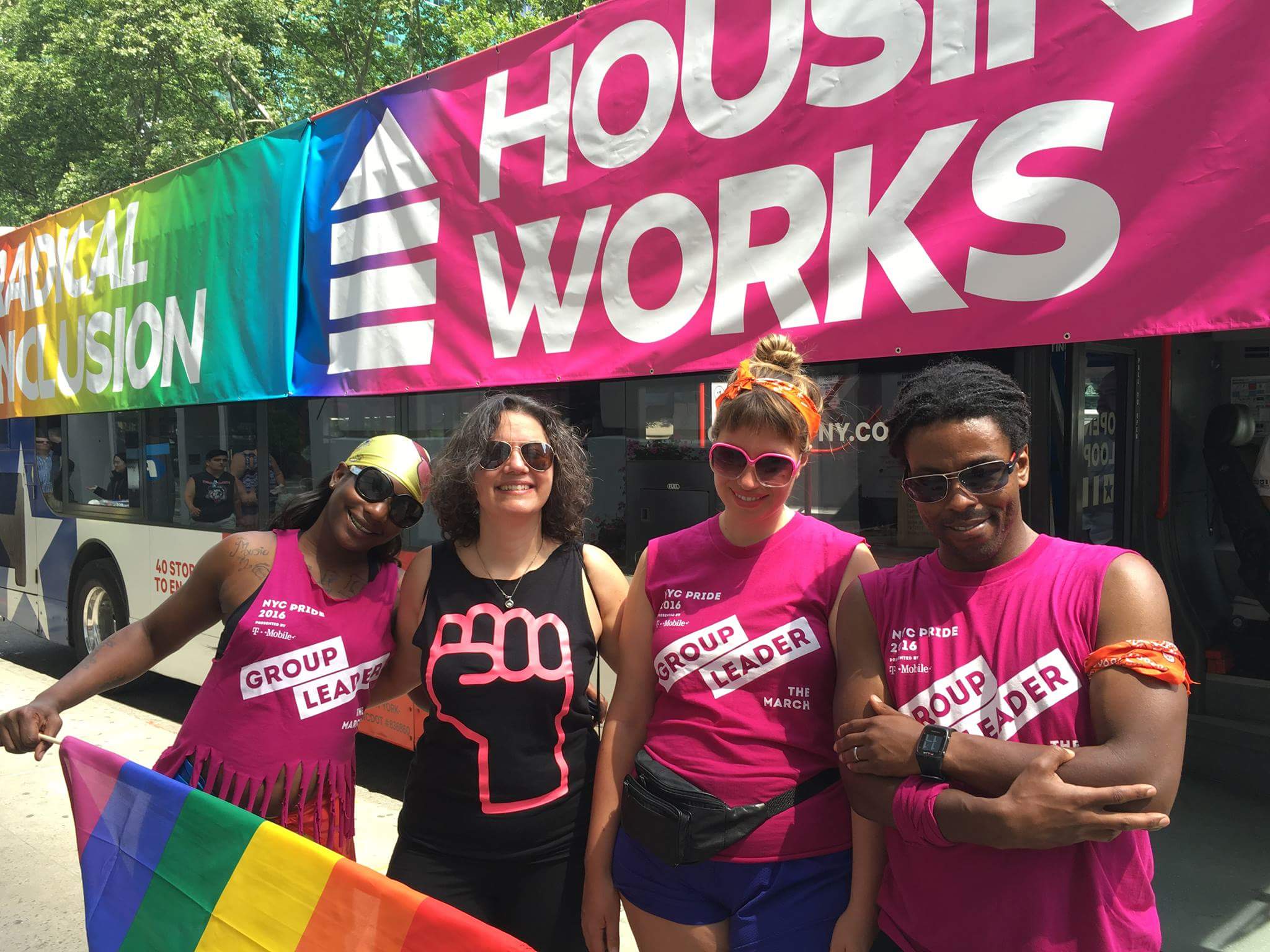
Me, with some of my amazing Housing Works Advocacy colleagues and friends, who inspire me every day (L to R): Valerie Reyes-Jimenez, Legacee Medina, me, Felicia Carroll. 

For the first time since the AIDS crisis began, we have the tools to end the epidemic. More than six years ago, when the audacious goal of ending AIDS as an epidemic in New York, even without a cure or vaccine, was first proposed by Housing Works, Treatment Action Group, and other allies, many people thought it was impossible, and the Governor’s Office and the State Department of Health were not yet sold on the idea. Since then, Housing Works has provided unparalleled leadership to get New York to adopt a plan that makes full use of the tools we have to end AIDS as an epidemic statewide by 2020. At the time of the state plan’s launch in 2014, in the course of educating people about the plan and its feasibility, we said, “an AIDS-FREE New York is closer than you think…” We weren’t kidding. This past December we marked major milestones in the state plan to end AIDS: unprecedented city and state decreases in HIV diagnoses. In 2016, NYC achieved a record 11% decrease, and NYS achieved a corresponding 8.7% decrease. The legislation and policy changes we’ve been fighting for to end the epidemic are working, and we are on track to do it by 2020! And it’s not just New York: Since 2014, more than a dozen additional U.S. jurisdictions have committed to end-AIDS plans, and the U.N. has established 2030 as its target date to bring global infection rates below epidemic levels.

This will also be my 10th year participating as a rider in this annual 3-day, 300-mile journey by bicycle. People sometimes ask me how and why I keep coming back. As someone who has now worked in Housing Works Advocacy for going on five years, I truly believe in the Housing Works lifesaving services this ride supports—because I see those programs and services in action and how much they’re needed and the difference they make firsthand every day. But the truth is, as much as I truly believe in those programs and the organization’s mission, many of my reasons to keep showing up to ride are self-serving.

BRAKING AIDS® is unique because it isn’t only a ride, it’s also a family. The experience of being part of that family and this shared experience for over a decade has challenged me to be my best self, which is to say that it challenges me to be not necessarily my strongest or surest but to be willing to show up even as and at my most vulnerable and uncertain. To show up as myself even when I’m tired, depleted, demoralized, struggling, plagued by self-doubt. It’s taught me to show up and try even when I’m stretched thin and fairly certain I haven’t got it in me. It’s shown me it’s not only okay but healthy and necessary to ask for help at times, a tough, recurring lesson for me because I’m private, and I’m stubborn and fierce about my sense of self-reliance and independence (and even with years of practice, I will be the first to admit I’m still *terrible* at asking for help!).


Me, with my friend and fellow rider Jamil Wilkins, during BRAKING AIDS® Ride 2016, getting a hug after the first 60 miles of riding. 

BRAKING AIDS® is also unique because like Housing Works and the work it does, it’s a movement. Both these communities and movements understand we cannot end AIDS as an epidemic in our state, nation, or around the world unless we collectively address the social and economic drivers of HIV—homelessness, unemployment, racism, homophobia, transphobia, misogyny and sexism, addiction, and mental illness. In the dark and divisive times in which we are living today, we are faced daily with acts of hate in every manifestation, and much of what we see, hear, and read reflects a diminishment of empathy in the public sphere. That makes it more important than ever that Housing Works and BRAKING AIDS® have both always stood for what we at Housing Works call “Radical Inclusion”: for accepting people as they are. We stand for love that heals and for acts of kindness, especially those directed to strangers.

Movements don’t and can’t sustain their work based on the efforts of any individual. As poet Mayda Del Valle wrote, “a movement is not a flash of light— it is a flame, a torch passed from one…to the next.” For that reason and in that spirit, I am asking for your help again to support my efforts. Together, we can end AIDS.

How You Can Help

Please consider DONATING TODAY! Here’s what your gift can help support:

$1,000 sustains one month of supportive housing

$500 provides 100 hygiene kits for homeless youth

$250 supports 30 days of mental health and substance use counseling

$150 covers a one-night stay at a Single-Room Occupancy for 2 homeless youth in need of emergency housing

$100 feeds 25 homeless youth during evening drop in hours at Housing Works’ East New York health center

DONATE VIA MY FUNDRAISING PAGE: 

https://fundraising.housingworks.org/participant/mika2018

Ways to make giving easier, to make your donation go further & to help me reach my $15K goal sooner: 

• PLEASE CHECK WITH YOUR HR DEPT. & SEE IF YOUR COMPANY WILL MATCH YOUR DONATION! If so, then check the “YES” bullet in the Company Matching section of the online donation form, and fill out the related information. You may be able to double or even triple your contribution! In 2016, over $3K of the $23K I raised came from company matches, so I cannot underscore enough how much this helps. 

• Recurring Monthly Gift: On the donation page, once you select a gift amount, click on the “Monthly” option to set up a recurring donation of any amount over your desired period of time. I prefer to donate this way because I can give more with only a small hit coming from my wallet each month.

• Cover Processing Costs:  Each donation incurs a processing fee that’s 7% of your gift. When the overall fundraising goal is $15K, 7% adds up: If everyone who gives covers the processing fee, that’s more than an additional $1,000 that goes straight to work at Housing Works. 

• Please forward this information to EVERYONE. Spread the word to your friends & colleagues! Forward the link to this blog post or share my donation link with your own networks on Facebook, Twitter, Instagram & other social media.

Thank you in advance for your generosity, friendship, kindness, encouragement, and support! I couldn’t do this without you.

Please join me & Housing Works in the fight to end AIDS by donating to Braking AIDS Ride 2018 (Cooperstown, NY, to Manhattan, Sept. 14-16)—Mika De Roo, Rider # 32. Donation site: https://fundraising.housingworks.org/participant/mika2018

Recap & Photos from BRAKING AIDS Ride 2016

A triumphant moment at Mile 97 of 107 on Day 2 of BRAKING AIDS Ride 2016, near Milford, CT:

IMG_1452.JPG

img_1450

As of the closing ceremony on Sept. 25, BRAKING AIDS Ride 2016 raised a net total of over $251,000 for Housing Works and its HIV/AIDS services—a number that has continued to increase in the weeks since, as post-ride donations have kept coming in. (I’ll be able to relay a final amount raised sometime around the end of the month. Stay tuned!)

To my amazement, thanks to the big hearts of over 140 individuals and a handful of fabulous corporate matching gift programs—the complete list appears at the bottom of this post—I was able to raise over $23,000. That fundraising total is over 50% more than I’ve raised in my biggest fundraising year doing this ride. From the bottom of my heart, thank you thank you thank you.

I couldn’t have done it without all of you. Some photos from the ride—some of which you may have seen if you’re on Facebook—appear below.

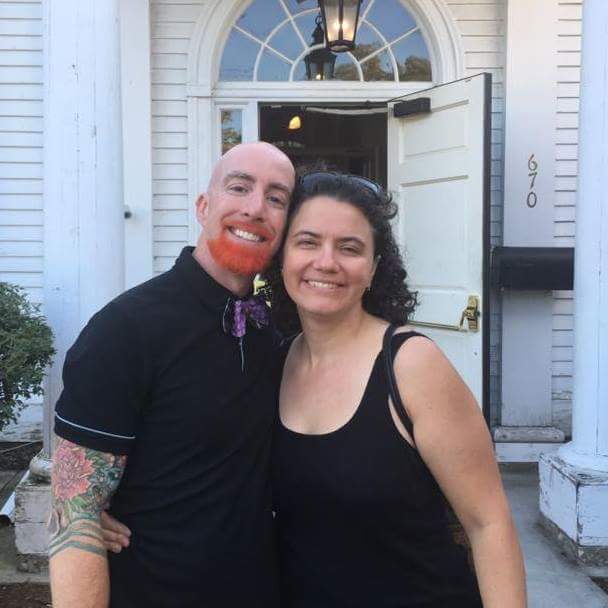
Me, reuniting during orientation with dear friend Tim Fitzpatrick, who I first met on the road in 2008 during my first of these AIDS rides (and no, his beard color isn’t typical; it was part of one of his fundraising campaigns for the ride):

img_1474

Photo courtesy of Angela Taylor

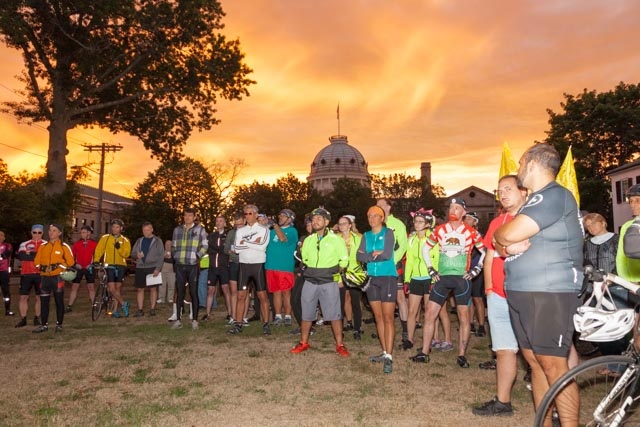
Sunrise on Day 1 of the ride before opening ceremonies, Dedham, MA:

img_1436

img_1470

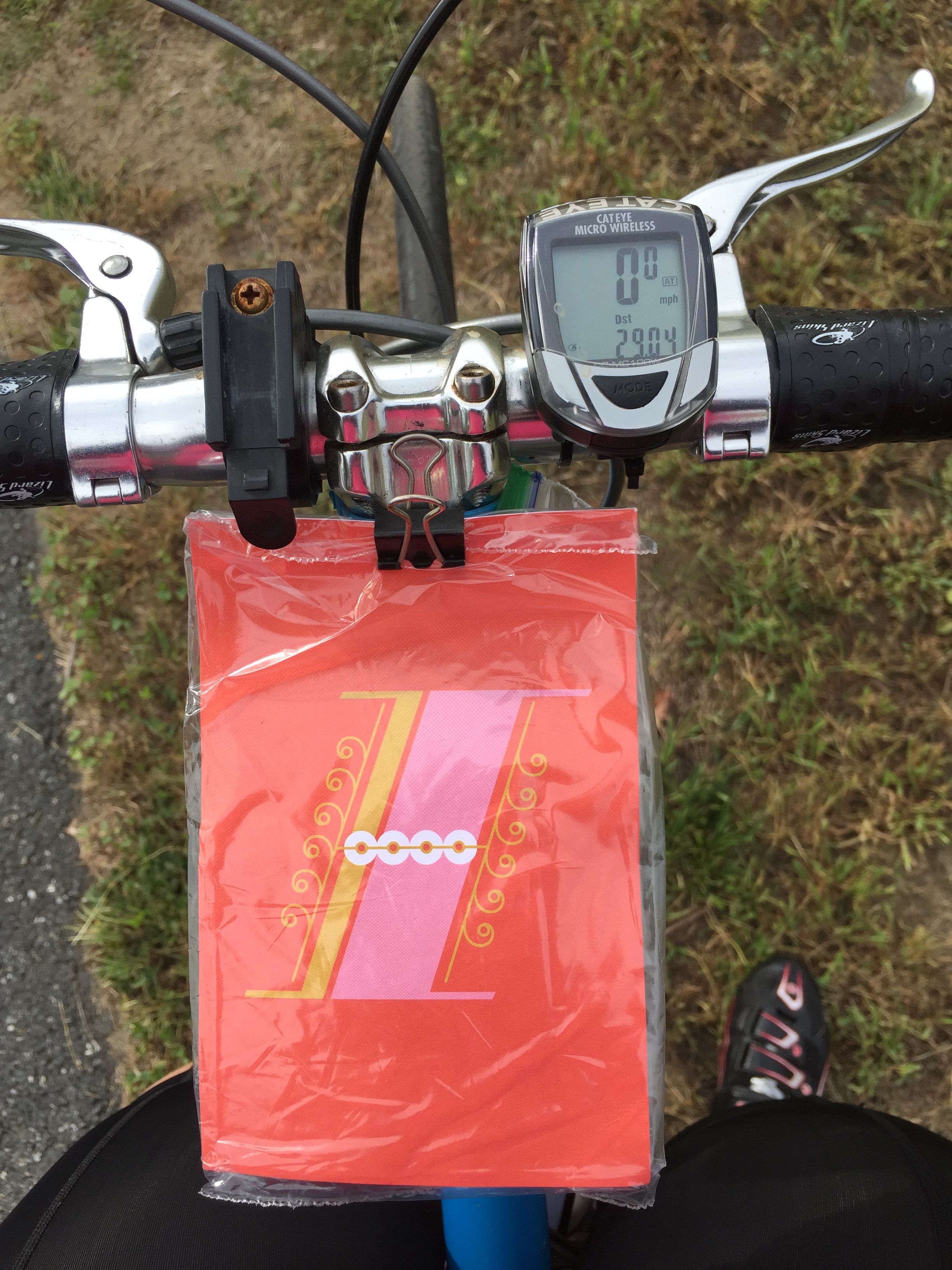
I always ride every year in memory of two family friends who died of AIDS and in honor of many friends—more than I can count—who live with HIV. This year, I got an unexpected, unsolicited donation from a friend who usually rides but who couldn’t ride this year and served on crew instead—a dollar for every year that she and her family have been without her brother Ira since he died of AIDS in May 1987. So this year I rode in his memory as well and I carried this postcard with me as I rode. His full name and the names of the others for whom I ride appeared on the back:

img_1439

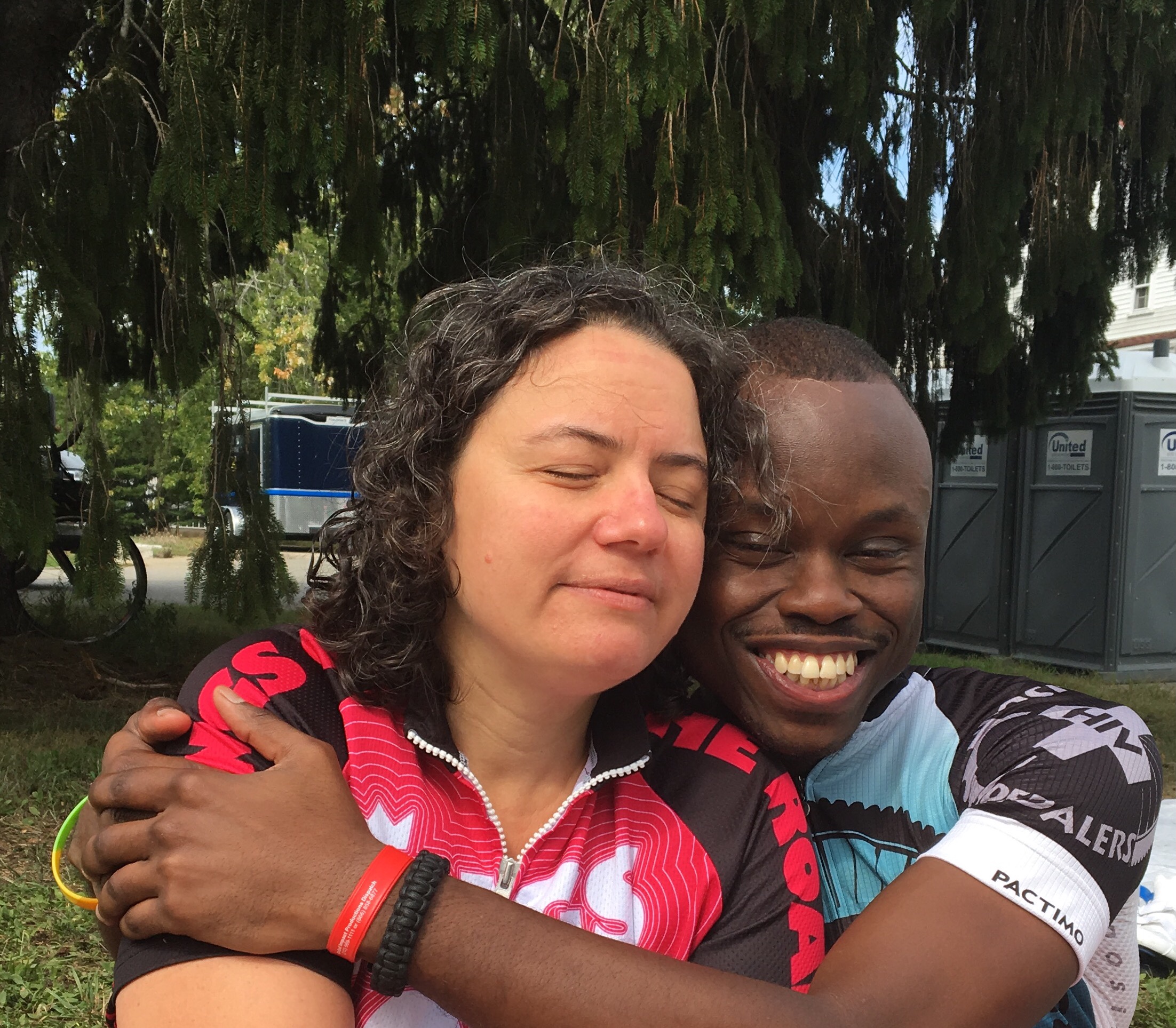
Me, getting a much-needed squeeze from fellow rider Jamil Wilkins during lunch, Day 1, somewhere in hilly Rhode Island:

img_1264

My favorite rest stop on the ride is near the end of Day 1, at the First Congregation of Griswold, in Griswold, CT. Every year, these amazing people come out to cheer us on and ply us with homemade pie and soup, as well as cards of encouragement from kids in the congregation. If all religious folks were as open and loving as these people are, the world would be a different, better place. Also, I highly recommend their strawberry-rhubarb pie.
img_1440
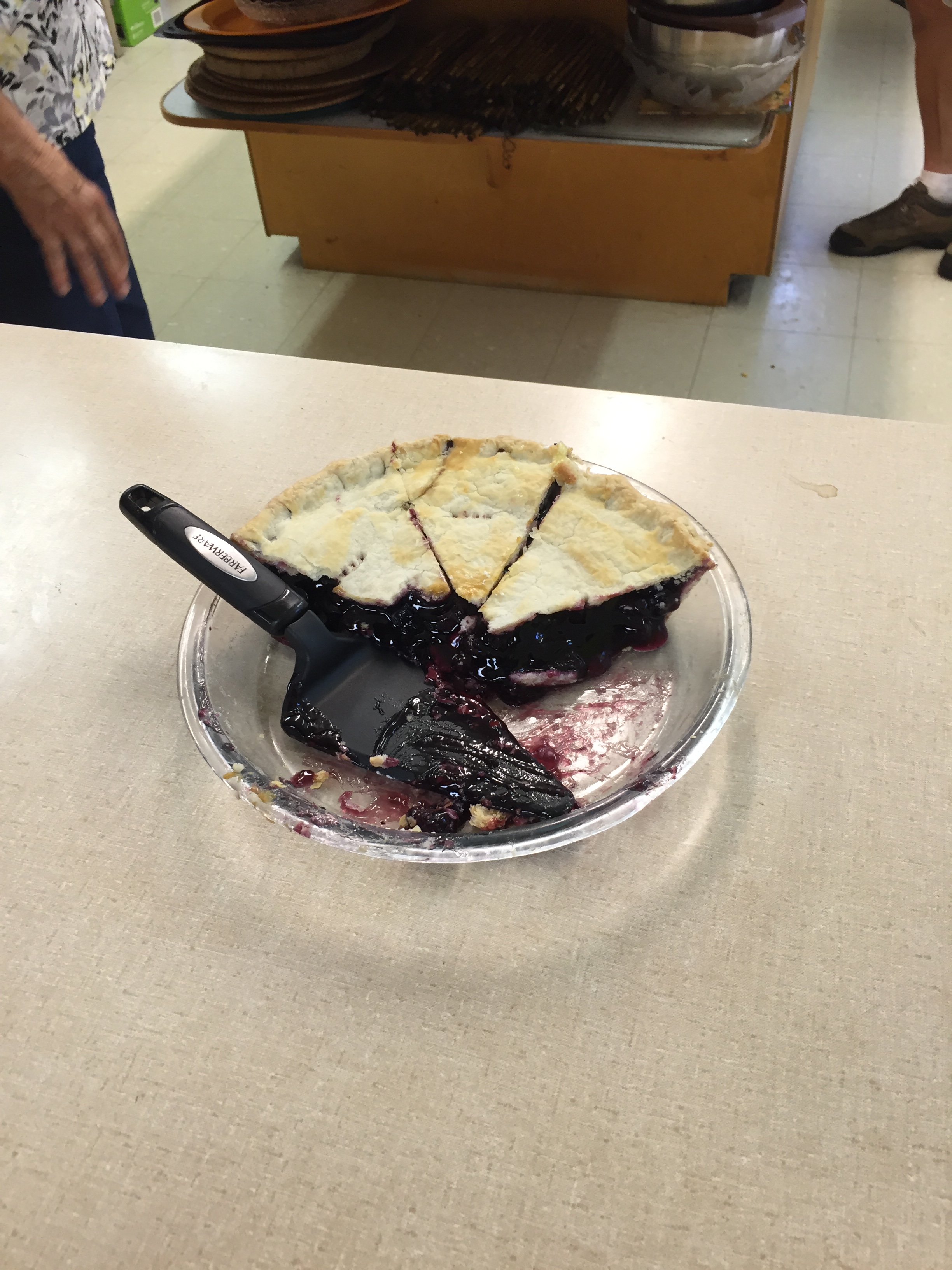
I ate my strawberry-rhubarb slice so quickly, I didn’t even get a photo. This is the blueberry, also a delight:

img_1441
Mile 97 of 107 on Day 2, near Milford, CT:
img_1446
Day 2 of the ride is Red Dress Day, so called because everyone is encouraged to don red clothing. The original idea was that from overhead, the riders cycling along the route would look like a red AIDS ribbon. However, AIDS ride cyclists and crew being the drama queens that they are, the Red Dress Day costumes range from the fashion forward to the fantastical to the frightening, and sometimes combine all of the above. This is what my better half Jen, who served on the crew again this year, wore that day. But lest you give her all the credit, I found that fetching squid headdress for her, courtesy of Marine Specialties in Provincetown, Massachusetts. Sorry, folks: This stunning cephalopod is spoken for.

2016.09.24

Photo courtesy of Monica Anderson

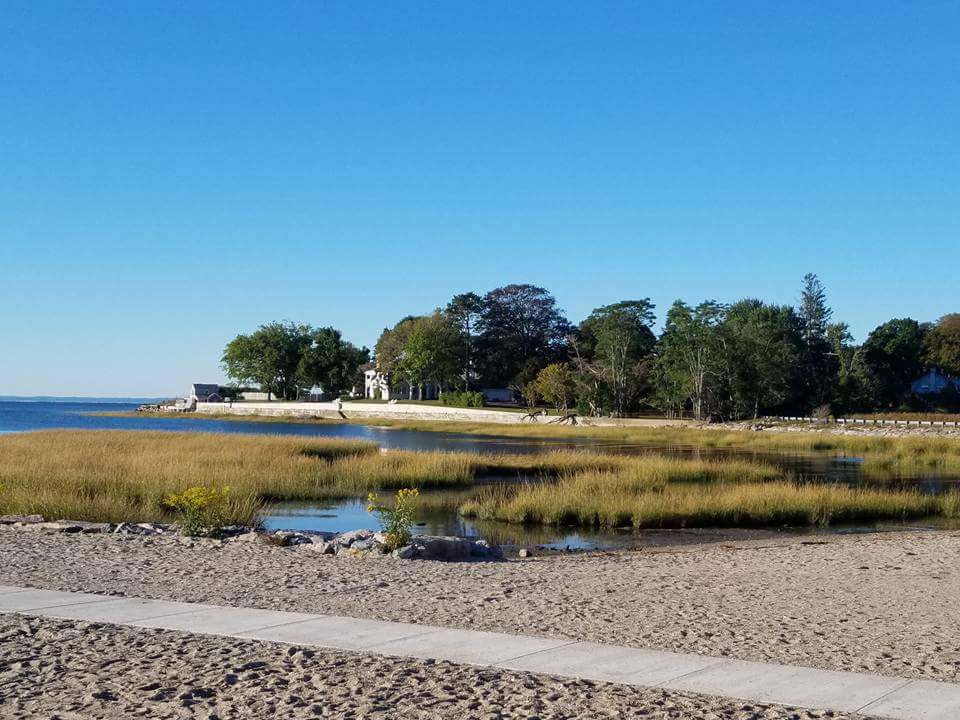
Scenic vistas from early morning on Day 3, near Southport, CT:

img_1476

Photo courtesy of Kathryn Leach

img_1475

Photo courtesy of Ann McCall

Riders gathered together right before closing ceremonies, Day 3, Cylar House, NYC:

img_1469

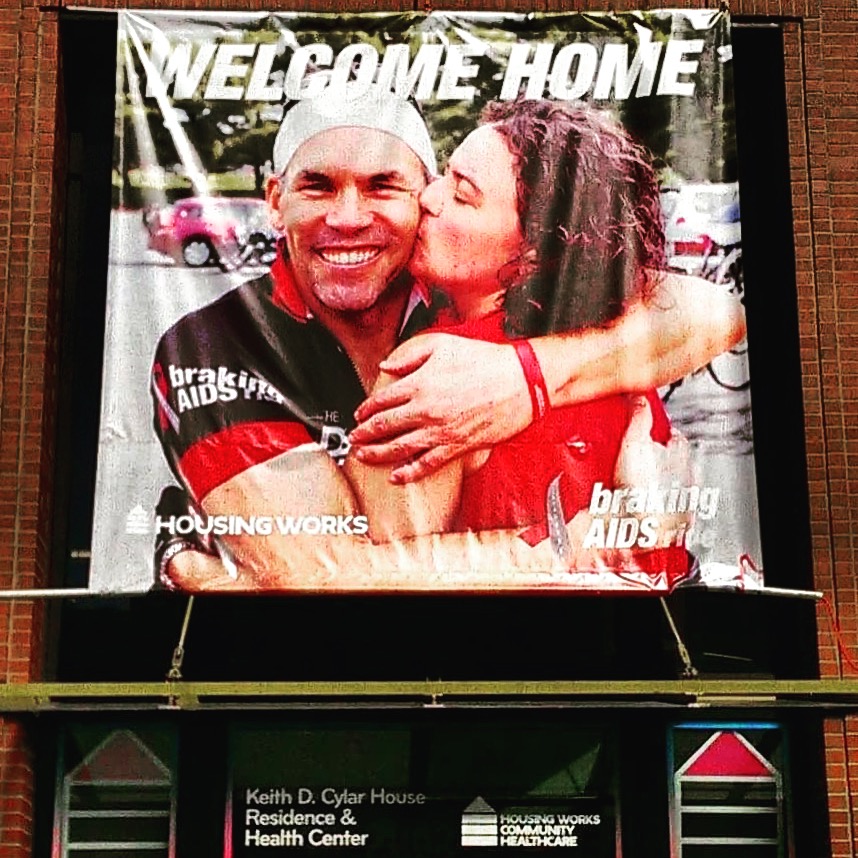
Imagine my shock to arrive at closing ceremonies only to be greeted by an giant “Welcome Home” banner of me and my friend and fellow rider Humberto Alers hanging above the Cylar House entrance. Humberto and I have gotten over our modesty and are available for any and all modeling gigs, FYI, should you have an upcoming photo shoot:

img_1459

Photo courtesy of Jennifer L. Anderson

The check presented to Housing Works during closing ceremonies for over $251,000. Now $251,000 and counting! And yes, if you are kicking yourself because you meant to donate, for the next few weeks you still can!

CLICK HERE TO DONATE

img_1471

THANK YOU AGAIN TO ALL MY AMAZING 2016 BRAKING AIDS RIDE DONORS:

Anonymous (39)
Jessica Abel & Matt Madden
Christopher Anderson & Melissa Stupka
James Anderson & Suzy Turner
Renée Anderson
Leah Bassoff
Charles Baxter
Jaron Benjamin
Jon Bierman
Kristin Bowen & Sam Cohen
Robert Brooks
Light Buggiani
Stephanie & Bill Carpenter
Donna & John Carroll
Stephanie Carroll
Lynne Carstarphen
David Cascia & Elite Fitness
Laura Coaty
Nancy Crochiere
Scott S. Davis
Adele Della Torre & Spencer Kubo
Mark Denecour
Mika De Roo
Zoe DeRoo
Nicole Dewey & Bill Seely
Disney
Annie & Jon Dunham
Blake Dunlap
Mariamne Eliopoulos
Kory Floyd & Brian Seastone
Dianne Orkin Footlick
David Gifford & Svenja Leggewie
Michael & Nicola Gillespie
Rebecca Gilpin
Goldman Sachs
Google
David Groff
Amanda Guinzburg
Karen Henry
Frank Hopp
Andrew Janke
Abigail Katz
Alison Kliegman
Carolyn Lengel
Becky Lien
Kelsey Louie
Rachel & Jon Lowy
Matt Martin
Mark Matienzo & Chela Weber
Karen McGrane
McGraw-Hill Education
Derek McNally
David Meier
Microsoft
Heather Mirman
Ben & Lorraina Morrison
Elizabeth Murphy
Liz O’Brien & Steve Emrick
Eva & Tom Okada
Jacob Okada & Carylanna Taylor
The gals at Papél New York
Gregg Passin
Anne Paterson
Nancy Perry
Abigail Pogrebin
Eileen Pollack
Josie Raney
David Raper
Felicia Rector
Candace Rivela
Rhona Robbin
Kenneth Robinson
Terri Schiesl
Roger Schwartz
Sandra Serebin
Samantha Shaber
Beth Shapiro
Virginia Shubert
Jane B. Smith
Frederick Speers & Chase Skipper
Andrew Spieldenner
Krishna Stone
Matthew Trokenheim & Jen Simon
Reed, Anna & Mila Vreeland
Clay Williams
Yu Wong

Help Me Raise $20K to End AIDS in NY by 2020!

Since 2008, I’ve participated in BRAKING AIDS® Ride, an annual 3-day, 300-mile journey from Boston to NYC by bicycle. Over that time, I’ve ridden thousands of miles on my trusty blue bicycle, The Blue Streak, to elevate awareness about HIV/AIDS. (Over 13,000 miles and counting—no joke!)

image

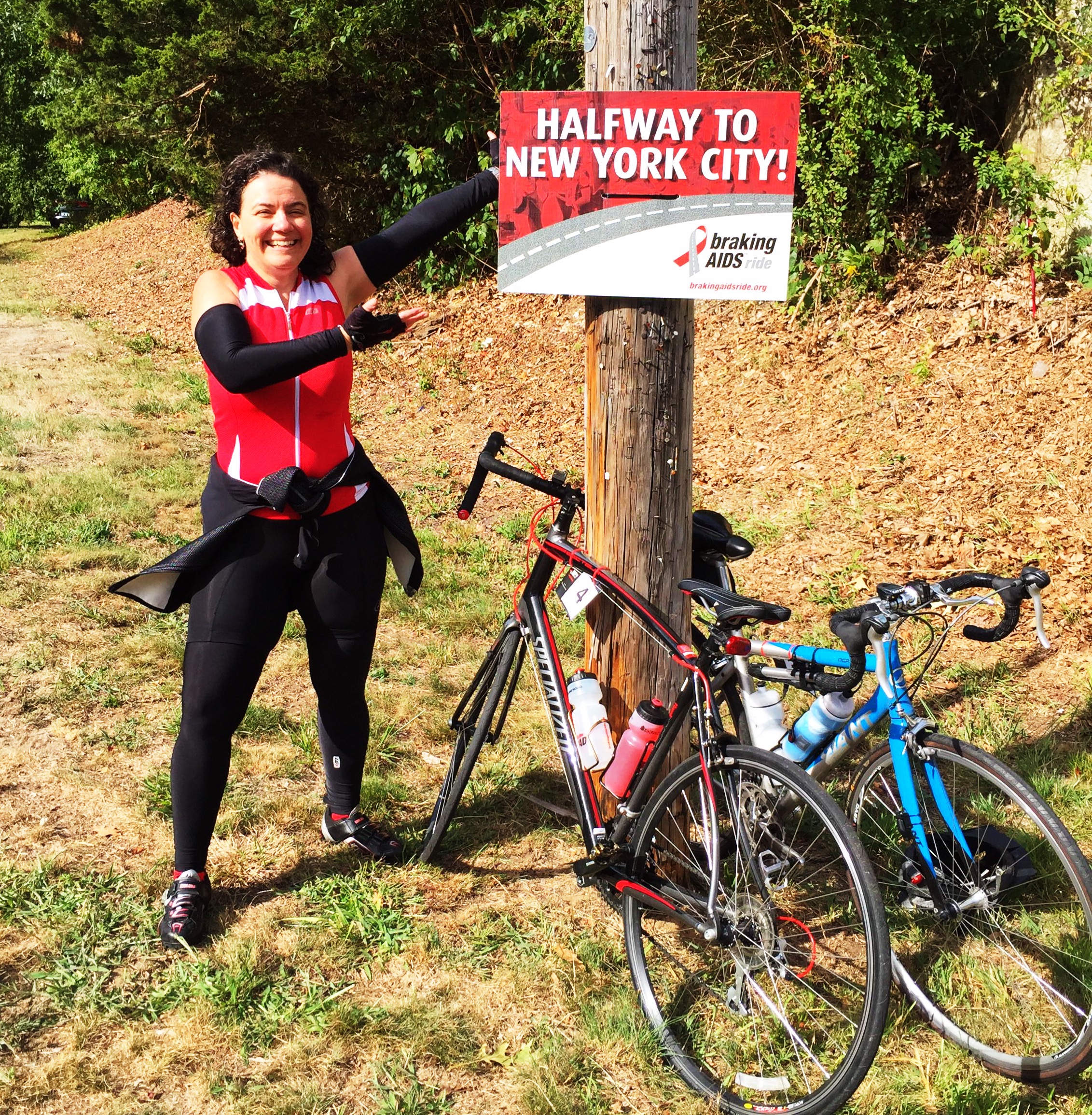
me, halfway through last year’s BRAKING AIDS Ride

We’re at a pivotal moment in the fight to end AIDS. Individual donations from hundreds of kind souls every year have been essential in helping me raise $70,000 and counting to support Housing Works’ many life-saving services for those living with HIV as well as its efforts toward ending the AIDS epidemic once and for all. Last year, I raised more than $14K. This year, I’m counting on the support of everyone I know to raise $20K for 2020—$20,000 to end AIDS as an epidemic in New York by 2020. (And yes, you read that correctly. I’m attempting to raise $20,000 in the next 7 weeks before the ride.)

I started myself off with a $500 donation—using the handy monthly donations option—and am aiming to kick in another $200–300 of my own by the ride. As of this writing I am at nearly $6,200, roughly 31% of my $20K goal.

If you already know the deal and want to just DONATE NOW, click here or scroll down to the “How You Can Help” section for details.

image

with Advocacy Dept. colleagues at this year’s NYC LGBT Pride march

The Hard Work is Working

It bears repeating: We can end AIDS as an epidemic, even without a cure or a vaccine. Along with many allies at the city, state, and national levels, Housing Works remains at the forefront of that movement. Once the epicenter of AIDS, New York is now at the forefront of progress. New data just released by the NY State AIDS Institute underscores that we are on track to end the epidemic: State HIV diagnoses are at a historic low, and the number of HIV+ New Yorkers who have reached “undetectable” status, the optimal health outcome for those with HIV, is at its highest ever.

What was once considered impossible, even crazy, or just overly optimistic sloganeering, is now a discernible future within reach. The audacity that it has taken to achieve the above milestones is taking hold and inspiring others to follow suit: San Francisco now has its own plan to end AIDS, and similar plans are in the works in other states and jurisdictions.

Why I’m Doing More

image

Someone said to me recently, “when you’re close to reaching a finish line, you don’t slow down or take your foot off the proverbial gas. You floor it.”

In the spirit of flooring it and daring to push harder, I am making my own move toward audacity by raising my fundraising bar this year—A LOT. In support of NY’s 2020 goal, in the hopes of what it may inspire others to reach for, and in support of all the Housing Works initiatives that will help us get there, I’m aiming to raise $20,000 for BRAKING AIDS® Ride 2016. In 2015, I raised over $14,000, so this year’s $20K goal is an ambitious stretch. But with your help and the help of other donors, it is more than possible.

The future of ending AIDS is up to us. We know how to do it with the existing prevention and treatment tools; we just need to invest in and expand upon the strategies that make those tools accessible to everyone who needs them.

image

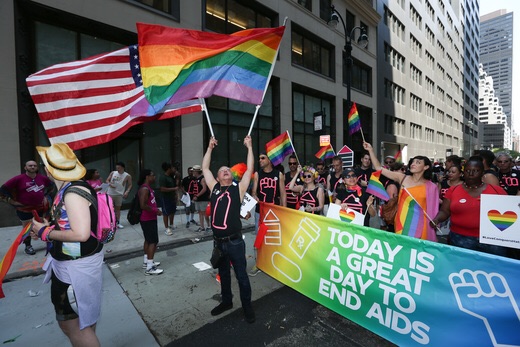
Every day is a great day to end AIDS.

How You Can Help

CLICK HERE TO DONATE TODAY & DIG DEEP. Donations of all sizes are welcome, but a $150 contribution or more will go a long way toward getting me to my $20,000 target. A $150 donation to Housing Works feeds 75 homeless youths during evening drop-in hours at Housing Works’ East New York Health Center. (More details on what different donation amounts will support can be found here.)

PLEASE CLICK HERE TO MAKE A TAX-DEDUCTIBLE DONATION NOW.

Some ways to make giving easier, to make your donation go further & to help me reach or exceed my $20K goal sooner:

  • PLEASE CHECK WITH YOUR HR DEPT. & SEE IF YOUR COMPANY WILL MATCH YOUR DONATION! Then check the “YES” bullet in the Company Matching section of the online donation form. (It’s the click-box under the donation amounts that’s labeled “This gift is matching eligible.”) You may be able to double or even triple your contribution! In 2015, over $3K of the $14K+ I raised came from company matches, so I cannot underscore enough how much this helps.
  • Recurring Gift: On the donation page, select the bright pink “Repeat Monthly” option at the bottom of the list of donation amounts to set up a recurring donation of any size over your desired period of time. I prefer to donate this way because I can give more with a smaller hit to my wallet each month.
  • Opt to cover the online donation processing costs. Right under the bright pink bar with the “Repeat Monthly” option, there’s another click-box that gives you the option to absorb the online processing fee that otherwise comes out of your donation. It’s a 7% fee, which is pretty small amount per individual donation, but if every one of my donors chose to cover this fee, it would mean thousands more overall in unrestricted donations to Housing Works.
  • Please forward this information to EVERYONE. Spread the word to your family, friends & colleagues! Send the link to this blogpost or share my donation link with your own networks on Facebook, Twitter, Instagram & other social media.


image

Thank you in advance for your generosity, kindness, encouragement, and support! I can’t do this without you.

Mika, BRAKING AIDS Rider #32

Please join me & Housing Works in the fight against AIDS/HIV by donating to Braking AIDS Ride 2016 (Boston to Manhattan, Sept. 23-25)—Mika De Roo, Rider # 32. Donation site: http://tinyurl.com/Mika20KforAIDSFreeNY2020

Why I Keep Coming Back to BRAKING AIDS Ride Every Year

This will be my eighth year participating in BRAKING AIDS Ride. One need look no further than this video of last year’s ride and of the amazing ride family I get to share this journey with each year to understand why I keep returning:

This year, I’m aiming to raise $20,000–much more than I’ve ever raised before–in support of Housing Works and New York’s ambitious plan end AIDS as an epidemic by the year 2020.

TO SUPPORT ME FOR BRAKING AIDS® Ride 2016, CLICK HERE. My goal is to raise $20,000 between now and September to benefit Housing Works life-saving HIV/AIDS services and to support the goal of reaching an AIDS-Free NY 2020.

IMG_0593

No Grit, No Pearl: What I Do the Day After Love Wins & U.S. Marriage Equality Prevails

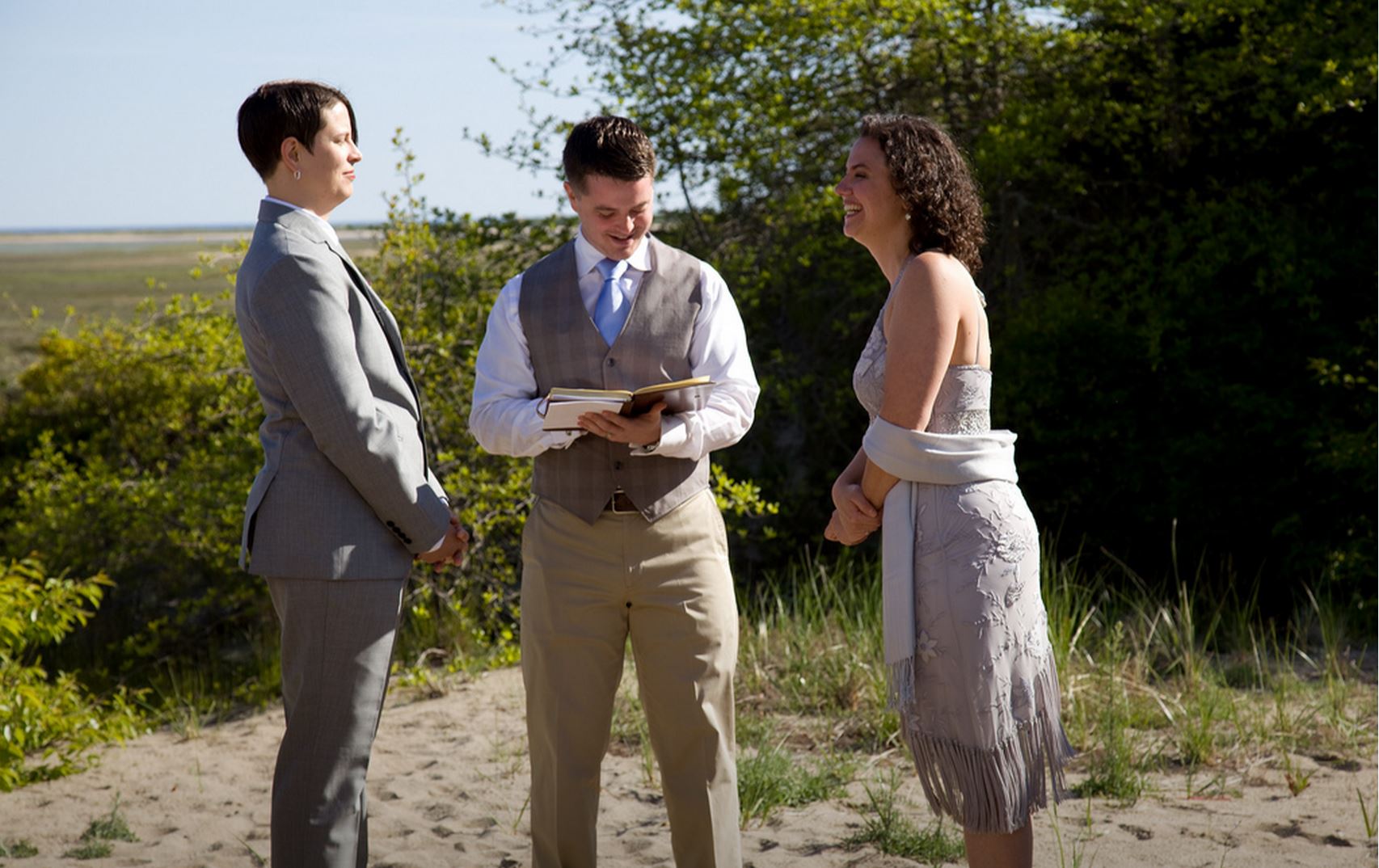
Family & friends joined me and my wife Jen for our wedding in Provincetown, Massachusetts, on May 16, 2010. Marriage equality was the law of the land in the Commonwealth of Massachusetts then, but had been voted down in New York State, our home, on my birthday, December 2, 2009.

Family & friends joined me and my wife Jen for our wedding in Provincetown, Massachusetts, on May 16, 2010. Marriage equality was the law of the land in the Commonwealth of Massachusetts then, but had been voted down in New York State, our home, on my birthday, December 2, 2009. Photo by Doreen Birdsell.

Part I. June 26, 2015, still taking in the amazing Supreme Court Decision on Marriage Equality:

I remember exactly when NY State (the State Senate, specifically) last voted against marriage equality because it was on my birthday, December 2, 2009. When my wife Jennifer and I got married in May 2010, after 12 years together, we held our wedding in Massachusetts, where gay marriage was legal. At that point, NY State still hadn’t budged on the issue. NY State finally did the right thing right before LGBT Pride in late June 2011, a full two and a half years after that contentious 2009 vote, with the passage of the Marriage Equality Act. NY was only the 6th state in the U.S. to legalize gay marriage, and it was also the most populous state in the union to have done so. That was four years ago, almost to the day.

My wife and I never thought we’d see marriage equality across the U.S. in our lifetimes. In the optimistic moments when we dared imagine, however briefly, that that miracle might happen at all, we didn’t think it would be until we were very old.

We were wrong.

Fred Speers, officiating at my wedding, May 16, 2010, West End of Provincetown, Massachusetts.From left to right: my wife Jen, Fred, me. Photo by Doreen Birdsell.

Fred Speers, officiating at my wedding, May 16, 2010, West End of Provincetown, Massachusetts.From left to right: my wife Jen, Fred, me. Photo by Doreen Birdsell.

I often find myself being the skeptic about our collective capacity to change for the better as a society. The news I see every day, especially where it concerns race and class, seems to confirm that dire, grim trajectory: a seemingly endless stream of depressing, enraging, heart-breaking news stories and statistics. In particular I am thinking of racist verdicts and acts of racially-based hatred and violence across different U.S. cities and regions. Trayvon Martin, Mike Brown, Eric Garner, Freddie Gray, the recent mass murder of 9 black people in a Charleston church by racist, domestic terrorist Dylann Roof. Between news like that and our collective inability to move U.S. public policy in any meaningful way on issues like gun control or climate change, it makes it easy for me to become disheartened and to tell myself, although small victories may happen, the big, national-level progress I so long to see is impossible, that really, as a nation, as a deeply flawed democratic, capitalist experiment, maybe we’re just fucked.

And maybe we are. God knows, even after today’s coup for LGBT Americans, we have a daunting amount of work to do to make things better for the vast majority of our citizens & residents.

But a day like today is evidence that when we keep at it, change for the better does come. Excruciatingly slowly. But nevertheless.

I was reminded of that fact further when I saw that my dear friend Frederick Speers, my other me, had posted in a similar, more personal vein about this same pendulum-swinging, what Martin Luther King Jr. meant when he said, “The arc of the moral universe is long, but it bends towards justice.” I’m sharing Fred’s post along with mine because it’s worth reading, I dare say more so than my own. Not only because I love him. Not only because he officiated at my Massachusetts wedding to Jennifer Anderson in 2010 and I officiated at his MA wedding to Chase Skipper in 2009. I share his post below because he’s brilliant and eloquent at showing first-hand how that moral arc has bent toward justice and equality for him, within his own lifetime. In less than 30 years, we’ve gone from a world that told him as a young boy, “if you’re gay, you’re better off dead,” to one that acknowledges him, his life, the love of his life, and their marriage together as being as worthy of life, liberty, and the pursuit of happiness as everyone else’s.

Fred’s Facebook post on Friday morning, just after the Supreme Court decision was made public:

At 12 years old, I asked god whether I should die because I loved another boy. I listened. And the people said: “There is hope for homosexuality, especially through prayer – because it’s not an unchangeable CONDITION like being black or a woman.”

At 18 I asked to hold my boyfriend’s hand in public. I listened, and the people said, “This isn’t a real problem for us — since you can’t reproduce, and AIDS will finish you off.”

At 21 I asked to serve my country. I listened and the people said, “ONLY if you lie about who you really are.”

At 33 I asked to marry the love of my life. We listened together. “OK,” the people said, “but only in a handful of states.”

At 39 we asked for equality for all. We held our breaths. And the people said, “We see you now for who you are: Your LOVE matters.”

#lovewins

Fred Chase Me 6.6.09

Me, with Chase Skipper and Fred Speers, on June 6, 2009. I officiated at their wedding in Provincetown. Nearly a year later, Fred officated at mine to Jen Anderson, also in Provincetown. Chase is holding their marriage license, which I had just signed.

So, let this day of celebration also be a reminder, dear friends, to my future self above all, that Sam Cooke was right when he wrote and sang in 1964, “It’s been a long, long time coming,/ But I know a change is gonna come; oh, yes, it will…”

#‎lovewins‬

Part II. June 27, 2015, The Day After a Winning a Hard-Won Battle, or, “No Grit, No Pearl,” or, What’s Next?

It’s been quite something to see and hear the amazing love, joy, and support from gay and straight friends and family alike in the aftermath of this historic ruling. I think the full weight of it still hasn’t quite sunk in, to be honest.

I posted on Facebook last night that Jen and I didn’t think we’d see this change happen in our lifetimes, or if we did, we believed we’d be old. Very old.

11695858_10153440161813656_2025565217349272418_n

Same-sex self-portrait, #NYCPride, me with Jennifer L. Anderson, June 28, 2015. Photo by Jennifer L. Anderson

11692696_10100874918598075_962224127238813092_n

Me with my amazing Housing Works Inc. Advocacy compadres, rocking ‪#‎NYCPride, June 28, 2015‬. The parade was so nice, we did the march twice! This photo was taken after Round 1, from left to right: Vinay Krishnan, Tony Ray, Jaron Benjamin, and me. Photo courtesy of Tony Ray.

Facebook-20150629-112153

Notorious RBG! One of my favorite sightings at #NYCPride, June 28, 2015. Photo by Jennifer L. Anderson.

Facebook-20150629-112215

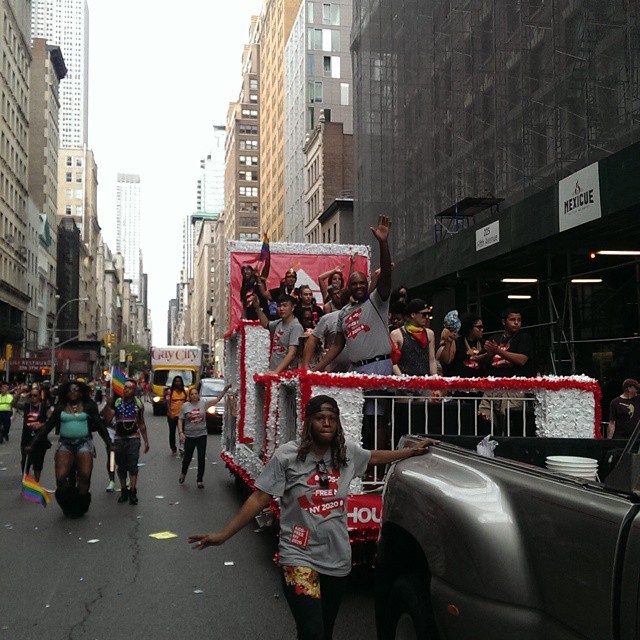
The Housing Works float, during the long wait to march at #NYCPride, June 28, 2015. I think the thing that may have moved me most at Pride was the young kids we kept meeting throughout the day, strangers from Alabama and Arkansas and Indiana and even from New York or somewhere geographically closer, who kept thanking us and reaching over the police barricades to high-five us or hug us because they were so happy and they know what a big deal this marriage equality is. I couldn’t pinpoint what it was about their joy that was so beautiful and then I realized: They looked hopeful. Photo by Jennifer L. Anderson.

Facebook-20150629-112230

Housing Works in the #NYCPride house, getting ready to march down Fifth Avenue, June 28, 2015. Photo by Jennifer L. Anderson.

Days like yesterday, which was and is a very personal celebratory moment for me and for many people I love, are also a reminder that when we work for the greater social good, year after year, decade after decade, century after century—even when it seems like we’re going nowhere because so many who wield power and wealth use those things to reflect all the hate in their hearts—when we keep at it, change does come. Excruciatingly slowly. But nevertheless.

To get there, though, we have to keep showing up, even when we seem to be in the darkest of tunnels. When all the news we see and hear is bad, unjust, unconscionable, shameful.

That being the case, this seems the perfect day to begin my fundraising for this year’s BRAKING AIDS® Ride.

I also marked this post-SCOTUS victory day with a 68-mile training ride to Nyack and back. There are no cute photos. It rained on the way back. I was alone, woefully behind on my training this season, slow. I didn’t break any records with my astonishing speed or hill-climbing prowess. I wasn’t special. Or charming. Or intelligent. My ego felt bruised at various points. I kept going. I climbed through Palisades Park for the first time this season. I ate my bagel at The Runcible Spoon and as I sipped my iced coffee, I texted everyone who was on my mind because I felt sad and a little lonely and a little scared about how I would feel on the four miles of climbs going back home. Not every fucking moment is a victory lap. Most moments aren’t. Most moments are training, which is work. I showed up. I worked. That is all.

This will be my eighth year doing this 3-day, 300-mile journey by bicycle to raise money for Housing Works and to raise awareness about HIV/AIDS. When I started back in 2008, I’d never raised this kind of money or ridden a bike this far or this hard. In the years since then, I’ve put in something like 13,000 miles on the same blue bicycle, and raised between $60,000 and $70,000.

My most generous supporters have donated with astonishing generosity year after year. Their support inspires and amazes me. Above all, it’s necessary, which is why I continue to ask for their help and the help of other kind people I know again and again, each time wondering whether they’re sick to death of hearing me ringing a relentless AIDS-fundraiser gong.

For now, I’m not going to belabor the importance of the cause and how this money helps people who need help. I’m not going to get into all the ways in which Housing Works lives out the belief that even the seemingly weakest or lost or most far-gone among us are deserving of second or third or fourth or however many chances it takes to change and make their own lives and the world they live in better. I won’t regale you with HIV statistics. For now, I’ll say this: We can end AIDS as an epidemic, even without a cure or a vaccine. Housing Works has been at the forefront of that movement toward an AIDS-Free New York, an AIDS-Free USA, an AIDS-Free world. This is our JFK moonshot. We will get there.

Change comes when people show up for the fights that need to be fought. The most important kinds of change are hard-won and require showing up again and again and again and again.

I’ll end with this: HIV/AIDS has been plaguing us for over 30 years. We’ve been fighting for a long time, and we’ll keep fighting until we reach an AIDS-free world. Change is coming.

TO SUPPORT ME FOR BRAKING AIDS® Ride 2015, CLICK HERE. My goal is to raise $10,000 to benefit Housing Works life-saving HIV/AIDS services by July 31, 2015.

Facebook-20150629-112245

The Housing Works #NYCPride contingent, getting ready for lift-off, June 28, 2015. Photo by Jennifer L. Anderson.

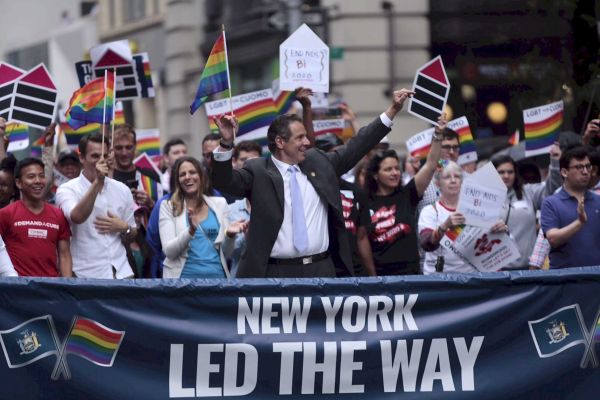
Is that a Housing Works sign or is the Governor just happy to see me? New York was the sixth state in the U.S. to make marraige equality legal and the most populous. It led the way for the domino effect of states that changed their laws to move toward the right side of history. New York can do the same for HIV/AIDS, which is as big and arguably an even bigger social justice issue than marriage equality. It's also a battle we're still fighting.

Is that a Housing Works sign or is the Governor just happy to see me? New York was the sixth state in the U.S. to make marraige equality legal and the most populous. It led the way for the domino effect of states that changed their laws to move toward the right side of history. New York can do the same for HIV/AIDS, which is as big and arguably an even bigger social justice issue than marriage equality. It’s also a battle we’re still fighting. Photo by Anthony Lanzilote.

Facebook-20150629-112255

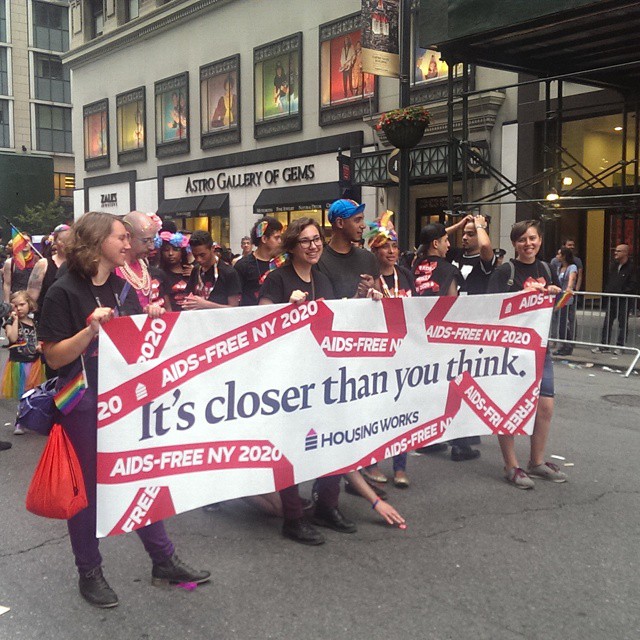
The Housing Works community, marching for #NYCPride, June 28, 2015. What’s next? Fighting for and achieving an AIDS-Free NY by 2020. Photo by Jennifer L. Anderson.

Salty Century Photo Essay: A Wellfleet-Provincetown-Dennis Figure 8

Every year, the peak of my training regimen for BRAKING AIDS Ride is completing at least one century ride, a training ride of 100 or more miles prior to the ride itself. Ideally, I get in one century sometime in July or August, and during my strongest years, I have been able to do at least two centuries before BRAKING AIDS begins. This year wasn’t one of those years, and I ended up doing one century ride during our annual vacation to Cape Cod. We stay in Wellfleet on the Outer Cape, so my route usually resembles something like a figure 8—roughly 50 miles going from our cottage to Provincetown and back, and then another 50 or so from our cottage to South Dennis and back.

Rather than staying on Route 6, the main highway on the Cape, which is two lanes—one in each direction—for most of it and is also the most direct route from Wellfleet to Truro and Provincetown, I took back roads for the the first 22 miles of my century ride this past Wednesday. I rode Lecounts Hollow Road to Ocean View Drive, Gross Hill and Gull Pond Roads, then Old Truro Road, Pamet Point Road, Old County Road, Castle Road, Bridge Road, Depot Road, and more, criss-crossing and riding Route 6 along the way for brief stretches. What did this mean? HILLS. Lots of them.

To get from South Wellfleet to Provincetown, rather than staying on Route 6, the main highway on the Cape, which is two lanes—one in each direction—for most of it and is also the most direct route, I took back roads for the first 22 miles of my century ride this past Wednesday. I rode Lecounts Hollow Road to Ocean View Drive, Gross Hill and Gull Pond Roads, then Old Truro Road, Pamet Point Road, Old County Road, Depot Road, Bridge Road, Castle Road, Corn Hill, and more, criss-crossing and riding Route 6 along the way for brief stretches. What did this mean? HILLS. Lots of them.

image

First beach pitstop after riding Ocean View Drive out of Wellfleet.

image

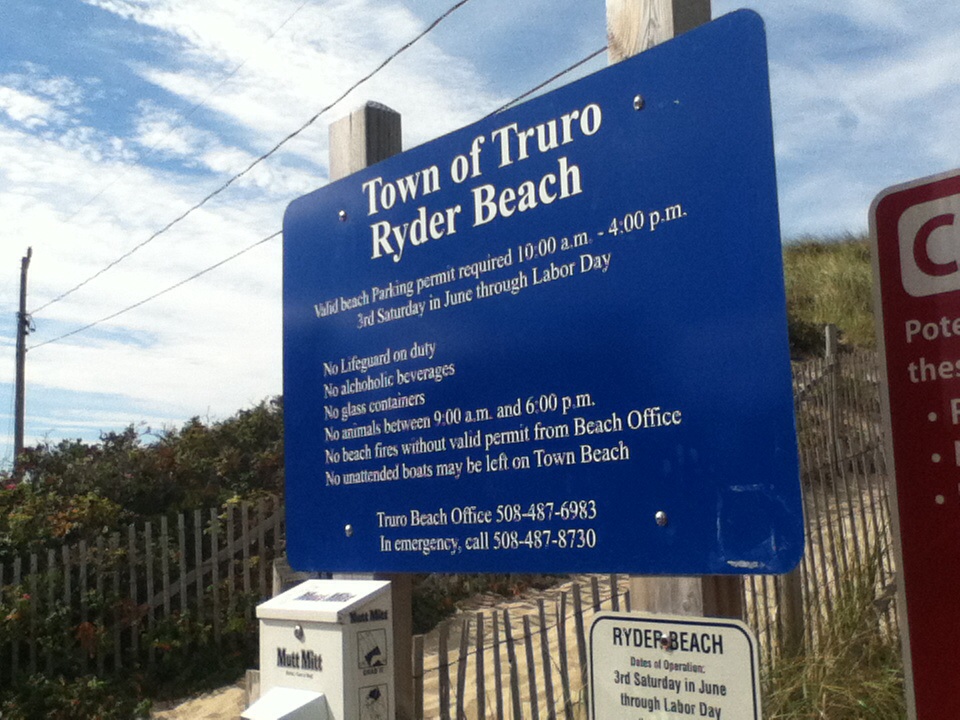
Ryder Beach, Truro.

image

Ryder Beach, Truro. The weather was windy in the morning, so much so I almost didn’t realize how hot it was until I stopped here.

image

The view of Corn Hill from Castle Road, Truro. Amazing how misleading photographs can be. These houses are on big, tall bluffs overlooking the marshes and the bay to the west. Lots of climbing.

image

One of the houses near Corn Hill, Truro.

image

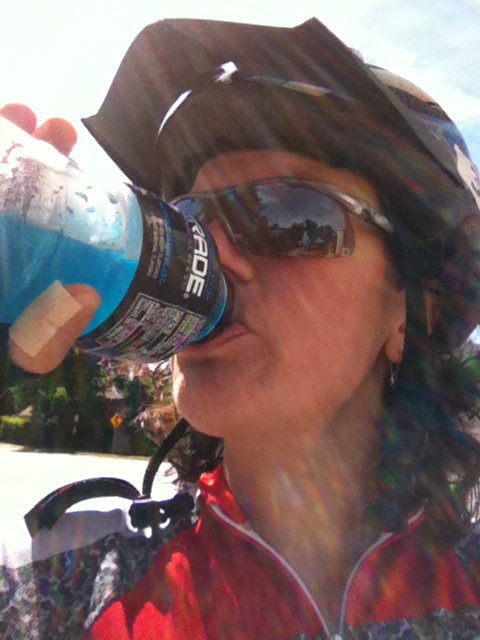
Powerade hydration self-portrait, #2. After over 20 miles of hilly back roads, I was hot and thirsty, so I stopped at the general store near the beginning of the Shore Road in North Truro. It used to be a hole in the wall called Dutra’s. Now it has been renovated and expanded, and they carry fancy Fever Tree tonic water. (This brand is light and not too sweet or cloying, perfect for cocktails, but four 6.8-ounce glass bottles are not worth $8.) I skipped the overpriced cocktail mixers and went for the sports drinks. I am not a big fan of Gatorade or Powerade, but hydration is key to endurance cycling. Electrolytes are your friend, and for whatever reason, perhaps because the blue versions of these products aren’t trying to simulate real fruit flavors like strawberry or grape or lemon, they tend to be the most palatable to me. Blue flavor, please, for me and The Blue Streak.

image

The window display at the expanded and renovated general store in North Truro. The place has new owners and is now called The Salty Market. To give you a sense of the scale here, the pig is nearly the height of the tall bench behind it, at which two gentlemen are seated. Both these guys kept giving me a weird look as I paused to snap this photo, as though I were interested in them and not the giant pig sculpture directly in front of them that was large enough for either one of them to straddle and ride like a  horse.

image

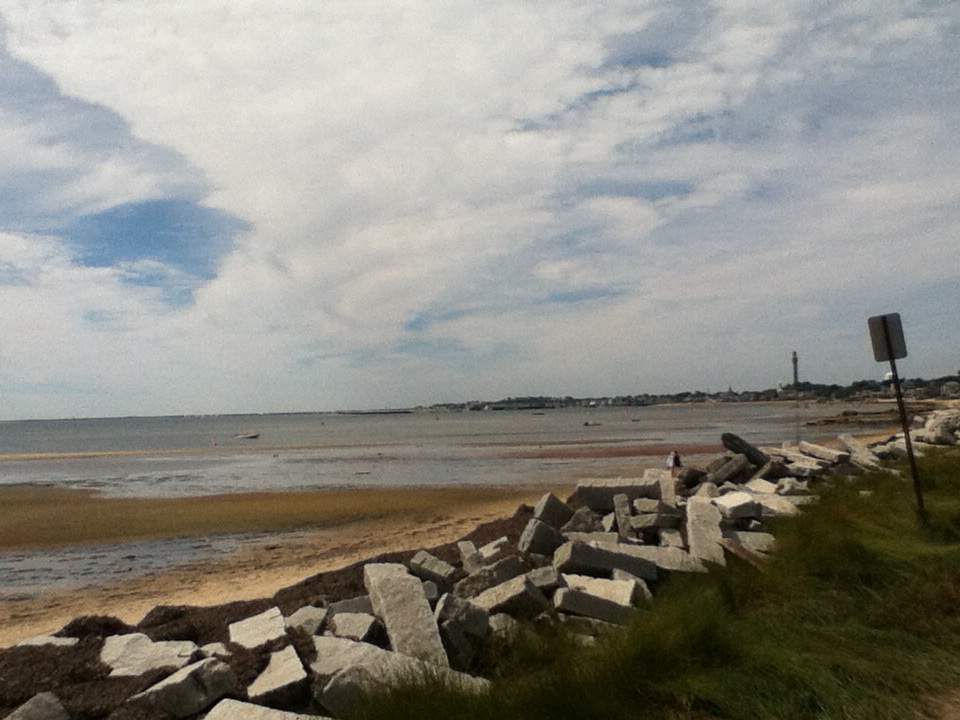
Provincetown, as viewed from Shore Road (Route 6A) in Truro, about 25 miles into my ride. The road is relatively flat, small rolling hills here and there, but headwind was something fierce in the morning, so it was slow going.

image

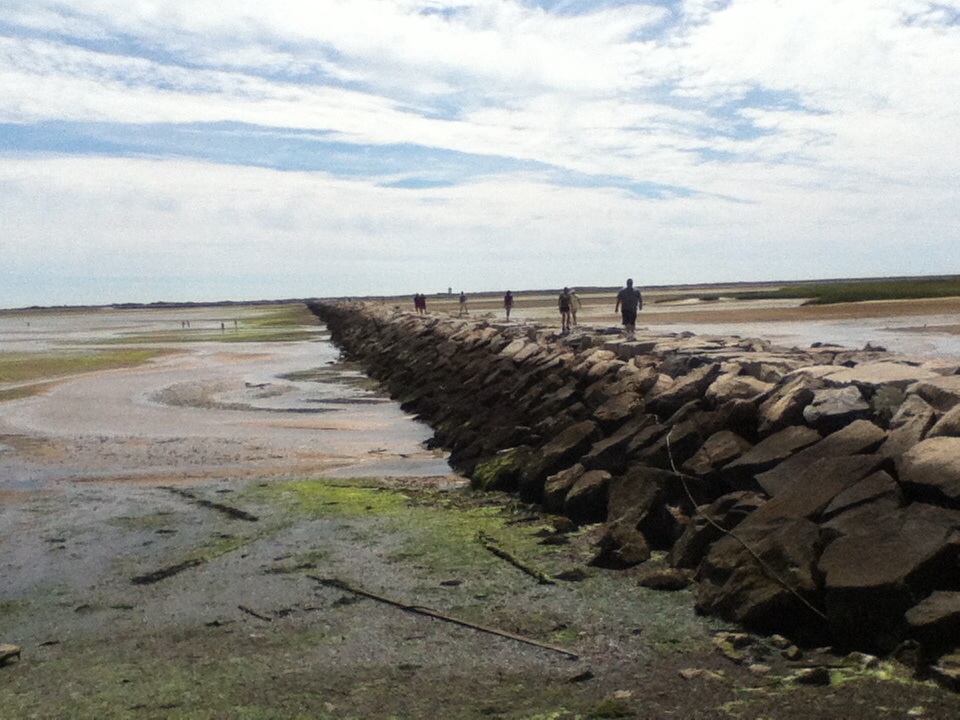
People walking on the sand bars during low tide on the bay, as seen from Shore Road, riding from Truro to Provincetown, late Wednesday morning.

image

Low tide on Shore Road between Truro and Provincetown, facing southwest.

image

After I arrived in Provincetown, I headed straight for Joe’s to get some iced coffee and then down the rest of Commercial Street to the West End, where I stopped at Relish, a deli that has incredible sandwiches as well as baked goods. When Jen and I got married in the West End in 2010, Frank, the guy who owns Relish, made our wedding cake. These are the store t-shirts.

image

To the disappointment of my friends Nicole Dewey, Kerri Fox, and Gregg Passin, cupcake lovers all, I did not get a cupcake at Relish, but this tray of them was so cute, I had to take a snapshot.

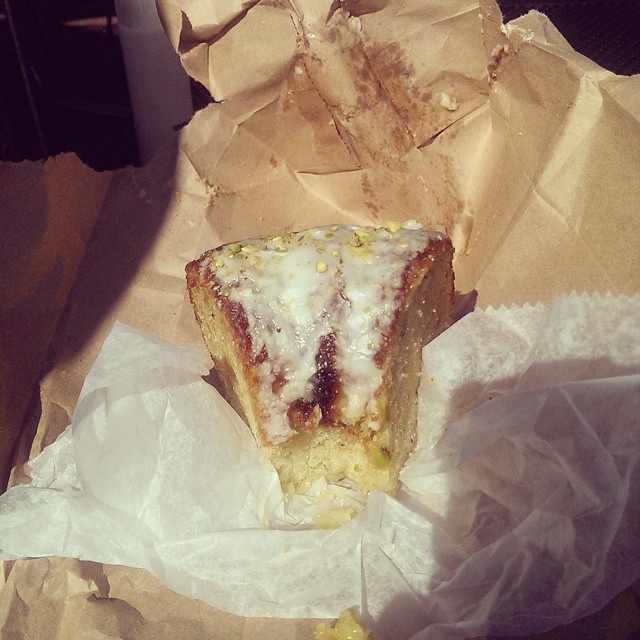
Objects may be larger than they appear. This slice of pistachio coffee cake from Relish is roughly the size of my head. Although the one pictured here is the one Jen and I shared from today (Friday), it is nearly identical to the one I purchased at Relish about 27 miles into my ride and housed all by myself.

Objects may be larger than they appear. This slice of pistachio coffee cake from Relish is roughly the size of my head. Have I mentioned that under the curly hair, I have a big melon for a head? Although the slice of cake pictured here is the one Jen and I shared this afternoon (Friday), it is nearly identical to the one I purchased at Relish about 27 miles into my ride and housed all by myself on Wednesday. Photo by Jennifer L. Anderson.

image

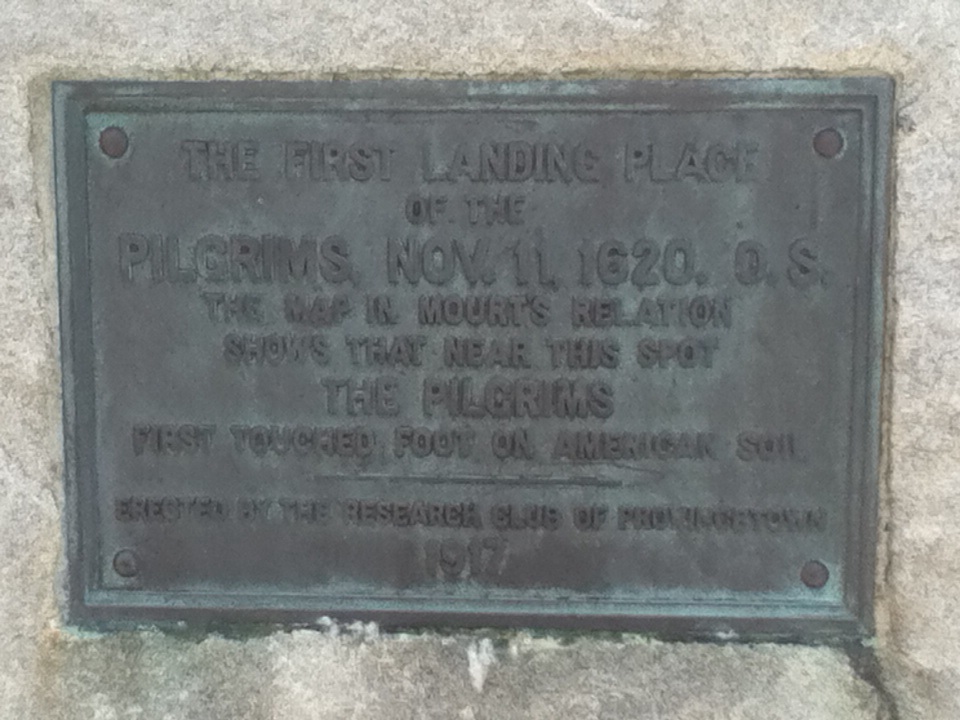
At the end of a Commercial Street in Provincetown’s West End is a traffic circle that feeds onto Provincelands Road, which in turn leads toward Herring Cove and Race Point Beaches. I had never noticed before this week that the rotary itself is a tiny park with this little plaque noting the first Pilgrims’ landing. Learn something new every day.

image

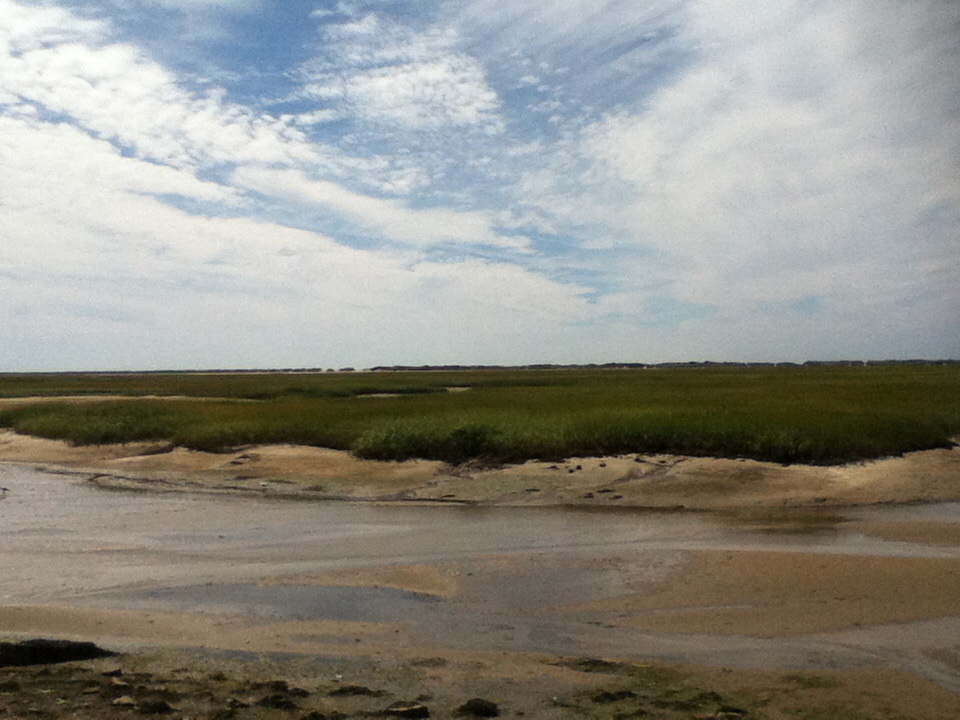
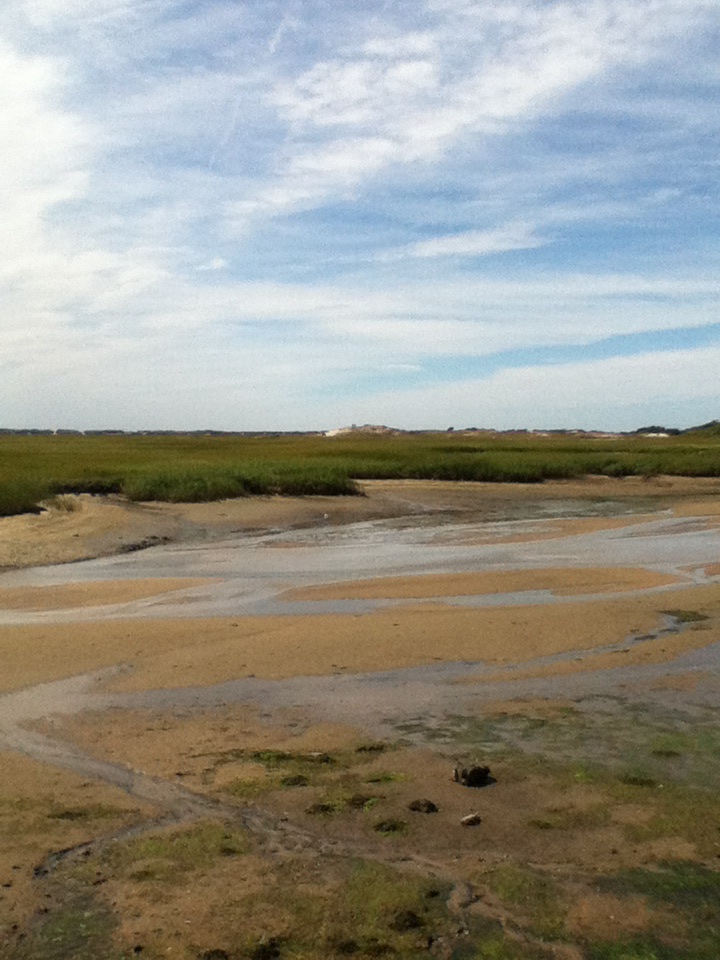
The outer rim of the West End rotary has benches that overlook the bay, the marsh, and the causeway. This is where I sat to eat my divine coffee cake from Relish and my iced coffee from Joe’s. Now that you see the view, you understand why those first Pilgrims decided to stay.

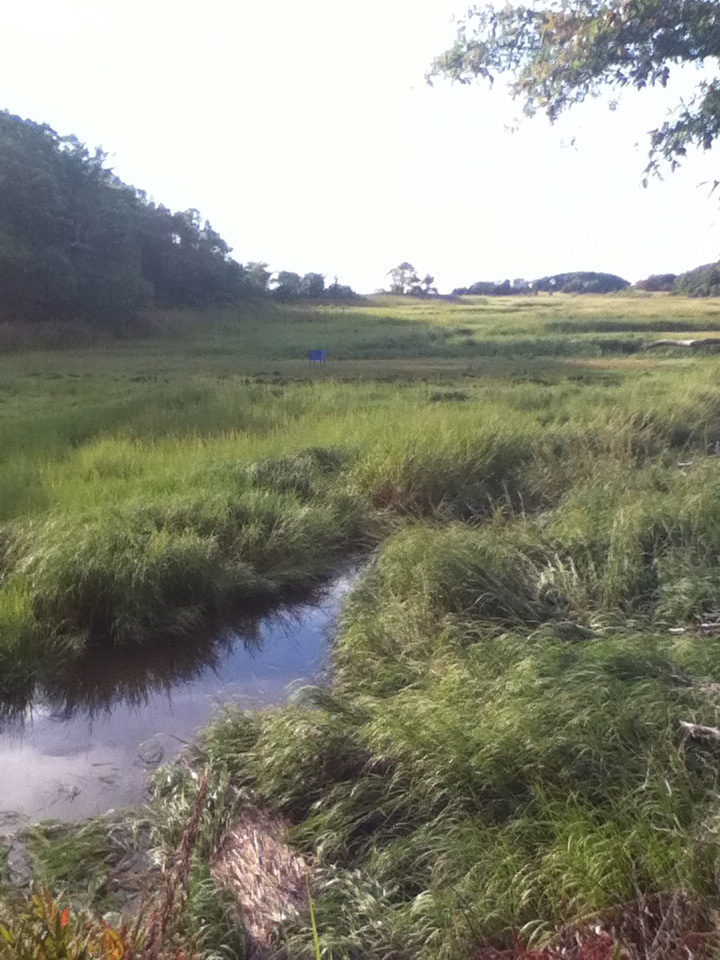
Another view of the West End marshes, Provincetown, at low tide. Love these colors.

Another view of the West End marshes, Provincetown, at low tide. Love these colors.

image

People walking the Breakway, which spans about 1.5 miles, West End, Provincetown.

image

The Tidal Flats and Provincetown Breakway at low tide, West End, Provincetown.

image

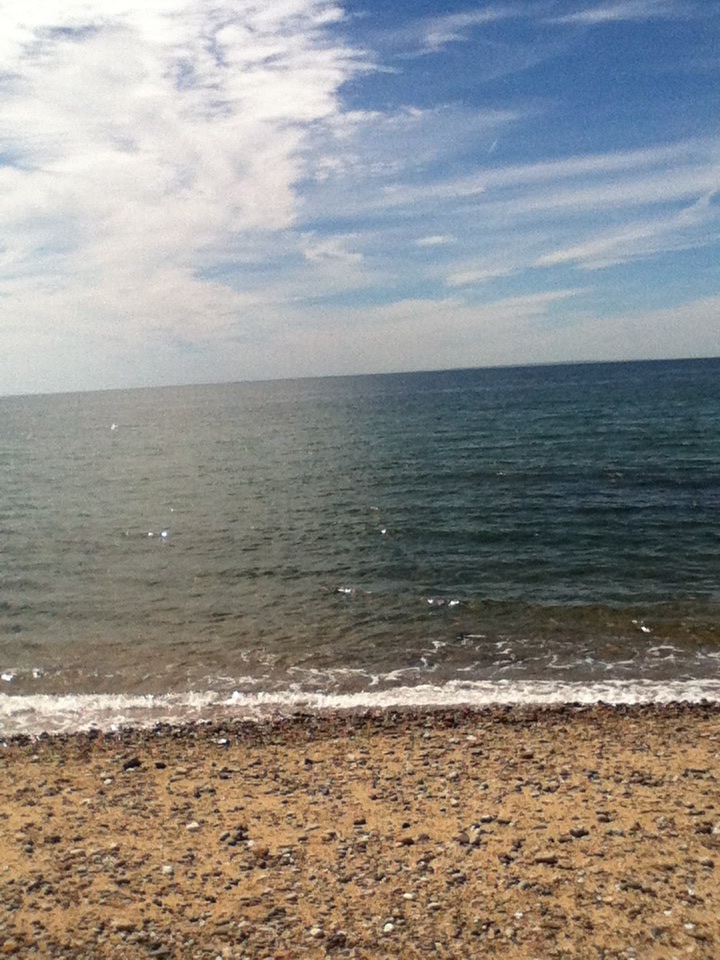
After my cake snack, I was hot. I should have headed straight back to Wellfleet. I had gotten a late post-9am start (ah, the beauty of a cool summer! No need to begin at 6am to avoid the heat!) so it was already noon, and because of all the hills and headwind as well, I was only about one-third of the way through my century ride. But instead I stopped here, at Herring Cove Beach, parked The Blue Streak, stripped off my cycling shoes and socks, and marched myself down to the water to go soak my head, literally, and cool off.

image

The Blue Streak, waiting for me patiently at Herring Cove, while I went to take a dip.

image

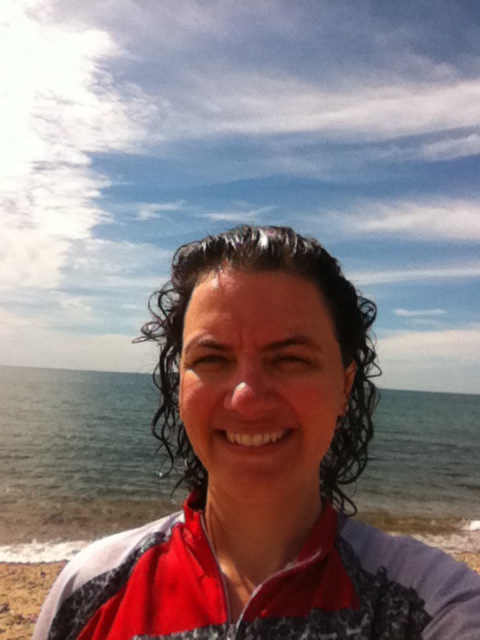
Self-portrait at Herring Cove Beach, after taking a dip in the ocean (or rather, wading in to the knees and dunking my head in). The other beachcombers were perplexed by my strange bathing costume.

Non-photographic, afternoon interlude: After my detour to Herring Cove, I hauled ass back to our tiny cottage in South Wellfleet, via Route 6, Shore Road, and some of the same hilly back roads in Truro. I was pleased to make much better time than I had during the morning. Remarkable what a difference headwind makes.

I stopped at the cottage and ate a self-made turkey sandwich that was serviceable but not worth photographing. While I was there, Jen returned from her own training ride of hill repeats along Ocean View Drive, so I got in a brief snuggle with her and our dog Sadie. Sadly, I had another 45 miles of riding to go, so the visit was short-lived.

The good news is that most of my remaining route, the 22-mile Cape Cod Rail Trail between Wellfleet and Dennis, was flat. Along the way, I passed through Wellfleet, Eastham, Orleans, Brewster, Harwich, and Dennis, and then back again in reverse. The scenery in parts is lovely but the road itself—like the NYC West Side bike path, open only to cyclists and people on foot—is unremarkable, mostly flanked by trees and scrubs on both sides, so I only tend to take a handful of photos en route. Also, the one annoying thing about the Rail Trail is that it includes numerous stop signs where the trail intersects with roads trafficked by cars, so the route requires a ton of stop-and-go slowing down and ramping up again. In addition, after the first leg of my ride, I tend to get increasingly impatient with completing the century and stop less to take out the camera. For more on what this second portion of the route looks like, see my previous post from last year.

image

One of the marsh views, facing west on the Rail Trail between Wellfleet and Dennis.

Unfortunately, it isn't visible in this photo, but I discovered during the last 30 miles of my 102.5-mile  ride this Wednesday that from a few places along the Rail Trail, one can see all the way to the bay. In this image, I could catch a small triangle of blue salt water right next to the tree silhouette near the top center.

Unfortunately, it isn’t visible in this photo, but I discovered during the last 30 miles of my 102.5-mile ride this Wednesday that on a clear day, from a few places along the Rail Trail, one can see all the way to the bay. In this image, I could catch a small triangle of blue salt water right next to the tree silhouette near the top center.

image

At this point in a long day of riding, especially on a road like the Rail Trail, which is flat, uneventful, and safe enough terrain that one can afford to zone out for a while, strange, random stuff starts to drift through one’s head. Lines from Pride & Prejudice, the number of bones and muscles in the feet, whether the road ahead will ever end, and any number of X-rated fantasies to keep the mind going and entertained while the legs continue their monotonous pedaling. It is also the section of the journey during which I decided to get “arty” with the photo composition. Look at me, putting the reflection of the sun at the center without showing the actual light source.

This is where the photographic record of my century ride 2014 ends. I had wanted to take a picture of my odometer with my total distance for the day to post here, but somewhere during the last 30 miles, in my bleary-eyed state, I went to look at my speed and I hit the reset button by accident so the mileage count started over. You will have to take my word for it: 102.5 miles total.

The thing about a century ride is that its full-day endlessness makes its completion all the more satisfying, and it’s also one of the best psychological confidence boosters I get prior to the actual BRAKING AIDS Ride. No matter how the day goes, a century is a good lesson that I repeat annually—less because of its physical training benefits and more because it reminds me that steady tenacity bears out. The closest thing I have to a picture of that figurative journey isn’t a photo from my century ride at all. It is a photo of me with my wife from the previous day, which she took during 45 miles of hot, hilly riding.

Seeing her beautiful face, all serious and sweaty from riding her bike, The Pale Horse, inspires me because she is a less experienced endurance cyclist than I, and she had a number of obstacles—physical and emotional—this summer that limited her training in a big way. Many people would have raised the required money for the ride, said to hell with the rest of the bike training, and not bothered doing the ride at all. Jen didn’t quit. When things were looking and feeling especially dark and dire in late July and early August, I assured her she doesn’t have anything to prove to anybody, except maybe herself, but she still refused to throw in the towel. Even at her most frightened and downtrodden, even when angry and disappointed at how the summer season went, she has kept showing up. Sometimes, she hasn’t been physically up to riding at all. Other days, she’s done shorter rides when she was unable to do longer ones and she’s ridden even when she has felt like crap, which has been often. She has also continued to insist on showing up and doing the actual BRAKING AIDS Ride, determined to have whatever ride experience she’s going to have. If that isn’t bravery and grit and perseverance, I don’t know what is. She has no idea what a fucking hero that makes her to me, so this is my way of trying to convey that. Jennifer Lynn Anderson, this post is for you:

This was actually taken the day before my century ride, doing a 45-miler with my wife Jennifer, who is also doing the ride next week. But she has been such a tenacious, brave beast during a challenging and difficult summer training season, and I am so proud of her, I wanted to post this here.

This was actually taken the day before my century ride, doing a 45-miler with my wife Jennifer, who is also doing the ride next week. But she has been such a tenacious, brave beast during a challenging and difficult summer training season, and I am so proud of her, I wanted to post this here.

LESS THAN A WEEK FROM TODAY, I WILL BE RIDING NEARLY 300 MILES IN 3 DAYS, FROM BOSTON TO NYC, TO BE PART OF THE FIGHT TO END AIDS. CLICK HERE TO DONATE TO SUPPORT ME & HOUSING WORKS FOR BRAKING AIDS® RIDE 2014.

On Possibility

I have been thinking a lot lately about possibility. How I go about determining what is possible for certain, what seems possible but hard, what is unlikely, and what is impossible.

It isn’t that I don’t ever get ambitious or dream big. It is that I also tend to be a realist. I am the person in the room who has vision but who’s also good at figuring out how to take an idea and create a process that turns the idea into a reality. I assess possible approaches, saying, “well, doing it that way won’t work” or “let’s try this instead.” Some of this may be temperament; some of it may be that I have spent a lot of my life around big-picture talkers. I am talking about people who need realists and makers—people who Do and Manage Concrete Stuff and turn imaginative talk into something more—to get anything done. Some of these big-picture folks have genuine vision with potential brilliance in them and some don’t; regardless, they tend to be people with authority and in some cases big ambitions about Making a Certain Outcome Happen. In my experience, however, many of these people set a high bar for others but offer up little by way of planning, knowledge, or proposed steps about how to get their desired result. They also don’t tend to care much about determining what will or won’t be entailed and which resources are essential and which are nice to have but not crucial. They rely on other people to do that—creative implementers, managers, analysts, builders—to translate abstraction into creative visions, interpret vague demands and desired results, arrange processes and people, outline a plan with concrete steps, manage the whole business, and in the end, make something happen. You can’t make anything happen with your head in the clouds all the time. It takes having at least one foot and better yet two feet on the ground at least some of the time. And at least in my career life, I am right a fair amount of the time about what does and doesn’t work, enough anyway that the realist, maker skills have gotten a lot of play in my workplaces and kept me employed.
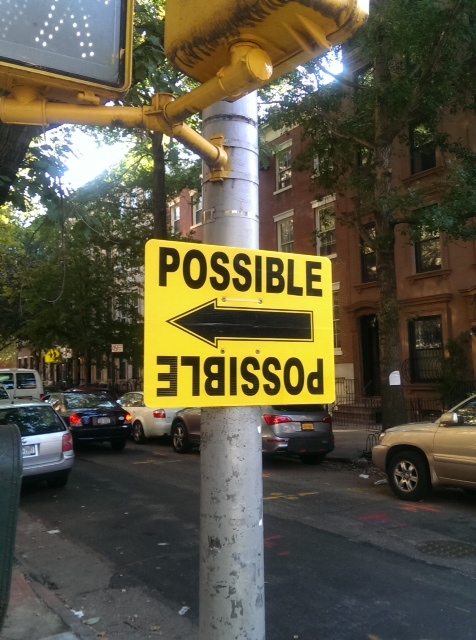
I encountered this mysterious street sign near a construction site on Henry Street in Brooklyn a few weeks ago while walking home. It was as though the universe was trying to tell me something. Turn left?

I encountered this mysterious street sign near a construction site on Henry Street in Brooklyn a few weeks ago while walking home. It was as though the universe was trying to tell me something. Turn left?

I have a mentor who has pointed out to me that our strengths and our weaknesses are often the same aspects of self. Whether they are operating as one or the other or both depends on how and when we are using them. The same person has also observed that I have a lot of experience and comfort with articulating to myself why something isn’t possible. I have spent a lot less time letting myself dream and imagine what I want, irrespective of whether it is possible or impossible. That tendency to gravitate toward hyper-realism and always be sussing out the odds has served me in good stead in some ways, but the problem with that frame of mind is that it’s prevented me from imagining in other parts of my life. How one can dream about what might seem impossible but is possible. That in turn has stopped me from imagining something that I desire but seems nuts—unrealistic or unlikely—and trying to do it anyway. It’s stopped me from trying and perhaps failing but maybe getting closer than I had thought. It has stopped me from seeing the value of a free imaginative space if I can’t guarantee a particular outcome. It has stopped me from trying and perhaps failing but in doing so learning something that might make the next attempt more effective. It has certainly stopped me from trying something unlikely and discovering I was wrong—that the effort was hard, maybe harder than even I thought it would be but that the goal was in fact possible. Not impossible as I had believed.

In short, the editor in me outshouts the writer in me. A lot of the time. I tend to talk myself out of a lot of ideas before I have even let myself dream them up much less gotten started on attempting them. Usually, it’s so unconscious and familiar a mental process—an internal argument, a whittling down of options, of paths to travel—that I am not even fully aware that I’ve had a hand, and a pretty significant one, in narrowing what’s possible for me and what I choose to pursue right from the beginning.

The fact that typing that last two paragraphs made me tear up a little underscores not only its veracity but also why it matters: Because it’s me holding myself back and getting in my own way. I am my own biggest obstacle. I don’t have any control over what gets in my way outside of me. But I do have agency over the role I play, the choices I make, the ideas I allow myself to contemplate and the paths I allow myself to carve out and walk.

One of the things I love about being part of BRAKING AIDS® Ride is it is a concrete, physical manifestation of challenging my own certainties about what is possible and what is impossible. It has also forced me to re-evaluate my own beliefs about what is going to prove to be hard or challenging in a given ride season. The first year I signed up for the ride, I didn’t know I could ride 100 miles at a stretch. I had no idea I would be able to slowly crank my ass up a hill that seemed like a mountain. I had never raised what ended up as almost $13,000 for anything. Other people may not have been surprised, but I didn’t know I could be relentless in asking family, friends, colleagues, and even acquaintances and strangers to donate money, even if it is for a worthy cause. I go back to BRAKING AIDS® Ride each year, yes, because I believe in and am passionate about the cause and because I love the spirit of the ride community, but also because the ride and the annual process of training and fundraising leading up to it force me to re-think what I believe my obstacles are every year and to keep showing up. Every year, I think to myself this is the year everyone who knows me will get fed up with hearing about HIV/AIDS and stop giving money. This is my sixth year doing this since 2008 and that fear—that little slice of reality, such as it is—has yet to materialize. Which is a way of saying I underestimate myself and perhaps more important, I underestimate the ongoing kindness, generosity, empathy, compassion, and interest of other people, all the individuals who have supported me with donations but also with love, encouragement, wisdom, humor, you name it. And perhaps I underestimate whatever small impact I have on them, and that their support has on me, too, because I worry about disappointment—expecting more of others and of myself and then being hurt when they or I fall short.

The ride is a space that has let me try to visualize and then do things I didn’t think were possible and, on my good days, to care a little bit less than I do in other parts of my life about failure and disappointment that things don’t turn out how I planned or imagined or dreamed. It’s forced me to redefine what is success and what is failure. It’s challenged me to see that the process of showing up and seeing what happens—and being open to the actuality, whatever it might be, often different than anything I could have imagined or planned or trained for—is more important than any outcome. I keep showing up and along the way, I hope that these life lessons sink in a little more and gets a little more integrated into my self and how I move in the world. My wish is that over time, these lessons also become something that I can live out not only on the ride but in the other parts of my life, too.

Training and fundraising for this event multiple times has also made me see again and again that I struggle with taking the many things I can’t see or hear on faith. I operate a lot of the time with a strong desire to see visible signs that who I am and what I do in the world make a difference, make something better for someone other than myself. Sometimes I think that longing is an insatiable part of me, and it’s difficult for me not to judge myself for that kind of ego, to yearn for that kind of constant reassurance and positive reinforcement so much it feels like a need—a prerequisite for attempting anything at all—rather than a want.

I’ve been doing this ride since 2008, so I can speak first-hand to the amazing collective energy in doing a community physical event. I am also a storyteller, so the power of the symbols and metaphors BRAKING AIDS® Ride offers when it comes to raising money and awareness for an important cause aren’t lost on me. The parallels between doing a daunting physical and financial challenge and living with a chronic disease like HIV are certainly inexact, but they still bring home messages about helping one another, about working and fighting together, about endurance, about pain, about compassion, and about love in a way that few direct-mail solicitations asking for donations can. Seeing HIV+ positive riders, who can choose to self-identify during the ride by riding with an orange flag on their bikes, climb hill after hill over 300 miles inspires me more than any fundraiser gala and gives me a different perspective on what it might be like to have to live with HIV each and every day. Three days on the ride makes HIV more palpable than statistics or a report in The New York Times. I have also been amazed by some of the people we encounter along the road every year, strangers who come out and stand on their lawns with signs to cheer us on.

Still, in spite of all that, I have wondered about whose minds we are really changing and whose hearts we are opening with the ride itself, pedaling our way across New England. At the very least, I know the ride has a transformative effect on everyone within our ride community. It connects a cause, which can easily become too much of an abstract idea, to our own friendships and families, to our goals and fears, and to our humanity. The stigma-free, passionate, and supportive environment of BRAKING AIDS® Ride is a profound enough experience that the ride is worth doing for those reasons alone. There’s also no question that the ride has an effect on the many clients who rely on the Housing Works life-saving services by raising funds that support those crucial programs. But even after years of being part of this experience, it’s sometimes hard to know—to see and recall in concrete ways—who we are reaching outside of the immediate ride and Housing Works community with our moving presence on the road.

Eric Epstein, President of Global Impact, which produces the event, calls BRAKING AIDS® Ride a civil-rights march on wheels. I don’t think he’s wrong, but I confess I have sometimes wondered whether we’re preaching to the already converted or whether our presence changes anyone. Who is hearing us as we cycle, rain or shine, through the suburbs of Boston, in small towns in Rhode Island, in Lyme, in New Haven, in Milford, in Yonkers, in the South Bronx, the signs on our bikes and messages on our bike jerseys publicly reminding folks that AIDS is still around and we still need to work together to fight it and someday, end it?

It isn’t lost on me that this same doubt nags at me in other parts of my life. Who is listening and does it matter? Is anyone out there? When I was a teacher, I wondered it about my students. Whenever I write something that other people read, I wonder if anyone’s reading, and if so, if my words and stories are resonating with anyone at all. Most of the time I haven’t the slightest clue.

But something happened during last year’s ride that gave me pause and made me think again about how we all have an impact on people all the time, in big and small ways. We just don’t always know it. In fact, most of the time, we won’t know it.

Every year on the ride, one day is declared Red Dress Day. Originally called Dress-in-Red Day, the concept came from one of the early AIDS rides many years ago; the idea is to have every rider wear something red so that from a distance, the riders cycling along the road would look like a red ribbon. The BRAKING AIDS® community being the creative, kooky, fun-loving bunch that it is, it’s also the day that many riders don an elaborate costume of one sort or another—everything from a red bike jersey to an Incredibles superhero outfit to a vinyl red bustier to a red tutu to red fishnet stockings to yes, a red cocktail dress.

red dress day beach group shot

Some riders posing during lunch at the beach, Red Dress Day, BRAKING AIDS® Ride, September 2013.

Riders Henry Bolden and Brigid Siegel, hotties dressed for success, Red Dress Day, Braking AIDS Ride, September 2013.

Riders Henry Bolden and Brigid Siegel, hotties dressed for success, Red Dress Day, BRAKING AIDS® Ride, September 2013.

The effect this visual parade has on the spectators who encounter us during the course of Red Dress Day varies. Some people are rude cat-callers, but many are simply curious, and some have even donated money on the spot when they find out why we’re riding. But overall, suffice it to say, Red Dress Day garners attention: It’s hard not to notice over one hundred people cruising through small New England towns, all of them wearing red, many of them in costumes or drag of one sort or another.

Tom Dwyer, riding through new England in style in his self-described "Tragic 'Ho" outfit, Red Dress Day, Braking AIDS Ride, September 2013.

Tom Dwyer, hitching a ride with one of our amazing moto-safety crew guys and cruising through new England in style in his self-described “Tragic ‘Ho” outfit, Red Dress Day, BRAKING AIDS® Ride, September 2013.
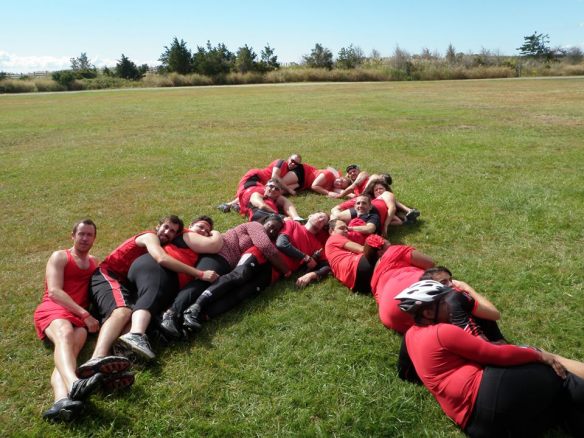
A small group of riders and crew gather during lunch at the beach to make a red ribbon, Red Dress Day, Braking AIDS Ride, September 2013.

A small group of riders and crew gathering during lunch at the beach to make a red ribbon, Red Dress Day, BRAKING AIDS® Ride, September 2013.

Another BRAKING AIDS® Ride tradition is that we all eat dinner together each night of the ride. During the course of the meal, various announcements are made by staff and crew, and for a portion of the evening the mic is opened up for anyone—rider or crew member—to share something from that day on the road. The moments people share run the gamut in tone and emotion: Some regale us with the silly or lewd comments they overheard people say. Others tell us what moved them or inspired them that day. On more than one occasion, brave souls have used that space to come out about their HIV status, sometimes for the first time to anyone.

Last year, crew member Linda Zipko got up at dinner one night and told us the following story: When she and a bunch of other BRAKING AIDS® Ride folks arrived at our host hotel en masse earlier that day, it turned out to be the same place we had stayed at the previous year. While she was in the lobby, one of the people who worked there walked up to her, perhaps recognizing her from the year before and said something like, “See? I heard you guys were coming back this year, so I wore a red shirt to work today.” Linda was warmed by the gesture and the two of them ended up hugging, two virtual strangers, right there in the hotel lobby. Normally a hug of that sort doesn’t last more than a second or two. But the hotel staff member held on, and it became clear to Linda something beyond a kind gesture of solidarity was happening. Tears began streaming down the face of the staff person, who clung to Linda, couldn’t quite release her, and who whispered in her ear that a close family member—father?—had been diagnosed with HIV during the previous year. I don’t recall what else the person said to Linda; I believe the words “thank you” were repeated a lot.

A number of other BRAKING AIDS® crew and riders were in the lobby at the time. They said later they could sense something big was transpiring as they witnessed the hug and the exchange; they just didn’t know what. Someone had the forethought to snap a photo of the moment as it took place, even without knowing what it was or what it meant.
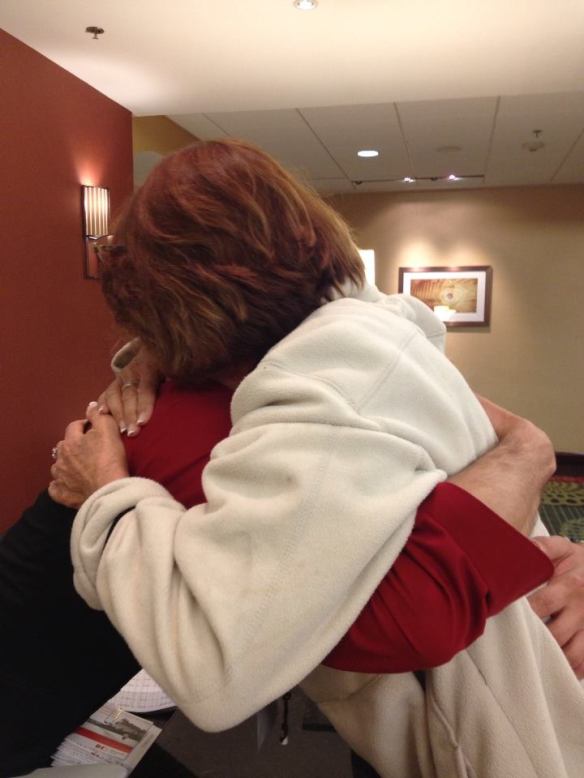
Crew member Linda Zipko hugs a new friend, who wore a red shirt for Red Dress Day, BRAKING AIDS® Ride, September 2013.

Crew member Linda Zipko hugging a new friend, who wore a red shirt for Red Dress Day, BRAKING AIDS® Ride, September 2013.

I wasn’t in the hotel lobby that afternoon. I was probably somewhere out on the road, trying to get my bike, the Blue Streak, which was having mechanical shifter troubles, through another 25 miles. I didn’t witness any of what Linda experienced first-hand, and yet I have found myself returning to this story again and again during the past year.

The story is touching, to be sure, but it doesn’t give me solid, neat answers. I don’t know what happened to that stranger in the hotel lobby afterward. Perhaps the moment with Linda unfolded, it was powerful and moving, and then like a thundershower, it was over. I can’t say what that person felt or whether the moment resonated and had ripple effects later. I don’t know whether this person has told any of what was shared with Linda to anyone else, before or since. Likewise, I don’t know whether the person told anyone about wearing the red shirt, before or after doing it. I only know that showing up in a red shirt that day last September meant that this singular person had been waiting, for months, possibly all year, to have some kind of brief connection with us, with our ride community, a bunch of strangers, for a few minutes—to say in some small way “HIV affects my life, too,” and in doing so, perhaps to feel a little less alone in the world with whatever challenges might come with that.

It also means that our presence as a ride community had an impact on someone, long before that person chose to say something to one of us about it. I wondered later about that, about that choice to say something to Linda. The person could have worn the shirt as a private gesture and said nothing at all, and might even have had the same feeling of connection, just without any of us knowing it. What if the person hadn’t recognized someone from the ride or felt too vulnerable and didn’t have the nerve to say something in the moment? What if Linda had been tired that night and not up to sharing the story with the rest of us? We would still have had an impact, possibly a big one, on a stranger. The difference is we wouldn’t know it.

That refrain hums in my head sometimes now like a strange, minor-key mantra. We don’t always know, we don’t always know.

We affect one another. All the time. We can’t always know how or when.

We don’t always know, we don’t always know.

That might sound pessimistic to some, but it isn’t. I try not to dwell too long on whether I’ll recognize those moments when signs of connection and impact and meaning rise to the surface, if and when they happen, or if I’ll be lucky enough to be present for them—literally and emotionally—when they do make themselves visible. I think of how many teachers and mentors and surrogate-parent figures and friends I’ve had over the years, of how much they have shaped who I am today. I think of the BRAKING AIDS® Riders and crew who have moved me, some who became close friends, and others who I haven’t seen recently. I think of how sometimes it has been the smallest moment that struck a chord or changed something in me—a gesture, a smile, a word of reassurance, a moment of tough love when I needed it, a split second where the eyes met in recognition. Then I observe to myself how rarely I ever shared the fact of that impact with those people, often because I wasn’t aware of it myself until much later.

We all matter. We don’t always know.

We don’t always know.

I keep returning to that moment with Linda and the hotel staff person. Then I think to myself that for every moment like that, one we get to witness and hear and talk about—to see some tangible proof that who we are and what we do matters—a dozen other moments like that may be happening to other people, changes inside the shell of their selves that are happening because of us, because of something we said or did, that we aren’t aware of and may never know of. Something that changes their perspective or their trajectory forever, however slightly.

I imagine the vastness of that big cloud of all we don’t know, of all those invisible moments of meaning and connection and impact—both the ones I benefit from and the ones in which I affect others in some way. It’s a big cloud that stretches the expanse of the sky, like something Magritte would have painted. I take great comfort in dreaming about its possibility.
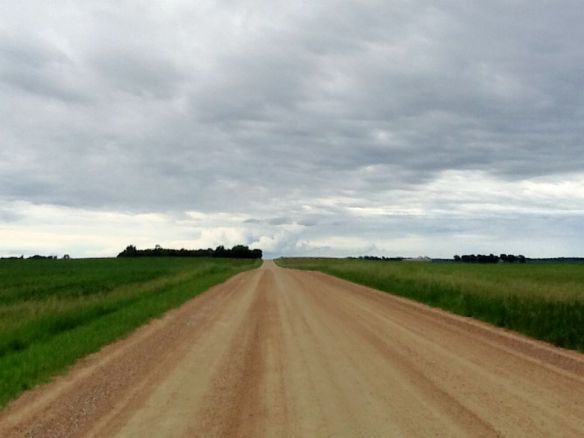
Northfield road with sky

CLICK HERE TO DONATE TO SUPPORT ME & HOUSING WORKS FOR BRAKING AIDS® RIDE 2014.

Next Stop: AIDS-FREE NY 2020

A graphic from the newly branded Housing Works AiDS-FREE NY 2020 campaign.

A graphic from the newly branded Housing Works AIDS-FREE NY 2020 campaign.

One of the advantages of working at Housing Works is that I get to see and hear firsthand the impact of our advocacy efforts. On June 29, coinciding with NYC Gay Pride, we achieved a big victory: Governor Andrew M. Cuomo made history with his public declaration of an advocacy-based plan to end the AIDS epidemic in New York by 2020, as reported in The New York Times and in a press release issued by the Governor’s office.

Later the same morning, Housing Works and other AIDS and LGBT advocates held a press conference to praise the Governor for stepping up. A video montage of the statements made appears below.

To anyone who has some knowledge of the history of the AIDS epidemic for over three decades, this may perhaps sound like a daunting goal. But Governor Cuomo’s announcement reflects his recognition that the landscapes of HIV and health care have changed. Although there are more New Yorkers living with HIV than in any other state in the nation, New York has the people, institutions, resources, and tools needed to end the epidemic that has plagued us for more than 30 years by stopping new HIV infections and halting AIDS-related deaths. Based on progress and an expansion of advancements that have already been made—from new prevention and testing technologies to highly effective antiretroviral treatments—we have the science to make the ambitious goal of decreasing new HIV infection to below epidemic levels by 2020 viable. A successfully treated HIV+ person can live a healthy life and is virtually unable to transmit HIV to others. New HIV prevention tools beyond condoms, such as PrEP (pre-exposure prophylaxis, in which an HIV-negative person takes a daily pill to reduce the risk for HIV infection) and PEP (post-exposure prophylaxis, or meds taken following possible HIV exposure to reduce the risk of transmission), combined with these advances, mean we can end AIDS as an epidemic even without a cure. For more on PrEP, see this recent New York Magazine cover story or this post on PrEP on the Housing Works advocacy blog.

New York State has already been laying the groundwork to reach that goal. Always a leader and center of innovation in the fight against AIDS, New York has experienced a decrease in new HIV diagnoses of nearly 40% in the last decade, with fewer new infections each year. By contrast, there has been no decline in the number of new HIV infections diagnosed nationally each year, which has remained static at roughly 50,000.

Reacting to the news of Cuomo’s commitment, Housing Works CEO Charles King put it best:

“This step by Governor Cuomo, setting a clear goal to end the AIDS crisis in New York State, is absolutely courageous. In doing so, the Governor is reshaping the way we think about the AIDS epidemic and is setting a new standard for leaders of other jurisdictions in the United States and, indeed, around the world.”

And now that the Governor has gone all in, the real work begins—creating a blueprint to end AIDS by 2020 and implementing it. Toward that end, Housing Works and its allies continue to urge the Governor to convene a high-level State Task Force to develop and design a strategic roadmap with concrete steps and benchmarks for the Cuomo Plan to End AIDS in New York State.

Housing Works staff, clients, volunteers, and allies, celebrating during NYC Gay Pride 2014.

Housing Works staff, clients, volunteers, and allies, celebrating during NYC Gay Pride 2014.

For its own part, the same day that the Governor made his historic public commitment, Housing Works officially launched the New York segment of the ongoing Housing Works AIDS-FREE advocacy campaign during Gay Pride, marching behind the above “AIDS-FREE NY 2020: Closer than you think.” banner during the parade. Housing Works’ AIDS-FREE Campaign is a collaborative, multi-year initiative committed to ending the AIDS epidemic—in New York State by 2020, in the United States by 2025, and worldwide by 2030. For an overview of the campaign, click here.

The tag line on the banner isn’t merely aspirational. We are closer to making the end of AIDS a reality than we’ve ever been.

How You Can Support the Work Housing Works Is Doing
to Reach an AIDS-FREE New York by 2020

By and large, Housing Works’ advocacy—the grassroots organizing and political lobbying work it does in Albany, D.C., and across the globe to promote an AIDS-FREE future—is not funded by grants or by corporate or government dollars.

That’s one reason events like Braking AIDS Ride are so important. The funds raised by the ride to support Housing Works are unrestricted and can be used when and how they are needed across the organization.

As of this writing, I’m a little more than halfway to my $5,000 fundraising goal.

Please donate today to help me reach the finish line!