Last month, my partner Jen and I drove up to the Catskills to spend a weekend with friends. The house in Palenville, New York overlooked the Niobe Waterfalls, and we could hearing the sound of the river water cascading over the rocks from every room. The river has several swimming holes, including a spot where I got the equivalent to a deep-tissue massage standing under one of the bigger waterfalls. Even Sadie, our dog, who is something of a princess and not one who takes to water, took a dip.

Dexter and Sadie, guarding us from the wild beasts in the woods and in the river, Palenville, New York, August 2012.
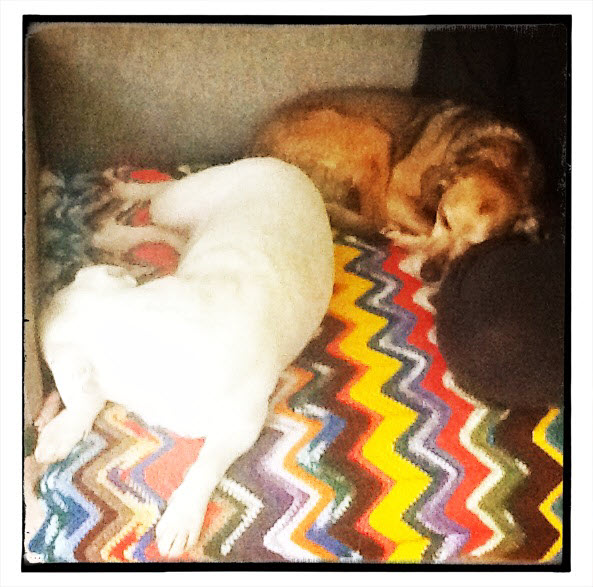
Dexter and Sadie, snoozing together, Palenville, New York, August 2012.
The weather was beautiful during the few days we were there. We hadn’t been away all summer, so our main priority was to relax and enjoy time with our friends. No one else besides me was a cyclist, I had done some serious riding the previous weekend, and I didn’t want to spend a full day away from all the people I’d driven up there to spend time with. If this all sounds like a justification for taking a weekend off without doing a long ride, it is. I know that life happens, but during training season, I have to justify, if only to myself, the handful of weekend days I choose not to train, or not to put in a lot of miles.

Niobe Falls, located on the property where we spent a weekend in Palenville, New York, last month.
My concession to myself that weekend was that we were in the mountains. Mountains, as in hills. Big ones. A few years ago, Jen and I had rented a different house in the same area near Woodstock, and while we were there, I did some hill work. As I’ve said before, when cycling up hills, I’ll slow down to a snail’s crawl when I need to, but I don’t stop. This isn’t an act of bravery so much as a survivalist mentality. Once you stop on a hill—because you’re tired, because your muscles give out, because you fall over, because the grade (steepness) is too severe, because you’re out of breath, whatever the reason—it’s even harder to start up it again on the bike. Psychologically and sometimes physically as well. When cyclists are forced to stop mid-hill, more often than not, they end up walking the rest of it.
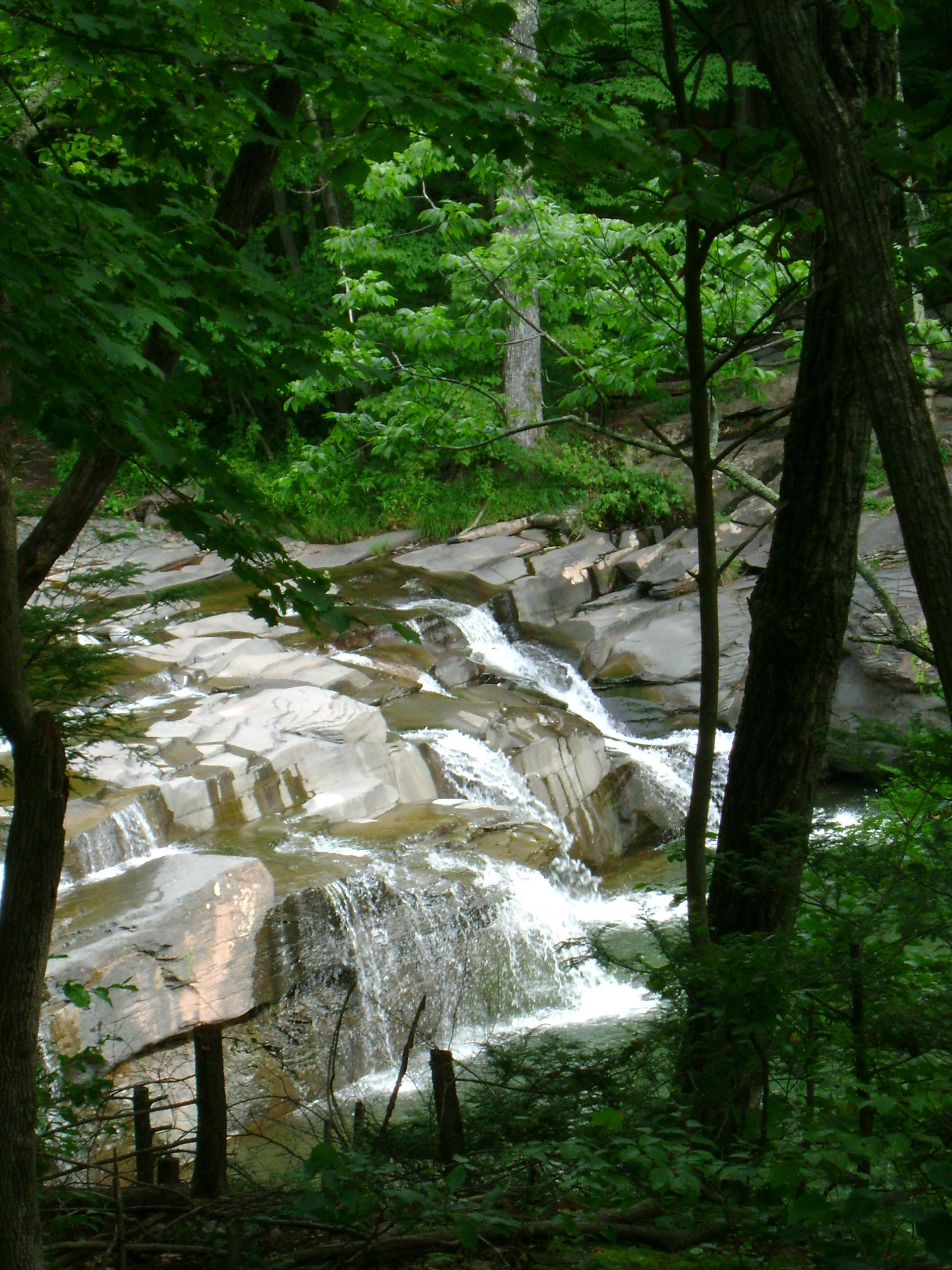
Niobe Falls, Palenville, New York, August 2012. We could hear the roaring sound of what you see here from every room in the house where we stayed.
The funny thing about the definition of failure in my world is that it only applies to me and my own endeavors and not to other people. Stopping mid-hill and walking the rest carries no stigma, no shame, and no failure—so long as it’s someone else we’re talking about. The trek I made up Meads Mountain Road in July 2010 goes up Overlook Mountain and spans roughly two miles, with around 1,100 vertical feet of climbing. I mention it now because up until last month, that was the hardest climb I’ve ever attempted—the first hill that was so grueling, I had to stop once along the way. The grade had become so steep, I couldn’t complete one of my pedal rotations, and I clipped out and had to stop before I lost my balance. I also almost fell over a second time trying to start again. I weaved and teetered for 10 to 15 feet before I was able to clip into my pedals fully and use my weight to steady myself and start the momentum of pulling myself up again. Stopping and starting again was humbling, but I didn’t end up walking any of it. I made it up to the top on my bike, and at the summit, I rewarded myself with a rest, with my admiration for the view, and then finally, with the joy of coasting down the same hill I’d climbed. In some ways, reaching the top felt even better once I got there because I almost hadn’t made it. When I looked up my route later on online, I found out the grade of Meads Mountain Road exceeded 11% most of the way, with a stretch of some 400 vertical feet with a 13% grade.

View of the valley near Woodstock, New York. Jen and I spent a long weekend here in July 2010, and while we were there, I cycled up Meads Mountain Road, a hill that almost beat me.
Even after cycling a lot for five consecutive seasons, I need a concrete point of comparison to appreciate what hill grades mean. Professionally, I come from an industry that relies on sales numbers to measure success; in that context, percentages below 50% sound small to me. They sound like nothing. Out of context, when I hear a hill has an 8% grade, that doesn’t mean much to me. The percentage is so low, it doesn’t sound too bad. To put these numbers in some perspective:
- A 0% grade is easy to fathom. It’s flat. Likewise, a grade of 1-2% is barely noticeable.
- At around 3%, you’ll start to feel the effect. While most riders will zip up inclines of 3-4% fairly easily, hills of this steepness will absorb a fair amount of their power.
- With a 10% grade, only cyclists in good shape are making it up without having to walk it, and unless they are hard-core racers, they’re struggling and using all their power to do it.
Data on some real-life hills can also help make the impact of grades more palpable and real:
- The Harlem Hill in the northwest section of Central Park is just shy of one-third of a mile, with 84 feet of vertical climbing at a 4.4% grade. It is regarded by many as the toughest hill in the six-mile outer loop of the park. Runners and cyclists do repeats of this segment for hill-training purposes. For me, it’s a good way to ease my way into the re-entry of a new training season in March and April.
- Palisades Park’s Alpine Hill, the toughest hill at the northern end of River Road in New Jersey, which I wrote about in a previous post, runs a little over a mile, with 400 feet of vertical climbing and a grade of 7.1%.

Pro cyclists making their way up Fillmore Street during the San Francisco Grand Prix in 2002. Reportedly, the climb has an average grade of 18%.
- The Fillmore Street Hill in San Francisco averages at an 18% grade. The photo above of cyclists climbing up this street was taken during the San Francisco Grand Prix, a race that was held annually for five years, from 2001 to 2005. Fillmore Street was considered to be one of the two most challenging hills in the race, whose participants included Lance Armstrong (who didn’t win during any of the five years this race existed, by the way). The other major hill on the course was on Taylor Street, and this is what top cyclist George Hincapie looked like going up it in 2002.
- The climbs in the Tour de France are slotted into five categories. From easiest to hardest, the first four are Category 4 through Category 1, and they correspond to the gear you’d need to be in to drive an old car up the hill. The toughest is Category HC, which stands for hors catégorie, or “beyond categorization,” and those are so steep, a car can’t traverse it. For some comparison, I looked into the relative levels of difficulty of the hills on the Tour. Of course, one needs to keep in mind that one major factor in the hill categorization is their length; most of these hills span between 4 and 23 kilometers, or between 2.5 miles and 14.3 miles. That said, it’s eye-opening that the average grades on most of these climbs are 6 or 7%, and the steepest portions max out at 11% and 13%.
Mind you, I don’t tend to look up hill grades before I seek out a route. It’s possible I should, but I certainly didn’t when I was in Palenville last month. That Saturday morning, I sipped my coffee and stared out the picture window at the Niobe Falls, then typed in basic search terms for local hills and cycling on my iPad. I researched only enough to discover that Platte Clove Road was seen as challenging and was only about eight miles from the house—perfect for my purposes. I could do some hill work and be back in less than a few hours. I finished breakfast, suited up shortly thereafter, took a couple of puffs on my still-new-ish asthma inhaler, and rode out.
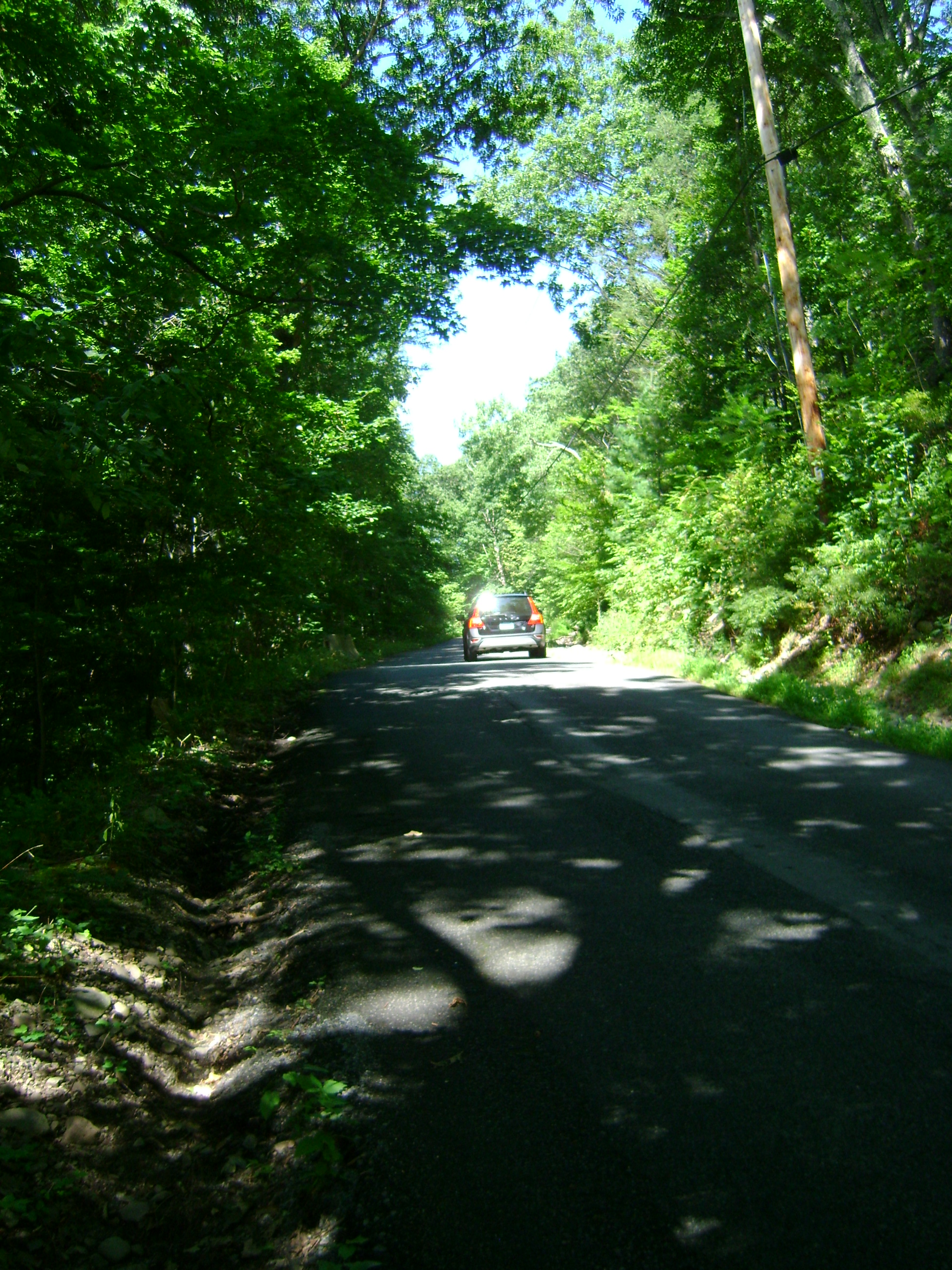
Platte Clove Road/Devil’s Kitchen, Tannersville, New York, August 2012. It’s deceptive, isn’t it? Through a camera lens, it doesn’t look that bad. But it was. And it got harder as I went.
The ride from Palenville to the base of Platte Clove Road in Tannersville is fairly forgiving, mostly flat with a few gentle inclines and rollers. The moment one turns onto Platte Clove, however, the grade shifts. At first it’s deceptively gradual. Then there is a clear point at which the suburban looking houses that are spaced closely together for the first mile stop, the forest tree line begins, and the road grade shifts upward dramatically. Even though the road is paved, there’s no mistaking the fact that you are climbing a mountain. For most of the way up, Platte Clove has no shoulder on either side; it’s just wide enough for two cars to pass each other driving in opposite directions, and in certain places, even that looks iffy. The asphalt ribbon of the road twists and turns, and the overall trajectory and grade shifts move continually up and up, so you can’t gauge how far you are from the peak of a given hill segment much less from the summit. What appears to be a brief crest and decrease in grade turns out not to be.
I didn’t know any of that before I attempted Platte Clove Road. I noticed one or two seasonal signs as I rode: The road is so narrow, so winding, steep, and difficult to navigate that it is closed to all traffic between November 1 and April 15. That was all I knew.
Platte Clove Road beat me. It didn’t take very long either. I was less than a mile into the mountain segment of it before I had to stop. The incline felt more like a wall than a mountain road. I was so short of breath, I thought I’d hyperventilate. Sweat stung my eyes and dropped from my chin, from my elbows. I let myself stand there at the side of the road for long enough to catch my breath, and then I tried to continue. Unlike my Meads Mountain Road climb, however, I couldn’t get going again. I tried, I weaved, and I started to fall over, along with my bike. I couldn’t get enough power to fully rotate the bike pedals.
I don’t know why I didn’t turn around. Stubborn and willful, I begrudgingly walked up the incline instead, for 10, 20, 30 feet. I felt terrible—hot, breathless, exhausted, achy, disappointed. Even pushing my bike while walking up the hill kept me panting. As I walked, I made myself think of all the BTC cyclists I knew who had had to walk up some or all of Mount Archer in East Lyme, Connecticut. I thought of the novice riders I’d seen stopping and walking Harlem Hill, and Alpine Hill, and the tough climb along Route 9W going south out of Piermont, New York and up to the New York-New Jersey state line. They did what they could and stopped when they had to—and then they kept going. They weren’t failures to me, and the world didn’t come to an end when they walked it.
The part that I hadn’t expected was that while the hill didn’t end, or even flatten really, the steepness did ease off ever so slightly. It hadn’t occurred to me that I might walk a portion of the climb, then get back on the bike and cycle up some more of it. I thought, “Maybe that was the worst of it.” I kind of knew I was kidding myself, but at that point, I was willing to say anything to myself to find a way to keep going. When the grade decreased, I got back on the bike and to my surprise, I was able to make a go of it.
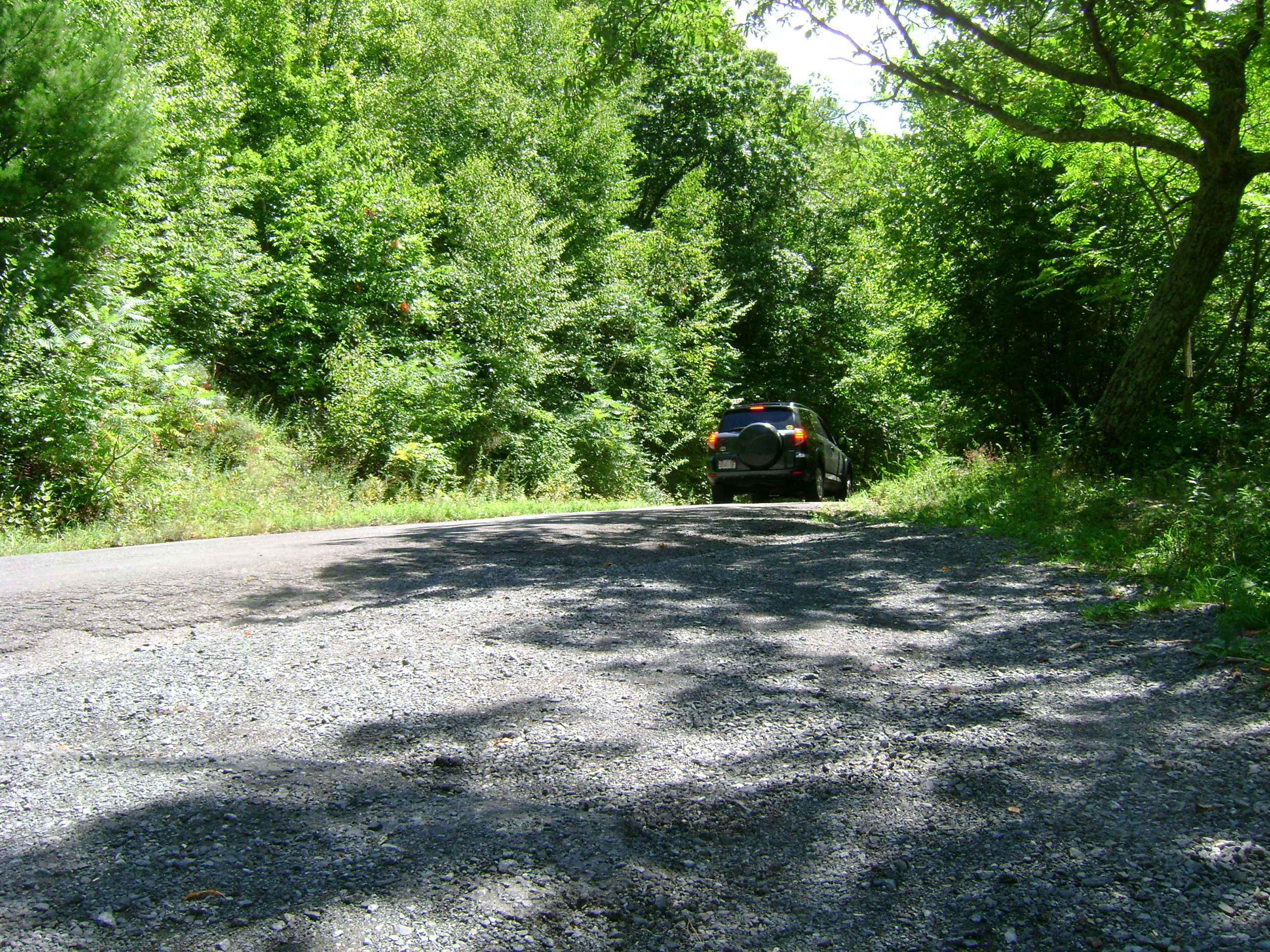
Higher up on Platte Clove Road/Devil’s Kitchen, Tannersville, New York, August 2012.
The satisfaction and relief were short lived. Less than a few minutes later, I had to stop again and get off my bike. This time, I had to pull over to the little ditch on the inner side of the road, and I stayed put for several minutes to catch my breath. A number of cars zipped by, wheezing their way up, most of them taking the curves too fast.
At that point, a big part of me wanted to say, “Fuck it. This hill beat me. I’m done.” I was almost in tears, possibly as much from physical exertion as from disappointment. My lungs were on fire. I looked at my odometer; I was only about nine or 10 miles from the house. I was plagued by the thought of not finishing what I’d come there to do.

Still higher on Platte Clove Road/Devil’s Kitchen, Tannersville, New York, August 2012.
But another part of me was curious. What if I walked a bit, until the steepness dissipated again? Would I be able to climb further? How high could I go using this painful stop-and-go method? Even more, how long would my self-esteem hold out? How much ego-bruising could I stand? Conversely, what might it feel like to keep going in assuming failure, knowing failure, embracing failure and physical pain, repeatedly? What it would be like to sit with and in the belly of disappointment, and still keep going? Would it feel more like failure to stop, rest, and walk again? What if I could continue to walk a bit, then ride a bit, then walk a bit if I needed to? What would happen to me?
I won’t lie. Most of the journey continued to feel lousy. My legs hurt from pedaling uphill for what felt like years. My arms hurt from trying to use my grip to gain some forward stability and momentum. My head ached. I was drenched with sweat. My bike felt like an anvil weighting me down. I felt as small as I ever have.
I did have to stop again. Three times? Maybe four? I don’t recall.
It’s hard to reconstruct what I was thinking as I plodded along. My mind may have drifted off to a Zen place where what was right in front of me was all I could focus on. On some less conscious level, I think I was testing my own dueling senses of agency and despair, as well as my physical limitations. I wanted to allow myself the space to fall short and to choose to sit with whatever that brought—discomfort, sadness, self-doubt. I haven’t been adept at giving myself that latitude and that freedom in other areas in my life. I wanted to do it, not because I wanted to suffer, but because I needed to know I could, and that afterward, I could still pick myself up and start again.
This all seems very obvious in the telling. Like something out of a self-help best-seller I’d never read. Knowing what’s meaningful and true and wise is one thing. Living it is far harder and the journey is more elusive.
People who are battling serious illness have to live some version of Platte Clove every day. The difference is they don’t have the option of getting off whatever rocky, merciless mountain road they’re on in favor of terrain that’s softer on their bodies and their spirits. They get to choose how to face it, battle it, and bear it. They get to choose who and what brings them a level of peace and grace as they traverse a hard, long journey with no maps and little comfort. That’s all. And they get to make those conscious decisions over and over again. That’s real bravery.

I didn’t know I had been in the Devil’s Kitchen until after I finished trying to climb it.
On my way down Platte Clove, the angle of the path was so bumpy and severe, I had to ride my brakes to slow myself down in order to not lose control of the bike. Even the downhill on this one wasn’t any fun. My body stayed tense until I made the left turn back onto the road leading back to the house.
About halfway back to the Waterfall House, I passed a copse of trees, and two deer bounded out to say hello, a doe and her fawn. That was the loveliest moment of the whole ride.
Later on, I did further digging online about the route I’d taken. I found out that the alternate name for Platte Clove Road was Devil’s Kitchen. It spans 2.2 miles and the climb is 1,280 vertical feet, 1,400 if you begin farther east. One website described it as “quite possibly the most hellacious climb in New York State, and one of the most difficult climbs in the Northeast, with over 1,200 feet of climbing, most of it steeper than 12% grade. Several sections exceed 22% grade.” Pro riders in the Tour de Trump reportedly ended up walking sections of it. The short video above is of pro riders making the climb during the Tour of the Catskills race.
How was the view from Platte Clove when I stopped? As breathtaking and beautiful as it would have been if I had sped all the way up:
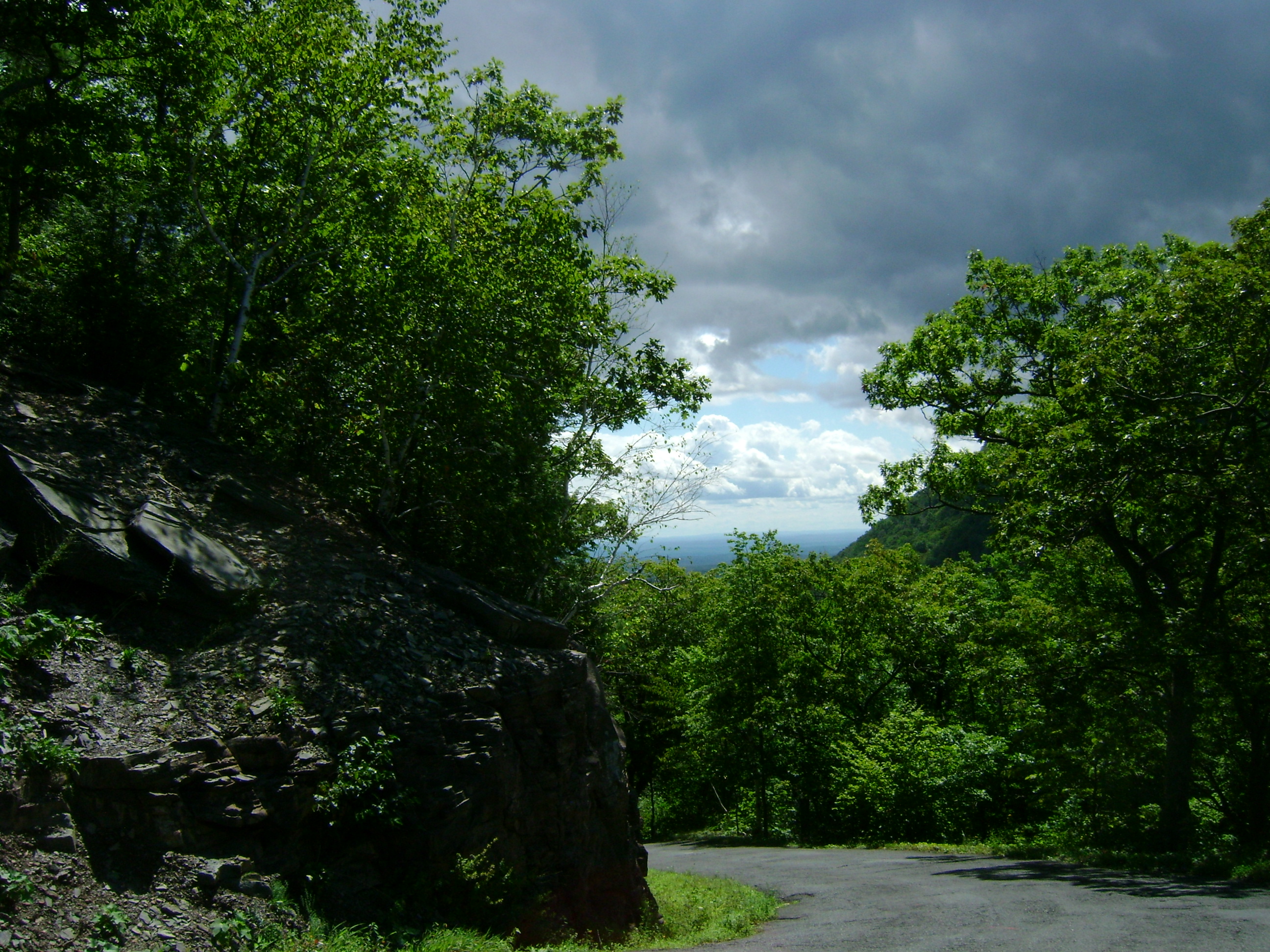
The view looking down Platte Clove Road/Devil’s Kitchen, Tannersville, New York, August 2012. This photo doesn’t do it justice. The little bluish strip under the bright spot in the sky at the center of the image is the expanse of the Hudson valley, which was visible for miles into the distance from where I was standing.
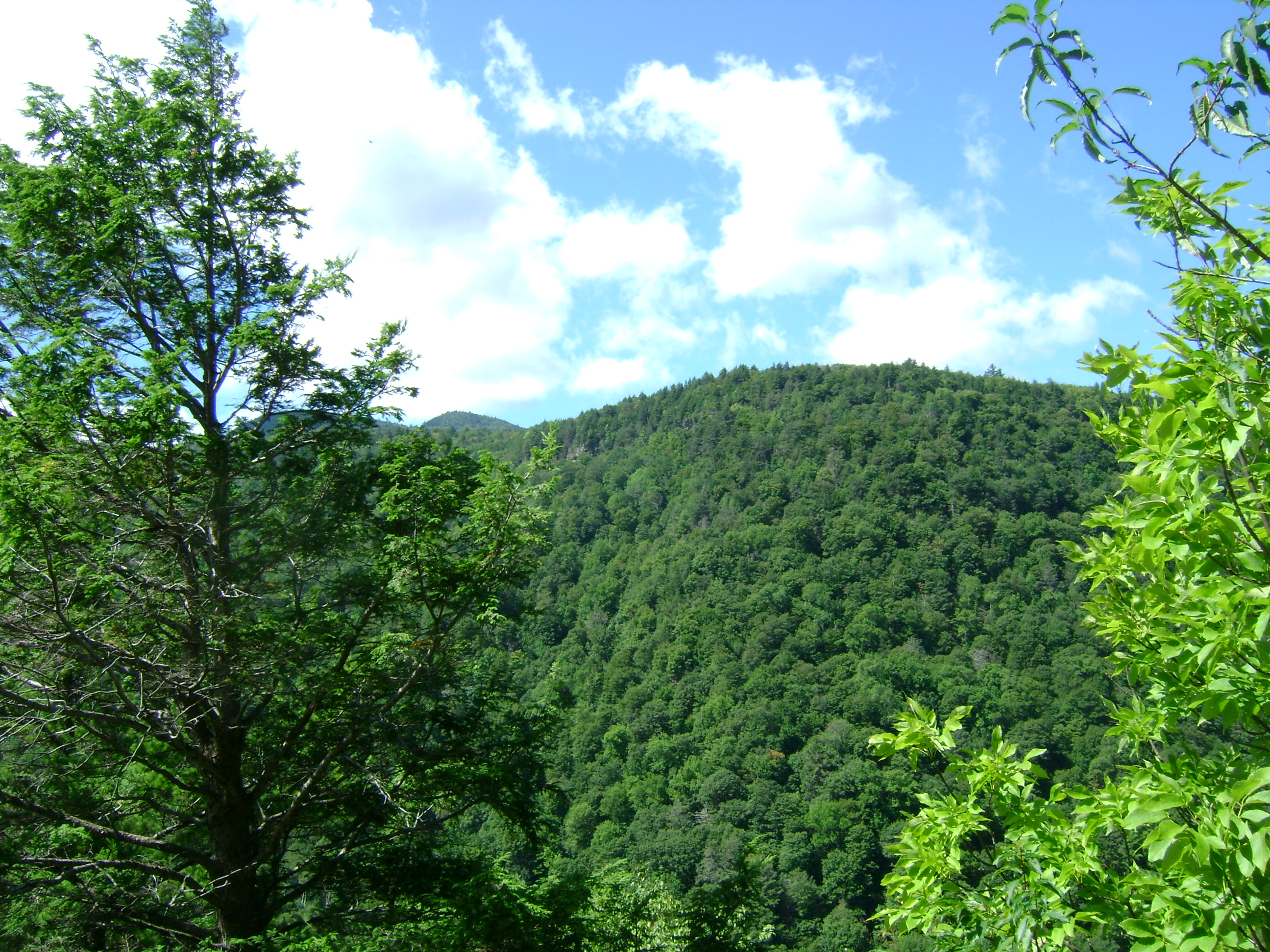
View of the neighboring mountain, from Platte Clove Road/Devil’s Kitchen, Tannersville, New York, August 2012.
Sources:
- New York Cycling Club list of regional hills, with distances and grades
- http://www.kenpapai.com/racing/sf2002/
- http://www.podiumcafe.com/2012/7/5/3134330/2012-tour-de-france-mountains-preview
- http://www.catskillsearch.com/site/2012/04/30/platte-clove-road-devils-kitchen-signs/
- http://capitaldistrictclimbs.blogspot.com/2010/10/platte-clove-road-devils-kitchen.html
- http://thehudsonvalleyrandonneur.blogspot.com/2012/08/climbing-through-devils-kitchen-platte.html
 The Blue Streak
BEAUTIFUL pics, SC and a GREAT story!!! Ride, Cupcake, Ride!!!
Great story. Enjoyed your telling quite a bit.
Mika, your post is awesome bravery. I am equally proud of you when you walk up a hill as I am when you ride it up, down, or coast. Failure is only a state of mind. I am even more proud of you when you write about your journey so eloquently. Love you forever, Mom
Well done..good story. Denis here…..Susans partner….your parents friend….a fellow cyclist. You’ll soon come to learn (actually you already know), that we cyclists always make it up the hill. We’re always successful. We don’t get beat. At times we might have to walk it but we don’t get beat. And because we continue to get up the hill and refuse to get beat, we get better at it. You’ll never have to fear another hill climb because you’ll always get to the top.
Hi – I came upon your blog looking up Devils Kitchen as I am going to ride it tomorrow as I need to go down to NYC area. I live in the Berkshires and hills are a way of life for us. Gearing is everything – I was wondering if that might have been one of the challenges you faced. Up here most of us have compact setups and some pretty large cassettes on the back so 15% and up is doable. That hill on an off the shelf setup would have anyone walking.
Hi, Thanks for writing, Bill. You’re quite right that some gearing modifications probably would have helped. I also applaud and admire your Berkshire hill prowess. My trek through Devils Kitchen last year was unplanned, and although I don’t live anywhere near there, one of these days, I’d like to attempt it again. How did your ride up Devils Kitchen go? -Mika
Great post. And thank you for the data on my two local hills! (Harlem Hill and Alpine Hill)
Thanks so much! Glad to hear it was helpful, and great to hear from you.
Any idea what the grade is on the two mini hills leading from the West Side Greenway (where the Little Red Lighthouse is located) to where you approach street level in Washington Heights? There’s the first one, it flattens out for a bit, then there’s the second one…
I know exactly the hills to which you’re referring here. I don’t have precise confirmable data on those grades. But based on my own memory of having climbed both and comparing them to the grades on both Harlem Hill and Alpine Hill, if I had to guess/estimate: I’d say that the first hill, which is the lesser of the two, is probably comparable to parts of Harlem Hill, probably the first, slightly less steep incline when you begin Harlem Hill. The second one, after it flattens out for a bit, while short, is, in my memory anyway, steeper than even the steepest section of Alpine Hill. Plus there’s that annoying little windy twist in it to that makes it even harder to keep the upward mometum going, especially if someone is coming the other way. Hope that helps at least a bit.