
Dennis was the first person I knew who was HIV+. He is also the first person I knew who died of AIDS.
I was nearly 15 when Dennis became ill. I don’t even know how long Dennis was sick before he died. My hazy memory and my instincts tell me it wasn’t very long.
In point of fact, I didn’t and don’t know much about Dennis first-hand, except that he was a constant in the thread of my family’s history while I was growing up. He was a journalist, and he spent most of his adulthood traveling the world, hopping from one political conflict and hotspot to the next to report on what was happening. So I didn’t see him often, but I had known him my entire life. Dennis was one of my mother’s best friends from childhood. My mother, who was born in Bucharest, had only two friends who date back to that early part of her life. Dennis was one of them. When the two of them got together in person, the air was filled with a dizzying barrage of Romanian. My mother has no siblings, and Dennis as close to an uncle as I ever had on that side of the family. Which is what he was, really. Family.
My mother could say a lot more about who Dennis was than I could and has enough personal memories of him to make up a book. These are the things I know about Dennis:
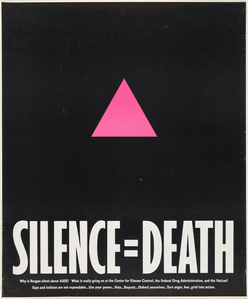
Silence = Death ACT UP poster, c. 1987-1995. Courtesy of New York Public Library Digital Gallery.
- He was funny.
- His full laugh was a high-pitched giggle that went on and on and somehow gave everyone in the room permission to laugh no matter how silly it sounded.
- He was fiercely intelligent.
- He loved politics and debating.
- He loved holding court with people.
- He had secrets. Before moving into journalism, he worked for the State Department. He was often evasive about where he was going for work and why. But it seemed that wherever major political trouble was brewing, there he was. I remember my mother musing that it wouldn’t surprise her at all to discover Dennis was some kind of covert ops spy.
- He knew many languages.
- He seemed to know everyone and have friends everywhere.
- He wasn’t handsome, but he had a kind face.
- He loved to have fun. One of my few concrete memories of Dennis takes place at a party. I remember Dennis’ insistence on dancing, even though no one else was.
- He was closeted, both about his sexual orientation and later on about his HIV status.
- No one talked about Dennis being gay.
- No one talked openly about the cause of Dennis’ mysterious illness when he got sick. His obituary in The New York Times was three paragraphs long and said he died of cancer.
Dennis was 37 years old when he died. I am nearly three years older than that now. If he had a romantic partner, his obit didn’t mention it.
A lot of things were different in December 1987:
AIDS and HIV had been around for six years, since 1981.
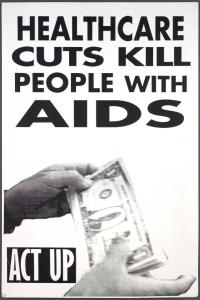
An ACT UP poster, c. 1987-1995. Courtesy of New York Public Library Digital Gallery.
President Ronald Reagan had been in office since 1981.
By December 1987, 71,751 cases of AIDS had been reported to the World Health Organization. The greatest number, 47,022 (65.5%) were reported by the United States. Both those figures are cumulative, since the first cases of the disease were reported in 1981.
When you contracted HIV in 1987, you were pretty certain you’d not only die, but die relatively quickly.
AZT, the first antiretroviral drug to treat AIDS, had only been FDA-approved for nine months.
ACT UP (AIDS Coalition to Unleash Power), the influential advocacy group devoted to working on behalf of people with AIDS and to shaping public policy, medical research, and treatment for the AIDS pandemic, had only existed for nine months.
The American Foundation for AIDS Research (amFAR) had only existed for two years.
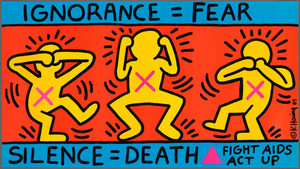
Silence = Death, Keith Haring, 1989. Courtesy of New York Public Library Digital Gallery.
Artist Keith Haring was still alive and would be for another 27 months.
Housing Works, this year’s Braking the Cycle beneficiary, had not yet been founded.
Gay rights activist Cleve Jones made the first panel for what would become the AIDS quilt, in memory of his friend Martin Feldman.
April 1, 1987, marked the first time Reagan gave a public speech on the disease.
Reagan’s second major address about AIDS was given on May 31, 1987, at a dinner honoring the American Foundation for AIDS Research (amFAR).
Abstinence and morality were emphases in both of Reagan’s speeches.
Even if Reagan’s claim on May 31 that “spending on AIDS has been one of the fastest growing parts of the budget,” was accurate, it was because there was nowhere for the numbers to go but up. The proposed allocated monies for AIDS in 1987 was $416 million, and only half of that was at the urging request of the Reagan Administration; Congress requested the other half.

United States government federal budget, 1987. Federal funding for AIDS accounted for .0038% of the total health budget for that year and .000416% of the overall federal budget.
Without any context, $416 million might not sound so bad. To put it in perspective, total federal spending on health that year was $110 billion, 11% of a $1 trillion ($1,000,000,000,000) federal budget. What that means? The federal budget’s spending in 1987 on AIDS, which Reagan boldly pronounced to be “Public Health Enemy #1,” accounted for .0038% of the federal government’s spending on health and .000416% of the overall federal budget. So little it wouldn’t even show up as a sliver on the pie chart reproduced here.
Federal defense spending in 1987 was 33% of the budget, or $330 billion.
People were so scared of HIV at the time and the ignorance about how one got it was still so common, many were afraid to touch with someone with HIV. Which is why it was a big deal that in 1987 UK Secretary of State for Social Services Norman Fowler became the first person to publicly shake hands with an AIDS patient. Even some of the educated, knowledgeable friends and family of those with HIV or AIDS were terrified they would contract it because at some point, they’d kissed the patient on the lips as a social greeting.
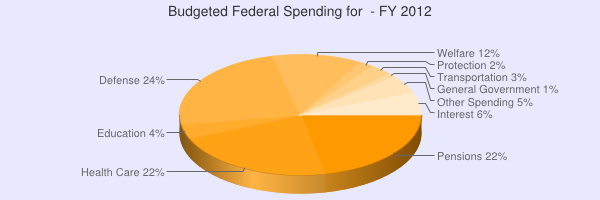
United States government federal budget, 2012. Federal funding for AIDS accounted for .034% of the total health budget and .0075% of the overall federal budget.
It’s 2012. Federal spending on health today is 22% of a budget of $3.8 trillion, or $836 billion. Of that, some $28.4 billion is being spent on AIDS and HIV, for both domestic and global activities combined.
Compared to where we were in 1987, that’s a huge leap. And yet: That’s a mere .034% of the health budget and .0075% of the overall federal budget.
Today, the reports that are released each year tout the fact that the annual rate of new HIV infections in the U.S. is relatively stable, as opposed to increasing each year. This is regarded as the good news. It is good news, but that number isn’t a reason to celebrate when you examine the historical trajectory either. Some 50,000 Americans become newly infected each year. That stable annual rate is bigger than the total number of AIDS cases reported in this country by the end of 1987.
Here is a fact that’s neither good news nor bad news, and after 31 years, it’s not even news at all: We still have a long road and a lot of work to do.
Sources: PBS Frontline; federal budget spending data from usgovernmentspending.com, 1987 and 2012; AIDS.gov; AIDS/HIV data from The Henry J. Kaiser Family Foundation.
 The Blue Streak
Here’s to you, Mika!
i was touched by your memories of dennis — i became friendly with him in 1980 when were were young foreign service officers preparing to go on assignment in latin america. we would frequently lunch together at this little cafe run by a rumanian couple in the basement of a rosslyn office building located near the foreign service institute where dennis introduced me to the delights of mamaliga and other unfamiliar dishes. he was a great raconteur and extremely charismatic though not handsome in a conventional sense. i never knew that he was gay or even suspected it for that matter. i do know that many women found him very attractive and even compelling — in that respect he was something like his father — whom i met when i was stationed in santo domingo and who was an amazing man with a very interesting past. after meeting his father, i realized that dennis did not fall too far from the tree in that respect. i wish that the state department could have been more welcoming to someone like dennis– who was so bright and talented and had so much to offer.
Pingback: HIV/AIDS: Good News, Bad News, Red Fish, Blue Fish, Loveship, Courtship, Pos-Ship, AIDS-ship, Sickship, Oldship, Deadship | The Blue Streak