
…the ability to create something sometimes is a medicine in itself.—Curtis Wheeler
I know Curtis Wheeler, an African-American artist, through my brother Jacob, who spent three years, from 2000 to 2003, making a documentary short film about Curtis and his life. The film follows the final three years of Curtis’ life as he battled AIDS. When they met, Jacob was still in film school at NYU’s Tisch School of the Arts, and Curtis was then living at Rivington House, a health care facility for AIDS patients on Manhattan’s Lower East Side. They became fast friends and had known one another about a year before they decided to make a film together. Curtis’ goal at the time—and what became the goal of the film my brother made about him—was to be able to heal enough to leave Rivington and return to his home, a 17-room mansion in a historic district of Washington Heights, so that he could continue to live an independent life and to paint.
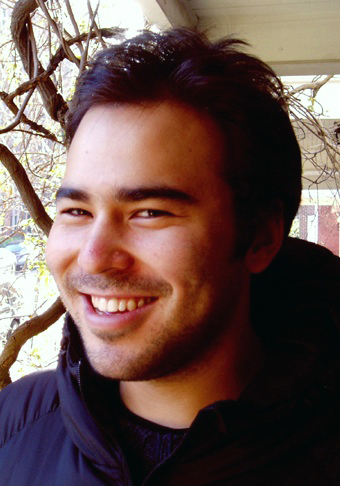
My brother Jacob Okada, who became Curtis Wheeler’s friend and made an award-winning short documentary film about the last three years of Curtis’ life.
I only met Curtis in person a handful of times, at Rivington House. What struck me about him is that he seemed to embody the ordinary and the extraordinary at the same time. The first time I met him, while I was visiting, I watched him get his hair cut—an everyday act that on the one hand is as mundane as it gets and is also oddly intimate. The scissors, the clippers, the towel, the cape draped around his neck to keep hairs from getting all over his clothes, the snippets of hair strewn in a halo on the floor around him as the hair stylist did her job. We talked about nothing and everything, him, my brother, his life as an artist. What I recall most about Curtis is that he was vibrant, philosophical, strong-willed, intelligent, colorful, and wickedly funny, all of which came through even as his physical body was deteriorating.
I also remember, with equal amounts of amusement, affection, and sadness, that he once asked me to get him a meal from one of the takeout joints down the street. Because he was sick to death of the monotony of the menu at Rivington. He was grateful for the care and kindness he received there, to be sure, but no one likes bland institutional food, and Curtis had been living there for ages, so one can hardly blame him. I went out for Curtis and brought back some Chinese; it was easy enough for me to do, so I did it—I was gone maybe 15 minutes and that was that. He thanked me, and I visited with him while he ate. It was such a small thing, this request, this favor, and yet the poignancy of it stayed with me. Perhaps because I was a near-stranger. The errand itself was easy and small and unremarkable, but the fact of his asking me said volumes. How strange our dependencies become when we are ill. How large even small acts of kindness can become. How one must rely on others, sometimes those we barely know or will never see again. How asking for help becomes something that’s necessary, likely even, nearly every day, even in those of us who are fiercely independent by nature. How the armor we usually use to hide our deepest vulnerabilities seems to fall away.
Curtis led many, many lives prior to his HIV diagnosis and the start of his illness—so many that the description of his bio almost sounded too fantastical to be real. Dancer. Teacher. Painter. World traveler—Curtis had traveled almost everywhere, through all of Europe, Russia, parts of Asia. My brother tried to describe Curtis’ love of the Italian Renaissance masters and how that showed up in his own painting to me. It wasn’t that I didn’t believe Jacob when he said it, but all the biographical facts of Curtis’ life seemed to contain some mythic element of the fantastical, the spiritual, an otherworldliness.

Michelangelo’s David, Florence, Italy. This Renaissance sculpture masterpiece is the sort of art Curtis studied and loved.
Those facts would have sounded pretty extraordinary even if Curtis hadn’t been slowly dying of AIDS when I met him. But I think their fairy-tale-like hue was amplified by how much they contrasted with his present-day life battling illness and just trying to get through the day, the week, the month. I didn’t consciously think it at the time, but those same aspects of Curtis’ experience—his extensive knowledge of European art and dance, his fierce intellect and passion for books and learning, the searching quality and curiosity that rose up out of so many of his conversations—bore no resemblance, seemingly no connection to the grim, earthbound realities of the setting in which I met him. On one level, of course I knew that HIV and AIDS happened to all sorts of people leading full, rich, interesting lives—not to one-dimensional stereotypes. And yet some part of me had trouble reconciling the exciting, mysterious past Curtis had led with the present-day one.
Curtis’ life was all those things—fantastical, unusual, spiritual—and yet on the most literal level, he had also done all the things and seen all the places my brother had said he had. His house in Washington Heights, which is where the photograph of him reproduced here was taken, teemed with books, sculpture, ornate furniture, art of all kinds. The way in which Curtis decorated the walls and floors of his 17-room home with his drawings and paintings seemed his artistic homage to all he had experienced in the world—and he had experienced a lot. It was as if he needed to create something outside himself, to heal his own spirit if not his body, something visual to show that all his past callings and journeys and memories, and his art in and of itself, were, in fact, the core of the fabric of his life and his being, as much his life as all the present-day rounds of dialysis he had to undergo, as the smokers’ room and Bingo Night at Rivington, as the Chinese takeout meal I delivered to him in a flat styrofoam container, with different depressed compartments in the tray for the rice, the main dish, the sauces, the egg roll.
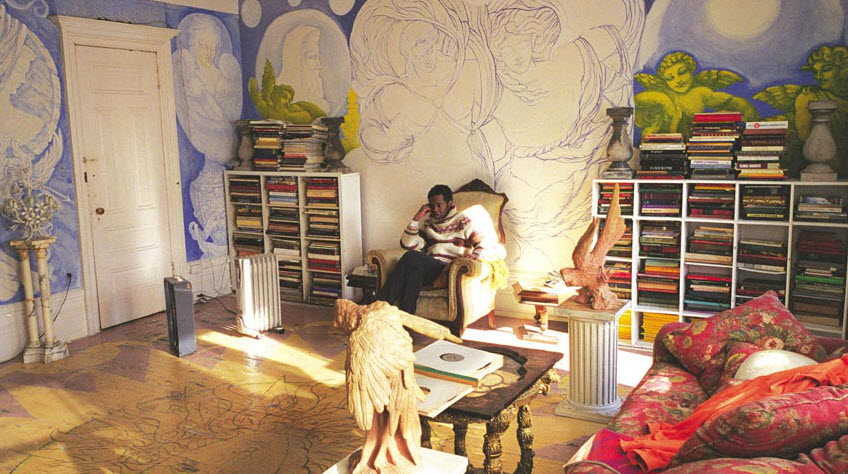
Curtis Wheeler, an African-American artist battling AIDS, in his house in Washington Heights, c. early 2003. This image is a film still from director Jacob Okada’s documentary short film Curtis (2003). Image appears courtesy of Jacob Okada.
The film Curtis was completed in 2003, and the final 33+-minute cut was finished the same day Curtis died. Fortunately, my brother had shown Curtis a close-to-final cut of the film before he passed away. The film aired multiples times on PBS, and it went on to the 2004 Sundance Film Festival and received an Honorable Mention in Short Filmmaking there. For those interested in additional background about the making of the film, an interview my brother did with Asian American Film appears here.
Curtis wasn’t the first person I knew with HIV or the first I knew who died from it. Nor was he the last. But both meeting him and later, in 2003, watching my brother’s finished short film about him brought some of the stigma and loneliness of HIV and AIDS home for me in new ways. Because while the film Curtis is about AIDS, to be sure, above all else, it reflects Curtis Wheeler as a complicated, insightful, multifaceted human being. Not an anonymous HIV statistic. Or a stereotype of whatever kind—black, male, gay.
Everyone who lives with HIV has a unique story. Everyone who dies from AIDS-related causes has a unique story. These people aren’t numbers. They don’t fit neatly into one-dimensional stereotypes that the rest of us can use to distance ourselves from the disease, its reach, and its brutality. Part of Curtis’ legacy is that he got to share some of his individual story and his self, and all the corresponding vulnerabilities, before he died, and it got documented, which will extend the sharing of that story in the years to come. He was lucky in that regard, the same way that he was lucky to have discovered and explored an inner well inside himself where he could find solace and healing though creating art, and he knew it. He also recognized that many others like him who are dealing with HIV and AIDS don’t have any of that.
Having known Curtis, however briefly, and riding for him reminds me of all those things—of the therapeutic power of creative expression, of how distinctive each human set of experiences is, and at the same time, of how equally important it is to acknowledge the elements of humanity we all share.
I’m grateful to Curtis for those things. I also wish he was still here.
 The Blue Streak
Sometimes you break my heart…and that is a good thing because it proves to me that I do, indeed, have one…
Pingback: HIV/AIDS: Good News, Bad News, Red Fish, Blue Fish, Loveship, Courtship, Pos-Ship, AIDS-ship, Sickship, Oldship, Deadship | The Blue Streak
I was a friend and classmate of Curtis. We shared a lunch table everyday. He was funny, way talented and a very sophisticated character. I remember him answering a question in our English class. Who was the character missing from a Shakespeare play? Curtis piped up loud and clear: “The prostitute with the heart of gold!” The class erupted in hysterics. That was my intro to Curtis. I’d love to see this film. Where is it available?
Hi Robert, thanks for commenting and saying hi. That’s a great Curtis story; thank you for sharing. Yes, the doc film is now viewable for free on YouTube for free:
Meant to include the link https://youtu.be/U84v2hJ7APc