On Hope, Uncertainty, and an AIDS-Free NY by 2020

In less than two months, once again, I’ll be participating in BRAKING AIDS® Ride, a 300-mile bike from Cooperstown to NYC. Between now and mid-September, I have two objectives: to get into some semblance of shape for the physical challenge of the ride and to raise $20,000 to support the amazing advocacy and services provided by Housing Works, the ride’s beneficiary.

Since my first year doing this ride in 2008, individual donations from people like you have been essential in helping me raise over $100,000 and counting to support life-saving services for those living with HIV as well as its efforts toward ending the AIDS epidemic once and for all. I’m counting on the support of hundreds of individual donors again this year to raise at least another $20,000 to end AIDS as an epidemic in New York by 2020.

Photo: Me on Day 1 of BRAKING AIDS® Ride 2018, by fellow rider Kyle Cameron. The photo later appeared as the Contents photo spread in the Nov./Dec. issue of Positively Aware magazine, which was pretty fabulous. 

As someone who worked at Housing Works for five years, I have seen firsthand how its programs and services make a concrete difference. Since its 1990 founding, Housing Works has provided services to more than 20,000 homeless and low-income New Yorkers living with HIV/AIDS. Unlike many HIV service providers, which tend to focus on one or two primary areas of service, Housing Works offers a startling array of programs that help address the overlapping, intersectional issues faced by its clients: In addition to housing, services include primary healthcare, meals, case management, nutrition, substance use treatment, legal assistance, and job training, as well as relentless advocacy at the city, state, and federal levels to fight for funding and legislation that will help us end AIDS once and for all. It also offers those services with respect and compassion, a context that is essential to healing but all too rare.

I began doing this ride in 2008 in memory of two family friends who died of AIDS-related illness in 1987 and 2003, respectively, and for many close friends who live with HIV. For BRAKING AIDS 2019, I am riding in memory of two friends who died this past year whose lives epitomize compassion and citizenry in the best senses of both words.

My friend Dawn Grimmett (1975–2019), a pediatric nurse who lived in Alabama, died unexpectedly this last April from complications from pneumonia. If we hadn’t both participated in AIDS rides, I might never have met Dawn—and I am lucky to have known her. Dawn was funny and kind. A giver of tremendous hugs and fierce loyalty. One had to pity anyone foolish enough to say a bad word about the people Dawn loved; as she herself put it, “I might look nice, but I’ll cut a bitch!” She also led by example: She was open and candid that she struggled with depression, which even today comes with so much stigma despite how common it is. Without fail, every year since 2004, Dawn traveled across the country to dedicate two weeks’ vacation to being a volunteer nurse on the crew for two different AIDS Rides—California AIDS LifeCycle in June and BRAKING AIDS® in September—dispensing Advil, Band-Aids, Gatorade, ice packs, sunscreen, and whatever medical care was needed, along with unconditional love, and just the right amount of snark. Her life, which ended all too soon, two months shy of her 44th birthday, is a testament to the power of showing up. Dawn reminds me that some of the most important and significant gifts to fellow human beings and contributions to a movement are comprised of mundane, ordinary, and often quiet acts of kindness. The impact of those acts are cumulative, and a commitment to those compassionate acts is the stuff that long-term change is made of.

Photo: This year, I will be riding in memory of my friend Dawn Grimmett (1975–2019), who was a volunteer nurse on every BRAKING AIDS® Ride I have ever done.

My friend Andy Vélez (1939–2019), a longtime LGBTQ and ACT UP New York activist, passed away on May 14 at age 80 after a severe fall in his Greenwich Village building earlier this spring. Andy joined ACT UP in 1987, the year of its founding, back when AIDS was a death sentence to so many, the downward spiral of the illness itself was ugly and painful, treatments were toxic and few, and our government leaders had been ignoring the burgeoning epidemic for six years. Andy was a devoted and fierce activist for 32 years, and his passion for and tenacity in undertaking righteous lifetime activism inspired and continues to inspire countless individuals, myself included. The friendship we developed during a relatively finite number of years of coalition activism together was and remains dear to me, and I miss his kindness, his delicious stories, his wicked and bawdy humor, and his authenticity. To read more about Andy’s remarkable life, check out the tribute that appeared in the Los Angeles Blade, as well as this piece in PLUS, “Why We Still Need HIV Warriors.”

Photo: This year, I will also be riding in memory of my friend Andy Vélez, a longtime LGBTQ & HIV/AIDS activist who passed away in May. In June, ACT UP New York created these buttons, featuring a portrait of Andy by Bill Bytsura of The AIDS Activist Project, in honor of Andy’s lifetime of fierce, relentless activism.

You don’t show up for 32 years of activism unless you have some faith and hope that what you’re doing will make a difference, whether you yourself are able to see that difference or not. Andy’s life is a reminder of that for me. It’s a reminder to heed what writer Rebecca Solnit says about hope:

“Hope locates itself in the premises that we don’t know what will happen and that in the spaciousness of uncertainty is room to act. When you recognize uncertainty, you recognize that you may be able to influence the outcomes — you alone or you in concert with a few dozen or several million others. Hope is an embrace of the unknown and the unknowable, an alternative to the certainty of both optimists and pessimists. Optimists think it will all be fine without our involvement; pessimists take the opposite position; both excuse themselves from acting. It’s the belief that what we do matters even though how and when it may matter, who and what it may impact, are not things we can know beforehand. We may not, in fact, know them afterward either, but they matter all the same, and history is full of people whose influence was most powerful after they were gone.” [emphasis mine]

I’m not usually good with uncertainty. In fact, I struggle with it. All the time. But BRAKING AIDS® and the example of people like Dawn and Andy challenge me to challenge myself to find that “spaciousness” Solnit describes.

When asked what he wanted to be remembered for, Andy once said, “As someone who is able to help.” I’m riding again this year because I am able to, and in that same spirit, I am asking for your help to support my efforts. Together, we can end AIDS.

Please DONATE TODAY. Donations of all sizes are welcome, but a gift of $200 or more will go a long way toward reaching my $20,000 goal. A $200 gift feeds 100 homeless youths at Housing Works’ East New York Health Center.   

DONATE VIA MY FUNDRAISING PAGE: https://give.classy.org/mika2019 

Photo: Me, wearing the Japanese ACT UP “Silence + Death” tee-shirt that Andy Vélez gave me several years ago as a gift, with my wife Jennifer at the Dyke March for NYC Pride 2019, which was also the 50th anniversary of the Stonewall riots.

Help Me Raise $15K for Housing Works & an AIDS-Free NY 2020

It finally feels like summer in NYC again. For me, a June heatwave means it’s long past time that I jumpstart my training and my fundraising for BRAKING AIDS® Ride.

Over the past decade, past donations from hundreds of generous souls have been essential in helping me raise over $90,000 and counting to support Housing Works’ many life-saving services for those living with HIV as well as its efforts toward ending the AIDS epidemic once and for all. 

I’m counting on that support again this year to raise at least $15,000 to end AIDS as an epidemic in New York by 2020.

WHY I KEEP RETURNING TO BRAKING AIDS® RIDE


Me, with some of my amazing Housing Works Advocacy colleagues and friends, who inspire me every day (L to R): Valerie Reyes-Jimenez, Legacee Medina, me, Felicia Carroll. 
For the first time since the AIDS crisis began, we have the tools to end the epidemic. More than six years ago, when the audacious goal of ending AIDS as an epidemic in New York, even without a cure or vaccine, was first proposed by Housing Works, Treatment Action Group, and other allies, many people thought it was impossible, and the Governor’s Office and the State Department of Health were not yet sold on the idea. Since then, Housing Works has provided unparalleled leadership to get New York to adopt a plan that makes full use of the tools we have to end AIDS as an epidemic statewide by 2020. At the time of the state plan’s launch in 2014, in the course of educating people about the plan and its feasibility, we said, “an AIDS-FREE New York is closer than you think…” We weren’t kidding. This past December we marked major milestones in the state plan to end AIDS: unprecedented city and state decreases in HIV diagnoses. In 2016, NYC achieved a record 11% decrease, and NYS achieved a corresponding 8.7% decrease. The legislation and policy changes we’ve been fighting for to end the epidemic are working, and we are on track to do it by 2020! And it’s not just New York: Since 2014, more than a dozen additional U.S. jurisdictions have committed to end-AIDS plans, and the U.N. has established 2030 as its target date to bring global infection rates below epidemic levels.

This will also be my 10th year participating as a rider in this annual 3-day, 300-mile journey by bicycle. People sometimes ask me how and why I keep coming back. As someone who has now worked in Housing Works Advocacy for going on five years, I truly believe in the Housing Works lifesaving services this ride supports—because I see those programs and services in action and how much they’re needed and the difference they make firsthand every day. But the truth is, as much as I truly believe in those programs and the organization’s mission, many of my reasons to keep showing up to ride are self-serving.

BRAKING AIDS® is unique because it isn’t only a ride, it’s also a family. The experience of being part of that family and this shared experience for over a decade has challenged me to be my best self, which is to say that it challenges me to be not necessarily my strongest or surest but to be willing to show up even as and at my most vulnerable and uncertain. To show up as myself even when I’m tired, depleted, demoralized, struggling, plagued by self-doubt. It’s taught me to show up and try even when I’m stretched thin and fairly certain I haven’t got it in me. It’s shown me it’s not only okay but healthy and necessary to ask for help at times, a tough, recurring lesson for me because I’m private, and I’m stubborn and fierce about my sense of self-reliance and independence (and even with years of practice, I will be the first to admit I’m still *terrible* at asking for help!).


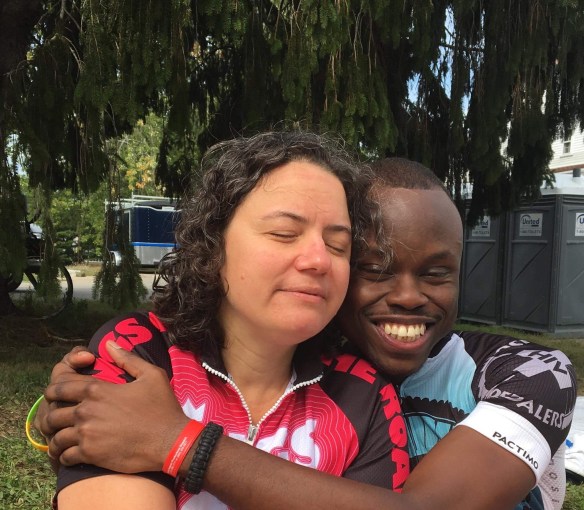
Me, with my friend and fellow rider Jamil Wilkins, during BRAKING AIDS® Ride 2016, getting a hug after the first 60 miles of riding. 

BRAKING AIDS® is also unique because like Housing Works and the work it does, it’s a movement. Both these communities and movements understand we cannot end AIDS as an epidemic in our state, nation, or around the world unless we collectively address the social and economic drivers of HIV—homelessness, unemployment, racism, homophobia, transphobia, misogyny and sexism, addiction, and mental illness. In the dark and divisive times in which we are living today, we are faced daily with acts of hate in every manifestation, and much of what we see, hear, and read reflects a diminishment of empathy in the public sphere. That makes it more important than ever that Housing Works and BRAKING AIDS® have both always stood for what we at Housing Works call “Radical Inclusion”: for accepting people as they are. We stand for love that heals and for acts of kindness, especially those directed to strangers.

Movements don’t and can’t sustain their work based on the efforts of any individual. As poet Mayda Del Valle wrote, “a movement is not a flash of light— it is a flame, a torch passed from one…to the next.” For that reason and in that spirit, I am asking for your help again to support my efforts. Together, we can end AIDS.

How You Can Help

Please consider DONATING TODAY! Here’s what your gift can help support:

$1,000 sustains one month of supportive housing

$500 provides 100 hygiene kits for homeless youth

$250 supports 30 days of mental health and substance use counseling

$150 covers a one-night stay at a Single-Room Occupancy for 2 homeless youth in need of emergency housing

$100 feeds 25 homeless youth during evening drop in hours at Housing Works’ East New York health center

DONATE VIA MY FUNDRAISING PAGE: 

https://fundraising.housingworks.org/participant/mika2018

Ways to make giving easier, to make your donation go further & to help me reach my $15K goal sooner: 

• PLEASE CHECK WITH YOUR HR DEPT. & SEE IF YOUR COMPANY WILL MATCH YOUR DONATION! If so, then check the “YES” bullet in the Company Matching section of the online donation form, and fill out the related information. You may be able to double or even triple your contribution! In 2016, over $3K of the $23K I raised came from company matches, so I cannot underscore enough how much this helps. 

• Recurring Monthly Gift: On the donation page, once you select a gift amount, click on the “Monthly” option to set up a recurring donation of any amount over your desired period of time. I prefer to donate this way because I can give more with only a small hit coming from my wallet each month.

• Cover Processing Costs:  Each donation incurs a processing fee that’s 7% of your gift. When the overall fundraising goal is $15K, 7% adds up: If everyone who gives covers the processing fee, that’s more than an additional $1,000 that goes straight to work at Housing Works. 

• Please forward this information to EVERYONE. Spread the word to your friends & colleagues! Forward the link to this blog post or share my donation link with your own networks on Facebook, Twitter, Instagram & other social media.

Thank you in advance for your generosity, friendship, kindness, encouragement, and support! I couldn’t do this without you.

Please join me & Housing Works in the fight to end AIDS by donating to Braking AIDS Ride 2018 (Cooperstown, NY, to Manhattan, Sept. 14-16)—Mika De Roo, Rider # 32. Donation site: https://fundraising.housingworks.org/participant/mika2018

Next Stop: AIDS-FREE NY 2020

A graphic from the newly branded Housing Works AiDS-FREE NY 2020 campaign.

A graphic from the newly branded Housing Works AIDS-FREE NY 2020 campaign.

One of the advantages of working at Housing Works is that I get to see and hear firsthand the impact of our advocacy efforts. On June 29, coinciding with NYC Gay Pride, we achieved a big victory: Governor Andrew M. Cuomo made history with his public declaration of an advocacy-based plan to end the AIDS epidemic in New York by 2020, as reported in The New York Times and in a press release issued by the Governor’s office.

Later the same morning, Housing Works and other AIDS and LGBT advocates held a press conference to praise the Governor for stepping up. A video montage of the statements made appears below.

To anyone who has some knowledge of the history of the AIDS epidemic for over three decades, this may perhaps sound like a daunting goal. But Governor Cuomo’s announcement reflects his recognition that the landscapes of HIV and health care have changed. Although there are more New Yorkers living with HIV than in any other state in the nation, New York has the people, institutions, resources, and tools needed to end the epidemic that has plagued us for more than 30 years by stopping new HIV infections and halting AIDS-related deaths. Based on progress and an expansion of advancements that have already been made—from new prevention and testing technologies to highly effective antiretroviral treatments—we have the science to make the ambitious goal of decreasing new HIV infection to below epidemic levels by 2020 viable. A successfully treated HIV+ person can live a healthy life and is virtually unable to transmit HIV to others. New HIV prevention tools beyond condoms, such as PrEP (pre-exposure prophylaxis, in which an HIV-negative person takes a daily pill to reduce the risk for HIV infection) and PEP (post-exposure prophylaxis, or meds taken following possible HIV exposure to reduce the risk of transmission), combined with these advances, mean we can end AIDS as an epidemic even without a cure. For more on PrEP, see this recent New York Magazine cover story or this post on PrEP on the Housing Works advocacy blog.

New York State has already been laying the groundwork to reach that goal. Always a leader and center of innovation in the fight against AIDS, New York has experienced a decrease in new HIV diagnoses of nearly 40% in the last decade, with fewer new infections each year. By contrast, there has been no decline in the number of new HIV infections diagnosed nationally each year, which has remained static at roughly 50,000.

Reacting to the news of Cuomo’s commitment, Housing Works CEO Charles King put it best:

“This step by Governor Cuomo, setting a clear goal to end the AIDS crisis in New York State, is absolutely courageous. In doing so, the Governor is reshaping the way we think about the AIDS epidemic and is setting a new standard for leaders of other jurisdictions in the United States and, indeed, around the world.”

And now that the Governor has gone all in, the real work begins—creating a blueprint to end AIDS by 2020 and implementing it. Toward that end, Housing Works and its allies continue to urge the Governor to convene a high-level State Task Force to develop and design a strategic roadmap with concrete steps and benchmarks for the Cuomo Plan to End AIDS in New York State.

Housing Works staff, clients, volunteers, and allies, celebrating during NYC Gay Pride 2014.

Housing Works staff, clients, volunteers, and allies, celebrating during NYC Gay Pride 2014.

For its own part, the same day that the Governor made his historic public commitment, Housing Works officially launched the New York segment of the ongoing Housing Works AIDS-FREE advocacy campaign during Gay Pride, marching behind the above “AIDS-FREE NY 2020: Closer than you think.” banner during the parade. Housing Works’ AIDS-FREE Campaign is a collaborative, multi-year initiative committed to ending the AIDS epidemic—in New York State by 2020, in the United States by 2025, and worldwide by 2030. For an overview of the campaign, click here.

The tag line on the banner isn’t merely aspirational. We are closer to making the end of AIDS a reality than we’ve ever been.

How You Can Support the Work Housing Works Is Doing
to Reach an AIDS-FREE New York by 2020

By and large, Housing Works’ advocacy—the grassroots organizing and political lobbying work it does in Albany, D.C., and across the globe to promote an AIDS-FREE future—is not funded by grants or by corporate or government dollars.

That’s one reason events like Braking AIDS Ride are so important. The funds raised by the ride to support Housing Works are unrestricted and can be used when and how they are needed across the organization.

As of this writing, I’m a little more than halfway to my $5,000 fundraising goal.

Please donate today to help me reach the finish line!