VIDEO: BRAKING AIDS® Ride 2022, opening ceremony remarks


BRAKING AIDS® Ride 2022 took place yesterday, and I was reminded again of all the reasons it’s always one of my favorite weekends of the year. I had the privilege of being asked to give some brief remarks at the opening ceremony kicking off the ride . My dear ride husband and fellow rider Clay Williams recorded and shared it via Facebook live (thank you, Clay), so I’m able to share it here. Below the video is a written transcript of the full speech.


Good morning,

The first person I knew who had AIDS was my mom’s childhood friend Dennis. Dennis, like my mom, came from an immigrant family, and was like an uncle to me. When he and my mom got together, the air thrummed with laughter and loud yakking in Romanian.

Those gatherings were infrequent because Dennis’ job as a journalist had him jumping from one global political hotspot to the next. But then he’d breeze into town and spark a jam session of multiple languages, dancing, eating, drinking. His laugh was a high-pitched cackle, one that would turn your head to see who had made that sound.

He confided to my mom that he was bisexual, but she believed he was gay. Regardless, his sexuality was a secret. And then, in early 1987 Dennis got sick and he stopped globetrotting. He died in December, and his NY Times obituary led with a common lie: “Dennis A. Volman, a reporter for The Christian Science Monitor, died of cancer Monday at the Mount Sinai Medical Center. He was 37 years old and lived in Washington.”

Dennis died a horrific death of physical agony from AIDS. If he had a partner, he took that secret with him. Only Dennis knew how much his soul suffered from shame and fear. I can only imagine it made a difficult dying process far lonelier.

This next bit I’ve never shared publicly. In 2012, I launched a blog about the ride, and I wrote an entry about Dennis. The blog’s main audience is my network, so imagine my surprise in 2013 to get emails from two strangers. One was a former girlfriend of Dennis’ who found the blog through a google search; she shared the post with the other stranger, an old friend of Dennis’s mom. They each emailed me to debate the historical record: Dennis had died of pneumonia while battling cancer. And why did I think Dennis was gay? The family friend was especially insistent it couldn’t have been homosexuality or AIDS. She cited his affairs with women, his poor health in childhood, his chronic pain from a back injury. From these women, I learned that Dennis had kept his illness secret, too. Only his nearest and dearest heard he was sick with “cancer” shortly before he died.

Our email exchanges ended quickly in a stalemate, but they unnerved me enough to ask my mom how she knew Dennis had AIDS. Apparently, she saw he had KS lesions when she visited him in the hospital.

I don’t judge Dennis for keeping secrets. Homophobia and AIDS stigma were prevalent enough that those choices may have protected him, whatever emotional price he paid. But by 2013, he’d been dead for over 25 years. His parents were dead. He had no children. No siblings. How had stigma, fear, and homophobia re-emerged, overshadowing sense and reason, when those lies protected no one anymore?

So why share this fucking heartbreaker of a story?

Because the shadow side of people’s humanity isn’t the only story. That is never the only story. Seeds of social justice were being planted even then. While Dennis was dying in March 1987, the first meeting of ACT UP was held in the West Village. Three years later, Housing Works was founded out of ACT UP’s housing committee. Both organizations demanded action from a government that ignored AIDS for years. These fiery activists didn’t wait for a grand utopian future; they acted with courage in a seemingly hopeless present, defying the cruelty and ignorance around them. They used civil disobedience to demand better drugs today, not tomorrow. They won those fights and saved countless lives.

Today the fight goes beyond medication; it’s a social justice battle—fighting the racism, homophobia, transphobia, and misogyny that fuel the AIDS epidemic in spite of our medical progress. For over 30 years, Housing Works has fought for social justice, anchored by this belief: that whether we are dying or healthy or somewhere in between, all human beings are deserving of housing, food, healthcare, and basic dignity and respect. Whether it’s AIDS, homelessness, the opioid crisis, COVID-19, or the next challenge, I trust Housing Works to lead with compassion, doing what needs to be done.

All of you are full of those same passions. The same courage, kindness, fierceness. The same miraculous blend of love, laughter, grief, and audacity. I see it every time Beth mentions Ira; when Clay passes me on a hill, again; when I see Cheyenne’s dazzling smile; when Amelia or Amy shouts something lewd at me on the road; when Linda envelopes me in a hug; when Wendy makes a bacon joke; when I see Jim stopping on the road to tell someone why we’re riding and when they say, “I don’t know anyone with HIV or AIDS,” he says, “yes, you do. I live with HIV.” What I see all around me is love—and I see it in every one of you.

These stories, our stories, are worth writing, sharing, expanding, and retelling. We come together on this ride to commemorate our dead and honor our best selves by showing up for those in need, and for one another. This ride is citizenry of the highest order. We have been writing that narrative together as a ride family for years, and the time I spend here with all of you every year heals my own soul on its darkest days. So let’s go write the next chapter.

On Hope, Uncertainty, and an AIDS-Free NY by 2020

In less than two months, once again, I’ll be participating in BRAKING AIDS® Ride, a 300-mile bike from Cooperstown to NYC. Between now and mid-September, I have two objectives: to get into some semblance of shape for the physical challenge of the ride and to raise $20,000 to support the amazing advocacy and services provided by Housing Works, the ride’s beneficiary.

Since my first year doing this ride in 2008, individual donations from people like you have been essential in helping me raise over $100,000 and counting to support life-saving services for those living with HIV as well as its efforts toward ending the AIDS epidemic once and for all. I’m counting on the support of hundreds of individual donors again this year to raise at least another $20,000 to end AIDS as an epidemic in New York by 2020.

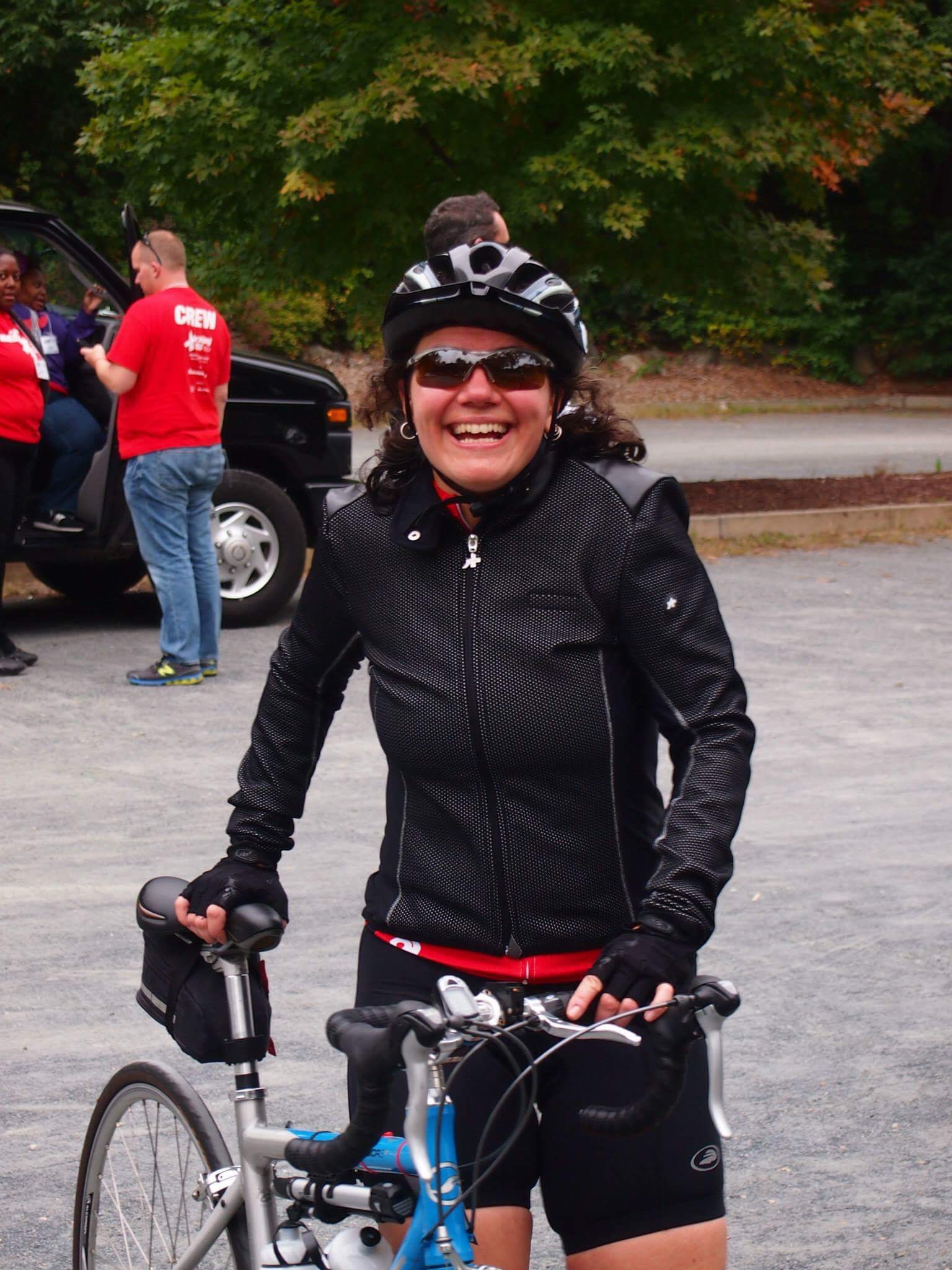
Photo: Me on Day 1 of BRAKING AIDS® Ride 2018, by fellow rider Kyle Cameron. The photo later appeared as the Contents photo spread in the Nov./Dec. issue of Positively Aware magazine, which was pretty fabulous. 

As someone who worked at Housing Works for five years, I have seen firsthand how its programs and services make a concrete difference. Since its 1990 founding, Housing Works has provided services to more than 20,000 homeless and low-income New Yorkers living with HIV/AIDS. Unlike many HIV service providers, which tend to focus on one or two primary areas of service, Housing Works offers a startling array of programs that help address the overlapping, intersectional issues faced by its clients: In addition to housing, services include primary healthcare, meals, case management, nutrition, substance use treatment, legal assistance, and job training, as well as relentless advocacy at the city, state, and federal levels to fight for funding and legislation that will help us end AIDS once and for all. It also offers those services with respect and compassion, a context that is essential to healing but all too rare.

I began doing this ride in 2008 in memory of two family friends who died of AIDS-related illness in 1987 and 2003, respectively, and for many close friends who live with HIV. For BRAKING AIDS 2019, I am riding in memory of two friends who died this past year whose lives epitomize compassion and citizenry in the best senses of both words.

My friend Dawn Grimmett (1975–2019), a pediatric nurse who lived in Alabama, died unexpectedly this last April from complications from pneumonia. If we hadn’t both participated in AIDS rides, I might never have met Dawn—and I am lucky to have known her. Dawn was funny and kind. A giver of tremendous hugs and fierce loyalty. One had to pity anyone foolish enough to say a bad word about the people Dawn loved; as she herself put it, “I might look nice, but I’ll cut a bitch!” She also led by example: She was open and candid that she struggled with depression, which even today comes with so much stigma despite how common it is. Without fail, every year since 2004, Dawn traveled across the country to dedicate two weeks’ vacation to being a volunteer nurse on the crew for two different AIDS Rides—California AIDS LifeCycle in June and BRAKING AIDS® in September—dispensing Advil, Band-Aids, Gatorade, ice packs, sunscreen, and whatever medical care was needed, along with unconditional love, and just the right amount of snark. Her life, which ended all too soon, two months shy of her 44th birthday, is a testament to the power of showing up. Dawn reminds me that some of the most important and significant gifts to fellow human beings and contributions to a movement are comprised of mundane, ordinary, and often quiet acts of kindness. The impact of those acts are cumulative, and a commitment to those compassionate acts is the stuff that long-term change is made of.

Photo: This year, I will be riding in memory of my friend Dawn Grimmett (1975–2019), who was a volunteer nurse on every BRAKING AIDS® Ride I have ever done.

My friend Andy Vélez (1939–2019), a longtime LGBTQ and ACT UP New York activist, passed away on May 14 at age 80 after a severe fall in his Greenwich Village building earlier this spring. Andy joined ACT UP in 1987, the year of its founding, back when AIDS was a death sentence to so many, the downward spiral of the illness itself was ugly and painful, treatments were toxic and few, and our government leaders had been ignoring the burgeoning epidemic for six years. Andy was a devoted and fierce activist for 32 years, and his passion for and tenacity in undertaking righteous lifetime activism inspired and continues to inspire countless individuals, myself included. The friendship we developed during a relatively finite number of years of coalition activism together was and remains dear to me, and I miss his kindness, his delicious stories, his wicked and bawdy humor, and his authenticity. To read more about Andy’s remarkable life, check out the tribute that appeared in the Los Angeles Blade, as well as this piece in PLUS, “Why We Still Need HIV Warriors.”

Photo: This year, I will also be riding in memory of my friend Andy Vélez, a longtime LGBTQ & HIV/AIDS activist who passed away in May. In June, ACT UP New York created these buttons, featuring a portrait of Andy by Bill Bytsura of The AIDS Activist Project, in honor of Andy’s lifetime of fierce, relentless activism.

You don’t show up for 32 years of activism unless you have some faith and hope that what you’re doing will make a difference, whether you yourself are able to see that difference or not. Andy’s life is a reminder of that for me. It’s a reminder to heed what writer Rebecca Solnit says about hope:

“Hope locates itself in the premises that we don’t know what will happen and that in the spaciousness of uncertainty is room to act. When you recognize uncertainty, you recognize that you may be able to influence the outcomes — you alone or you in concert with a few dozen or several million others. Hope is an embrace of the unknown and the unknowable, an alternative to the certainty of both optimists and pessimists. Optimists think it will all be fine without our involvement; pessimists take the opposite position; both excuse themselves from acting. It’s the belief that what we do matters even though how and when it may matter, who and what it may impact, are not things we can know beforehand. We may not, in fact, know them afterward either, but they matter all the same, and history is full of people whose influence was most powerful after they were gone.” [emphasis mine]

I’m not usually good with uncertainty. In fact, I struggle with it. All the time. But BRAKING AIDS® and the example of people like Dawn and Andy challenge me to challenge myself to find that “spaciousness” Solnit describes.

When asked what he wanted to be remembered for, Andy once said, “As someone who is able to help.” I’m riding again this year because I am able to, and in that same spirit, I am asking for your help to support my efforts. Together, we can end AIDS.

Please DONATE TODAY. Donations of all sizes are welcome, but a gift of $200 or more will go a long way toward reaching my $20,000 goal. A $200 gift feeds 100 homeless youths at Housing Works’ East New York Health Center.   

DONATE VIA MY FUNDRAISING PAGE: https://give.classy.org/mika2019 

Photo: Me, wearing the Japanese ACT UP “Silence + Death” tee-shirt that Andy Vélez gave me several years ago as a gift, with my wife Jennifer at the Dyke March for NYC Pride 2019, which was also the 50th anniversary of the Stonewall riots.

Help Me Raise $15K for Housing Works & an AIDS-Free NY 2020

It finally feels like summer in NYC again. For me, a June heatwave means it’s long past time that I jumpstart my training and my fundraising for BRAKING AIDS® Ride.

Over the past decade, past donations from hundreds of generous souls have been essential in helping me raise over $90,000 and counting to support Housing Works’ many life-saving services for those living with HIV as well as its efforts toward ending the AIDS epidemic once and for all. 

I’m counting on that support again this year to raise at least $15,000 to end AIDS as an epidemic in New York by 2020.

WHY I KEEP RETURNING TO BRAKING AIDS® RIDE


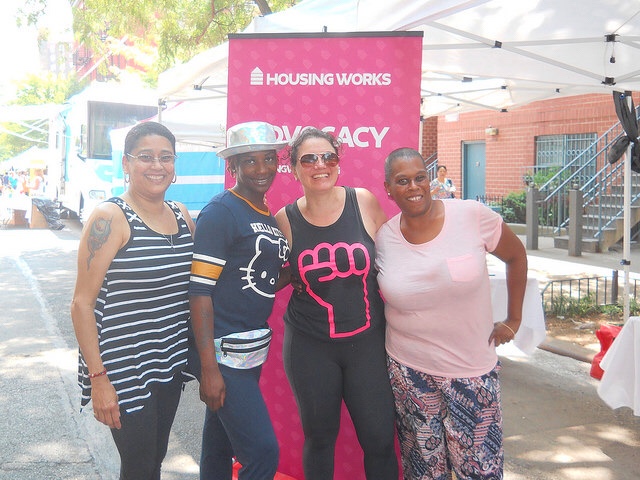
Me, with some of my amazing Housing Works Advocacy colleagues and friends, who inspire me every day (L to R): Valerie Reyes-Jimenez, Legacee Medina, me, Felicia Carroll. 

For the first time since the AIDS crisis began, we have the tools to end the epidemic. More than six years ago, when the audacious goal of ending AIDS as an epidemic in New York, even without a cure or vaccine, was first proposed by Housing Works, Treatment Action Group, and other allies, many people thought it was impossible, and the Governor’s Office and the State Department of Health were not yet sold on the idea. Since then, Housing Works has provided unparalleled leadership to get New York to adopt a plan that makes full use of the tools we have to end AIDS as an epidemic statewide by 2020. At the time of the state plan’s launch in 2014, in the course of educating people about the plan and its feasibility, we said, “an AIDS-FREE New York is closer than you think…” We weren’t kidding. This past December we marked major milestones in the state plan to end AIDS: unprecedented city and state decreases in HIV diagnoses. In 2016, NYC achieved a record 11% decrease, and NYS achieved a corresponding 8.7% decrease. The legislation and policy changes we’ve been fighting for to end the epidemic are working, and we are on track to do it by 2020! And it’s not just New York: Since 2014, more than a dozen additional U.S. jurisdictions have committed to end-AIDS plans, and the U.N. has established 2030 as its target date to bring global infection rates below epidemic levels.

This will also be my 10th year participating as a rider in this annual 3-day, 300-mile journey by bicycle. People sometimes ask me how and why I keep coming back. As someone who has now worked in Housing Works Advocacy for going on five years, I truly believe in the Housing Works lifesaving services this ride supports—because I see those programs and services in action and how much they’re needed and the difference they make firsthand every day. But the truth is, as much as I truly believe in those programs and the organization’s mission, many of my reasons to keep showing up to ride are self-serving.

BRAKING AIDS® is unique because it isn’t only a ride, it’s also a family. The experience of being part of that family and this shared experience for over a decade has challenged me to be my best self, which is to say that it challenges me to be not necessarily my strongest or surest but to be willing to show up even as and at my most vulnerable and uncertain. To show up as myself even when I’m tired, depleted, demoralized, struggling, plagued by self-doubt. It’s taught me to show up and try even when I’m stretched thin and fairly certain I haven’t got it in me. It’s shown me it’s not only okay but healthy and necessary to ask for help at times, a tough, recurring lesson for me because I’m private, and I’m stubborn and fierce about my sense of self-reliance and independence (and even with years of practice, I will be the first to admit I’m still *terrible* at asking for help!).


Me, with my friend and fellow rider Jamil Wilkins, during BRAKING AIDS® Ride 2016, getting a hug after the first 60 miles of riding. 

BRAKING AIDS® is also unique because like Housing Works and the work it does, it’s a movement. Both these communities and movements understand we cannot end AIDS as an epidemic in our state, nation, or around the world unless we collectively address the social and economic drivers of HIV—homelessness, unemployment, racism, homophobia, transphobia, misogyny and sexism, addiction, and mental illness. In the dark and divisive times in which we are living today, we are faced daily with acts of hate in every manifestation, and much of what we see, hear, and read reflects a diminishment of empathy in the public sphere. That makes it more important than ever that Housing Works and BRAKING AIDS® have both always stood for what we at Housing Works call “Radical Inclusion”: for accepting people as they are. We stand for love that heals and for acts of kindness, especially those directed to strangers.

Movements don’t and can’t sustain their work based on the efforts of any individual. As poet Mayda Del Valle wrote, “a movement is not a flash of light— it is a flame, a torch passed from one…to the next.” For that reason and in that spirit, I am asking for your help again to support my efforts. Together, we can end AIDS.

How You Can Help

Please consider DONATING TODAY! Here’s what your gift can help support:

$1,000 sustains one month of supportive housing

$500 provides 100 hygiene kits for homeless youth

$250 supports 30 days of mental health and substance use counseling

$150 covers a one-night stay at a Single-Room Occupancy for 2 homeless youth in need of emergency housing

$100 feeds 25 homeless youth during evening drop in hours at Housing Works’ East New York health center

DONATE VIA MY FUNDRAISING PAGE: 

https://fundraising.housingworks.org/participant/mika2018

Ways to make giving easier, to make your donation go further & to help me reach my $15K goal sooner: 

• PLEASE CHECK WITH YOUR HR DEPT. & SEE IF YOUR COMPANY WILL MATCH YOUR DONATION! If so, then check the “YES” bullet in the Company Matching section of the online donation form, and fill out the related information. You may be able to double or even triple your contribution! In 2016, over $3K of the $23K I raised came from company matches, so I cannot underscore enough how much this helps. 

• Recurring Monthly Gift: On the donation page, once you select a gift amount, click on the “Monthly” option to set up a recurring donation of any amount over your desired period of time. I prefer to donate this way because I can give more with only a small hit coming from my wallet each month.

• Cover Processing Costs:  Each donation incurs a processing fee that’s 7% of your gift. When the overall fundraising goal is $15K, 7% adds up: If everyone who gives covers the processing fee, that’s more than an additional $1,000 that goes straight to work at Housing Works. 

• Please forward this information to EVERYONE. Spread the word to your friends & colleagues! Forward the link to this blog post or share my donation link with your own networks on Facebook, Twitter, Instagram & other social media.

Thank you in advance for your generosity, friendship, kindness, encouragement, and support! I couldn’t do this without you.

Please join me & Housing Works in the fight to end AIDS by donating to Braking AIDS Ride 2018 (Cooperstown, NY, to Manhattan, Sept. 14-16)—Mika De Roo, Rider # 32. Donation site: https://fundraising.housingworks.org/participant/mika2018

No Grit, No Pearl: What I Do the Day After Love Wins & U.S. Marriage Equality Prevails

Family & friends joined me and my wife Jen for our wedding in Provincetown, Massachusetts, on May 16, 2010. Marriage equality was the law of the land in the Commonwealth of Massachusetts then, but had been voted down in New York State, our home, on my birthday, December 2, 2009.

Family & friends joined me and my wife Jen for our wedding in Provincetown, Massachusetts, on May 16, 2010. Marriage equality was the law of the land in the Commonwealth of Massachusetts then, but had been voted down in New York State, our home, on my birthday, December 2, 2009. Photo by Doreen Birdsell.

Part I. June 26, 2015, still taking in the amazing Supreme Court Decision on Marriage Equality:

I remember exactly when NY State (the State Senate, specifically) last voted against marriage equality because it was on my birthday, December 2, 2009. When my wife Jennifer and I got married in May 2010, after 12 years together, we held our wedding in Massachusetts, where gay marriage was legal. At that point, NY State still hadn’t budged on the issue. NY State finally did the right thing right before LGBT Pride in late June 2011, a full two and a half years after that contentious 2009 vote, with the passage of the Marriage Equality Act. NY was only the 6th state in the U.S. to legalize gay marriage, and it was also the most populous state in the union to have done so. That was four years ago, almost to the day.

My wife and I never thought we’d see marriage equality across the U.S. in our lifetimes. In the optimistic moments when we dared imagine, however briefly, that that miracle might happen at all, we didn’t think it would be until we were very old.

We were wrong.

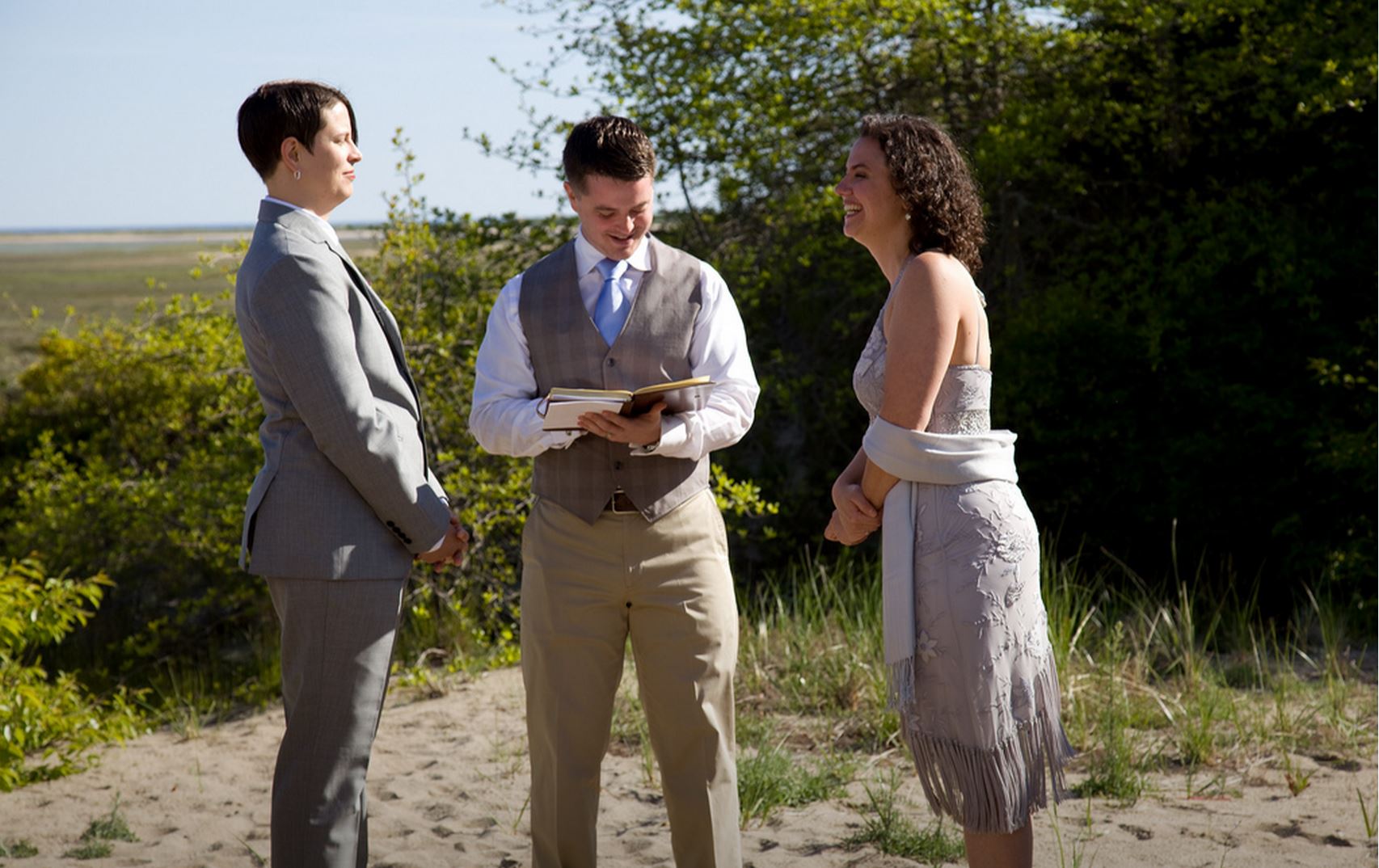
Fred Speers, officiating at my wedding, May 16, 2010, West End of Provincetown, Massachusetts.From left to right: my wife Jen, Fred, me. Photo by Doreen Birdsell.

Fred Speers, officiating at my wedding, May 16, 2010, West End of Provincetown, Massachusetts.From left to right: my wife Jen, Fred, me. Photo by Doreen Birdsell.

I often find myself being the skeptic about our collective capacity to change for the better as a society. The news I see every day, especially where it concerns race and class, seems to confirm that dire, grim trajectory: a seemingly endless stream of depressing, enraging, heart-breaking news stories and statistics. In particular I am thinking of racist verdicts and acts of racially-based hatred and violence across different U.S. cities and regions. Trayvon Martin, Mike Brown, Eric Garner, Freddie Gray, the recent mass murder of 9 black people in a Charleston church by racist, domestic terrorist Dylann Roof. Between news like that and our collective inability to move U.S. public policy in any meaningful way on issues like gun control or climate change, it makes it easy for me to become disheartened and to tell myself, although small victories may happen, the big, national-level progress I so long to see is impossible, that really, as a nation, as a deeply flawed democratic, capitalist experiment, maybe we’re just fucked.

And maybe we are. God knows, even after today’s coup for LGBT Americans, we have a daunting amount of work to do to make things better for the vast majority of our citizens & residents.

But a day like today is evidence that when we keep at it, change for the better does come. Excruciatingly slowly. But nevertheless.

I was reminded of that fact further when I saw that my dear friend Frederick Speers, my other me, had posted in a similar, more personal vein about this same pendulum-swinging, what Martin Luther King Jr. meant when he said, “The arc of the moral universe is long, but it bends towards justice.” I’m sharing Fred’s post along with mine because it’s worth reading, I dare say more so than my own. Not only because I love him. Not only because he officiated at my Massachusetts wedding to Jennifer Anderson in 2010 and I officiated at his MA wedding to Chase Skipper in 2009. I share his post below because he’s brilliant and eloquent at showing first-hand how that moral arc has bent toward justice and equality for him, within his own lifetime. In less than 30 years, we’ve gone from a world that told him as a young boy, “if you’re gay, you’re better off dead,” to one that acknowledges him, his life, the love of his life, and their marriage together as being as worthy of life, liberty, and the pursuit of happiness as everyone else’s.

Fred’s Facebook post on Friday morning, just after the Supreme Court decision was made public:

At 12 years old, I asked god whether I should die because I loved another boy. I listened. And the people said: “There is hope for homosexuality, especially through prayer – because it’s not an unchangeable CONDITION like being black or a woman.”

At 18 I asked to hold my boyfriend’s hand in public. I listened, and the people said, “This isn’t a real problem for us — since you can’t reproduce, and AIDS will finish you off.”

At 21 I asked to serve my country. I listened and the people said, “ONLY if you lie about who you really are.”

At 33 I asked to marry the love of my life. We listened together. “OK,” the people said, “but only in a handful of states.”

At 39 we asked for equality for all. We held our breaths. And the people said, “We see you now for who you are: Your LOVE matters.”

#lovewins

Fred Chase Me 6.6.09

Me, with Chase Skipper and Fred Speers, on June 6, 2009. I officiated at their wedding in Provincetown. Nearly a year later, Fred officated at mine to Jen Anderson, also in Provincetown. Chase is holding their marriage license, which I had just signed.

So, let this day of celebration also be a reminder, dear friends, to my future self above all, that Sam Cooke was right when he wrote and sang in 1964, “It’s been a long, long time coming,/ But I know a change is gonna come; oh, yes, it will…”

#‎lovewins‬

Part II. June 27, 2015, The Day After a Winning a Hard-Won Battle, or, “No Grit, No Pearl,” or, What’s Next?

It’s been quite something to see and hear the amazing love, joy, and support from gay and straight friends and family alike in the aftermath of this historic ruling. I think the full weight of it still hasn’t quite sunk in, to be honest.

I posted on Facebook last night that Jen and I didn’t think we’d see this change happen in our lifetimes, or if we did, we believed we’d be old. Very old.
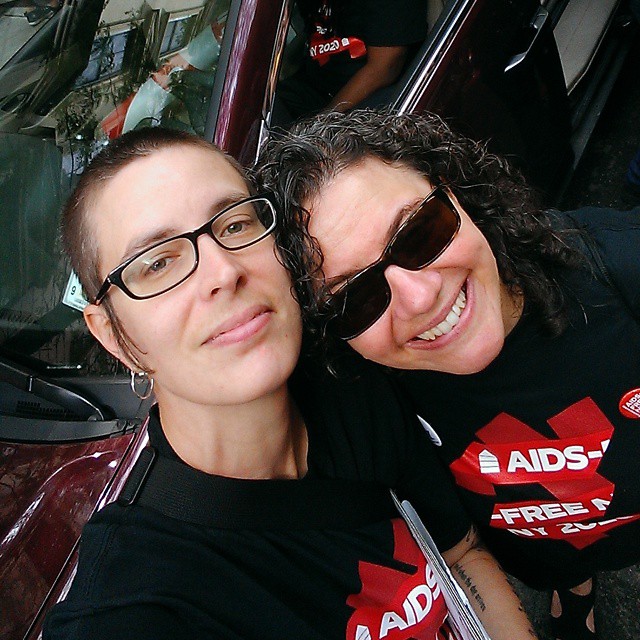
11695858_10153440161813656_2025565217349272418_n

Same-sex self-portrait, #NYCPride, me with Jennifer L. Anderson, June 28, 2015. Photo by Jennifer L. Anderson

11692696_10100874918598075_962224127238813092_n

Me with my amazing Housing Works Inc. Advocacy compadres, rocking ‪#‎NYCPride, June 28, 2015‬. The parade was so nice, we did the march twice! This photo was taken after Round 1, from left to right: Vinay Krishnan, Tony Ray, Jaron Benjamin, and me. Photo courtesy of Tony Ray.

Facebook-20150629-112153

Notorious RBG! One of my favorite sightings at #NYCPride, June 28, 2015. Photo by Jennifer L. Anderson.
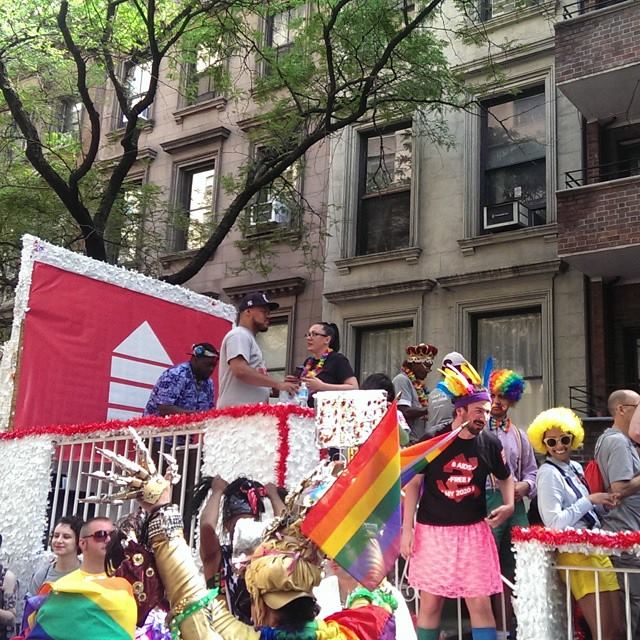
Facebook-20150629-112215

The Housing Works float, during the long wait to march at #NYCPride, June 28, 2015. I think the thing that may have moved me most at Pride was the young kids we kept meeting throughout the day, strangers from Alabama and Arkansas and Indiana and even from New York or somewhere geographically closer, who kept thanking us and reaching over the police barricades to high-five us or hug us because they were so happy and they know what a big deal this marriage equality is. I couldn’t pinpoint what it was about their joy that was so beautiful and then I realized: They looked hopeful. Photo by Jennifer L. Anderson.
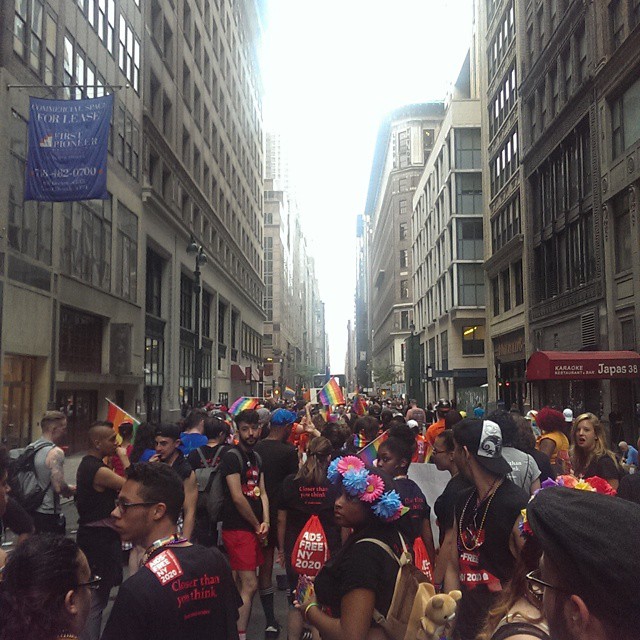
Facebook-20150629-112230

Housing Works in the #NYCPride house, getting ready to march down Fifth Avenue, June 28, 2015. Photo by Jennifer L. Anderson.

Days like yesterday, which was and is a very personal celebratory moment for me and for many people I love, are also a reminder that when we work for the greater social good, year after year, decade after decade, century after century—even when it seems like we’re going nowhere because so many who wield power and wealth use those things to reflect all the hate in their hearts—when we keep at it, change does come. Excruciatingly slowly. But nevertheless.

To get there, though, we have to keep showing up, even when we seem to be in the darkest of tunnels. When all the news we see and hear is bad, unjust, unconscionable, shameful.

That being the case, this seems the perfect day to begin my fundraising for this year’s BRAKING AIDS® Ride.

I also marked this post-SCOTUS victory day with a 68-mile training ride to Nyack and back. There are no cute photos. It rained on the way back. I was alone, woefully behind on my training this season, slow. I didn’t break any records with my astonishing speed or hill-climbing prowess. I wasn’t special. Or charming. Or intelligent. My ego felt bruised at various points. I kept going. I climbed through Palisades Park for the first time this season. I ate my bagel at The Runcible Spoon and as I sipped my iced coffee, I texted everyone who was on my mind because I felt sad and a little lonely and a little scared about how I would feel on the four miles of climbs going back home. Not every fucking moment is a victory lap. Most moments aren’t. Most moments are training, which is work. I showed up. I worked. That is all.

This will be my eighth year doing this 3-day, 300-mile journey by bicycle to raise money for Housing Works and to raise awareness about HIV/AIDS. When I started back in 2008, I’d never raised this kind of money or ridden a bike this far or this hard. In the years since then, I’ve put in something like 13,000 miles on the same blue bicycle, and raised between $60,000 and $70,000.

My most generous supporters have donated with astonishing generosity year after year. Their support inspires and amazes me. Above all, it’s necessary, which is why I continue to ask for their help and the help of other kind people I know again and again, each time wondering whether they’re sick to death of hearing me ringing a relentless AIDS-fundraiser gong.

For now, I’m not going to belabor the importance of the cause and how this money helps people who need help. I’m not going to get into all the ways in which Housing Works lives out the belief that even the seemingly weakest or lost or most far-gone among us are deserving of second or third or fourth or however many chances it takes to change and make their own lives and the world they live in better. I won’t regale you with HIV statistics. For now, I’ll say this: We can end AIDS as an epidemic, even without a cure or a vaccine. Housing Works has been at the forefront of that movement toward an AIDS-Free New York, an AIDS-Free USA, an AIDS-Free world. This is our JFK moonshot. We will get there.

Change comes when people show up for the fights that need to be fought. The most important kinds of change are hard-won and require showing up again and again and again and again.

I’ll end with this: HIV/AIDS has been plaguing us for over 30 years. We’ve been fighting for a long time, and we’ll keep fighting until we reach an AIDS-free world. Change is coming.

TO SUPPORT ME FOR BRAKING AIDS® Ride 2015, CLICK HERE. My goal is to raise $10,000 to benefit Housing Works life-saving HIV/AIDS services by July 31, 2015.
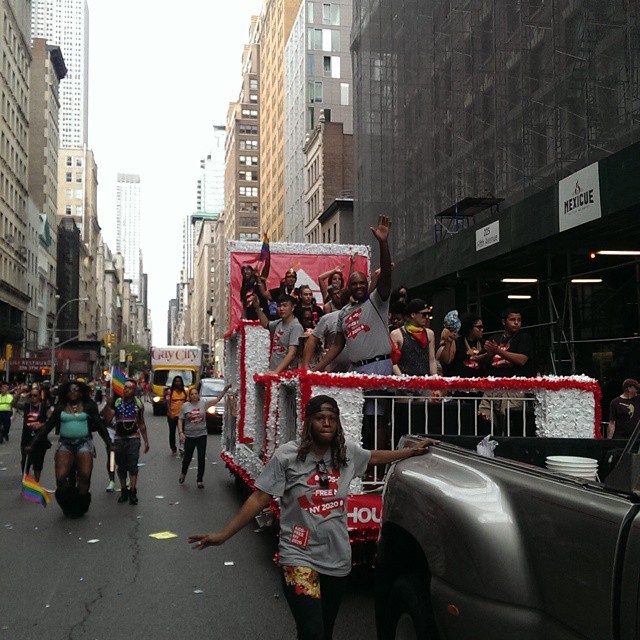
Facebook-20150629-112245

The Housing Works #NYCPride contingent, getting ready for lift-off, June 28, 2015. Photo by Jennifer L. Anderson.
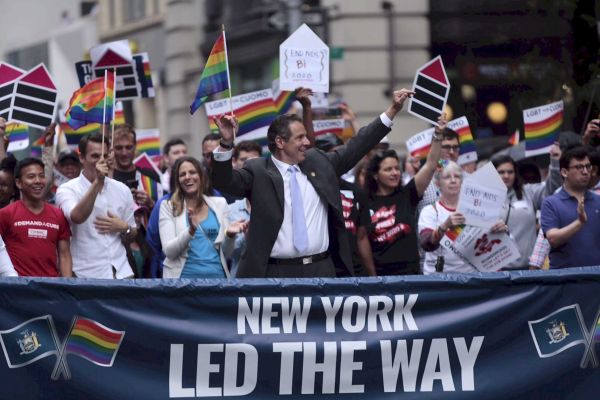
Is that a Housing Works sign or is the Governor just happy to see me? New York was the sixth state in the U.S. to make marraige equality legal and the most populous. It led the way for the domino effect of states that changed their laws to move toward the right side of history. New York can do the same for HIV/AIDS, which is as big and arguably an even bigger social justice issue than marriage equality. It's also a battle we're still fighting.

Is that a Housing Works sign or is the Governor just happy to see me? New York was the sixth state in the U.S. to make marraige equality legal and the most populous. It led the way for the domino effect of states that changed their laws to move toward the right side of history. New York can do the same for HIV/AIDS, which is as big and arguably an even bigger social justice issue than marriage equality. It’s also a battle we’re still fighting. Photo by Anthony Lanzilote.
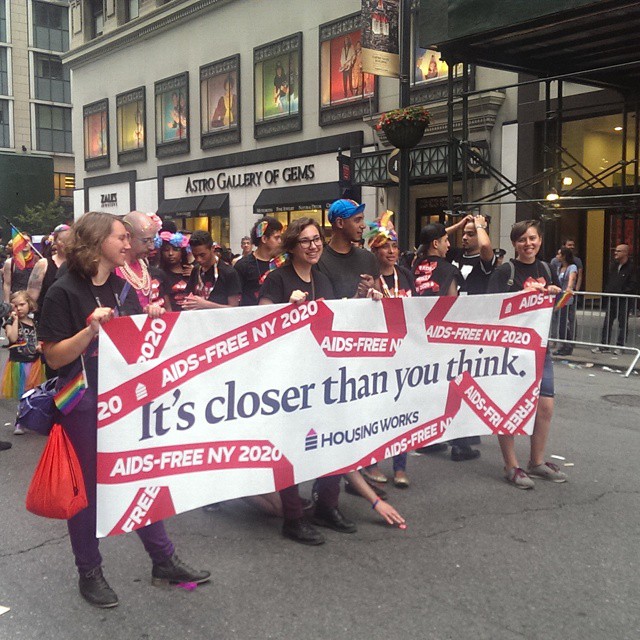
Facebook-20150629-112255

The Housing Works community, marching for #NYCPride, June 28, 2015. What’s next? Fighting for and achieving an AIDS-Free NY by 2020. Photo by Jennifer L. Anderson.