
AIDS and HIV have no borders. There are no maps that say, “Beyond this point, there be HIV.”

The Carta Marina, an early 16th century map of the Nordic countries. Like many early maps, it featured depictions of dragons, sea monsters, and serpents as a warning, to indicate, as the saying goes, “Beyond this point, there be dragons.”
Nevertheless, some geographical regions get hit harder by HIV than others, for all the usual reasons—economics, population size and concentration, demographic factors (ethnicity, gender, age, sexual orientation, etc.), health care access, education, and the like.
New York City, my birthplace and my current home, was one of two places where the majority of the first AIDS cases occurred; the other was San Francisco.
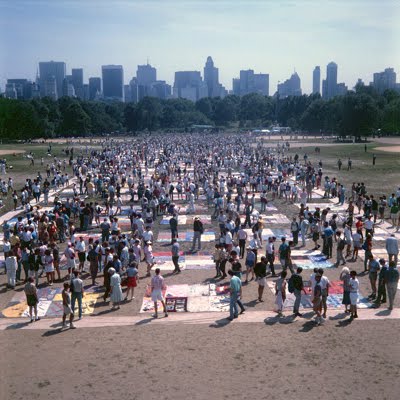
The AIDS Quilt in Central Park in 1988.
Over 30 years later, New York City remains the epicenter of HIV/AIDS in the United States:
- More than 107,000 New Yorkers are living with HIV, and thousands more are unaware they’re infected.
- HIV is the third leading cause of death for New York City residents aged 35 to 54.
- The case rate for AIDS in New York City is almost triple the U.S. average.
- HIV transmission through heterosexual sex is outpacing transmission through intravenous drug use by more than four to one.
- Nearly 80% of new diagnoses are among blacks and Hispanics.

Even within New York City, the playing field for who is directly affected by HIV is far from level. According to an April 2012 health study released by the University of Wisconsin Population Health Institute, based on 2010 Census data, the majority of individuals diagnosed with HIV in New York City were in the South Bronx, Central Brooklyn, and in the Clinton/Hell’s Kitchen, Chelsea, and Harlem neighborhoods of Manhattan. (The New York City metropolitan area map reproduced here relies on the NYC United Hospital Fund (UHF) neighborhood boundaries.)
The good news is that the above data can be used to allocate resources and efforts to the people and places where they are most needed. Case in point: The same week the health study was published, Housing Works, the beneficiary of this year’s Braking the Cycle ride, relaunched a newly renovated facility, the East New York Community Health Center. As a result, the Center will now be able to provide comprehensive care to Central Brooklyn communities irrespective of their HIV status. The renovation was made possible by a Human Resource & Service Administration (HRSA) grant awarded to Housing Works to provide comprehensive primary care services to the general community, and targeting the homeless community in particular; the expansion of the facility will effectively double the number of primary-care patients seen per year.
New York City is so vast and so densely populated, it can seem like an anonymous place, a place where it’s hard for an individual to have an impact. The Housing Works effort in East New York reminds me of why I do this ride. It reminds me that even in New York City, every small contribution by every individual to make the lives of our neighbors better matters. Most of all, it reminds me of the many reasons I’m so glad to live here and be a born-and-bred New Yorker.
Sources: “A Vision of a Grim Past and a Hopeful Future,” New York Times, April 8, 2012; Housing Works East NY Center ribbon cutting; Housing Works East NY Center re-opening
 The Blue Streak