

Family & friends joined me and my wife Jen for our wedding in Provincetown, Massachusetts, on May 16, 2010. Marriage equality was the law of the land in the Commonwealth of Massachusetts then, but had been voted down in New York State, our home, on my birthday, December 2, 2009. Photo by Doreen Birdsell.
Part I. June 26, 2015, still taking in the amazing Supreme Court Decision on Marriage Equality:
I remember exactly when NY State (the State Senate, specifically) last voted against marriage equality because it was on my birthday, December 2, 2009. When my wife Jennifer and I got married in May 2010, after 12 years together, we held our wedding in Massachusetts, where gay marriage was legal. At that point, NY State still hadn’t budged on the issue. NY State finally did the right thing right before LGBT Pride in late June 2011, a full two and a half years after that contentious 2009 vote, with the passage of the Marriage Equality Act. NY was only the 6th state in the U.S. to legalize gay marriage, and it was also the most populous state in the union to have done so. That was four years ago, almost to the day.
My wife and I never thought we’d see marriage equality across the U.S. in our lifetimes. In the optimistic moments when we dared imagine, however briefly, that that miracle might happen at all, we didn’t think it would be until we were very old.
We were wrong.
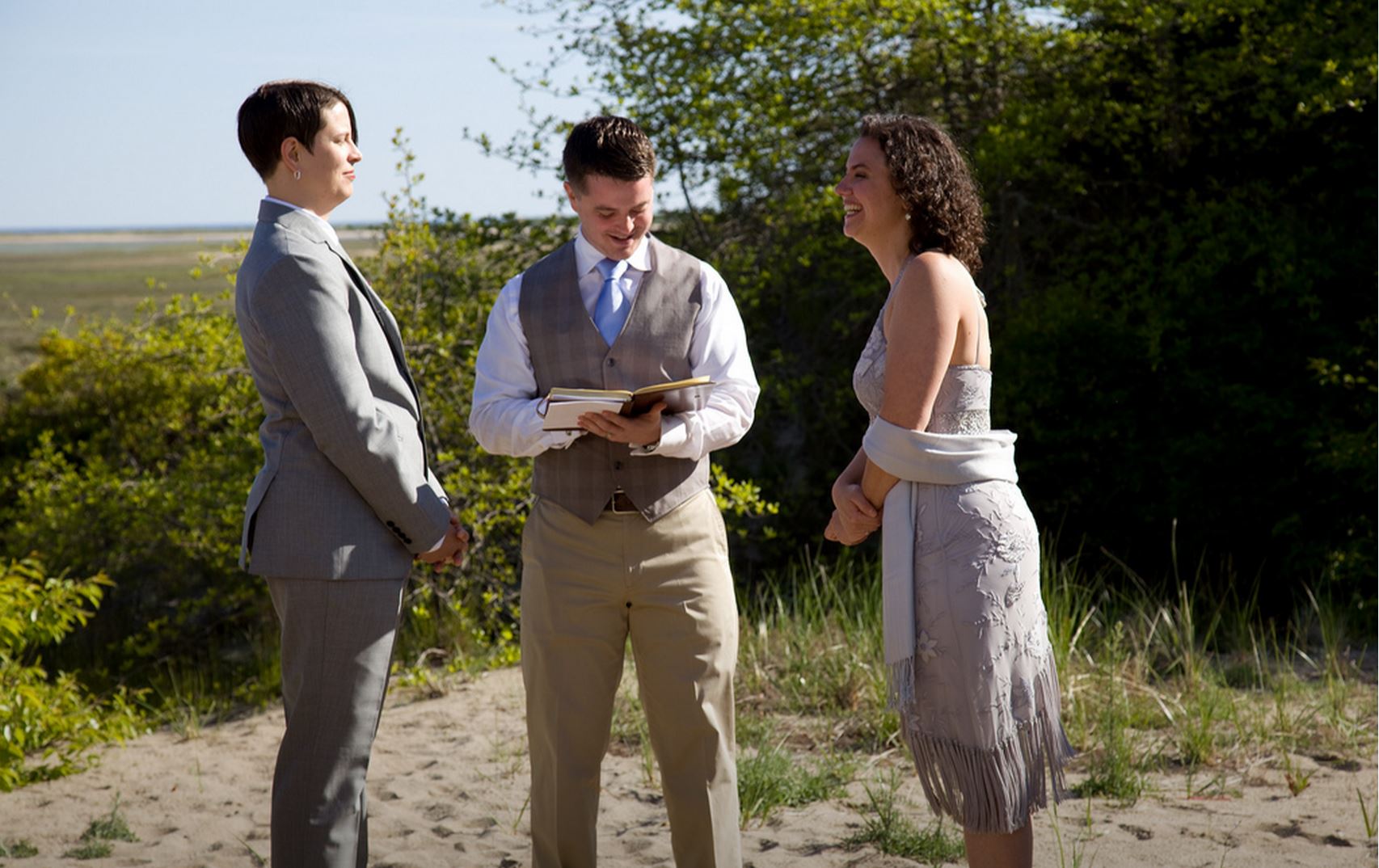
Fred Speers, officiating at my wedding, May 16, 2010, West End of Provincetown, Massachusetts.From left to right: my wife Jen, Fred, me. Photo by Doreen Birdsell.
I often find myself being the skeptic about our collective capacity to change for the better as a society. The news I see every day, especially where it concerns race and class, seems to confirm that dire, grim trajectory: a seemingly endless stream of depressing, enraging, heart-breaking news stories and statistics. In particular I am thinking of racist verdicts and acts of racially-based hatred and violence across different U.S. cities and regions. Trayvon Martin, Mike Brown, Eric Garner, Freddie Gray, the recent mass murder of 9 black people in a Charleston church by racist, domestic terrorist Dylann Roof. Between news like that and our collective inability to move U.S. public policy in any meaningful way on issues like gun control or climate change, it makes it easy for me to become disheartened and to tell myself, although small victories may happen, the big, national-level progress I so long to see is impossible, that really, as a nation, as a deeply flawed democratic, capitalist experiment, maybe we’re just fucked.
And maybe we are. God knows, even after today’s coup for LGBT Americans, we have a daunting amount of work to do to make things better for the vast majority of our citizens & residents.
But a day like today is evidence that when we keep at it, change for the better does come. Excruciatingly slowly. But nevertheless.
I was reminded of that fact further when I saw that my dear friend Frederick Speers, my other me, had posted in a similar, more personal vein about this same pendulum-swinging, what Martin Luther King Jr. meant when he said, “The arc of the moral universe is long, but it bends towards justice.” I’m sharing Fred’s post along with mine because it’s worth reading, I dare say more so than my own. Not only because I love him. Not only because he officiated at my Massachusetts wedding to Jennifer Anderson in 2010 and I officiated at his MA wedding to Chase Skipper in 2009. I share his post below because he’s brilliant and eloquent at showing first-hand how that moral arc has bent toward justice and equality for him, within his own lifetime. In less than 30 years, we’ve gone from a world that told him as a young boy, “if you’re gay, you’re better off dead,” to one that acknowledges him, his life, the love of his life, and their marriage together as being as worthy of life, liberty, and the pursuit of happiness as everyone else’s.
Fred’s Facebook post on Friday morning, just after the Supreme Court decision was made public:
At 12 years old, I asked god whether I should die because I loved another boy. I listened. And the people said: “There is hope for homosexuality, especially through prayer – because it’s not an unchangeable CONDITION like being black or a woman.”
At 18 I asked to hold my boyfriend’s hand in public. I listened, and the people said, “This isn’t a real problem for us — since you can’t reproduce, and AIDS will finish you off.”
At 21 I asked to serve my country. I listened and the people said, “ONLY if you lie about who you really are.”
At 33 I asked to marry the love of my life. We listened together. “OK,” the people said, “but only in a handful of states.”
At 39 we asked for equality for all. We held our breaths. And the people said, “We see you now for who you are: Your LOVE matters.”
#lovewins

Me, with Chase Skipper and Fred Speers, on June 6, 2009. I officiated at their wedding in Provincetown. Nearly a year later, Fred officated at mine to Jen Anderson, also in Provincetown. Chase is holding their marriage license, which I had just signed.
So, let this day of celebration also be a reminder, dear friends, to my future self above all, that Sam Cooke was right when he wrote and sang in 1964, “It’s been a long, long time coming,/ But I know a change is gonna come; oh, yes, it will…”
#lovewins
Part II. June 27, 2015, The Day After a Winning a Hard-Won Battle, or, “No Grit, No Pearl,” or, What’s Next?
It’s been quite something to see and hear the amazing love, joy, and support from gay and straight friends and family alike in the aftermath of this historic ruling. I think the full weight of it still hasn’t quite sunk in, to be honest.
I posted on Facebook last night that Jen and I didn’t think we’d see this change happen in our lifetimes, or if we did, we believed we’d be old. Very old.
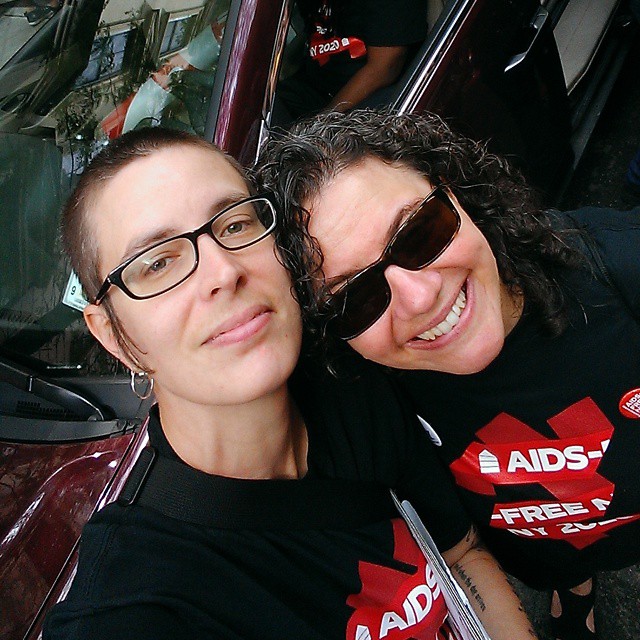
Same-sex self-portrait, #NYCPride, me with Jennifer L. Anderson, June 28, 2015. Photo by Jennifer L. Anderson
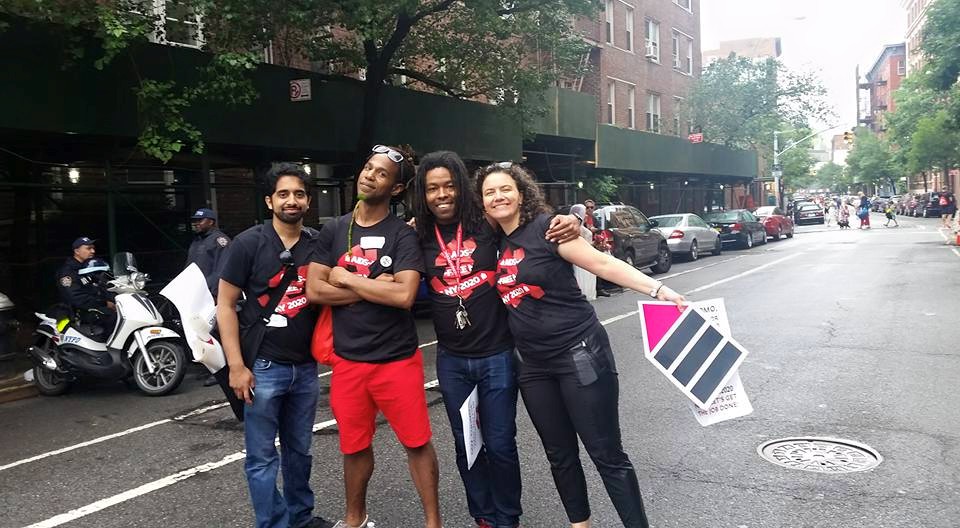
Me with my amazing Housing Works Inc. Advocacy compadres, rocking #NYCPride, June 28, 2015. The parade was so nice, we did the march twice! This photo was taken after Round 1, from left to right: Vinay Krishnan, Tony Ray, Jaron Benjamin, and me. Photo courtesy of Tony Ray.

Notorious RBG! One of my favorite sightings at #NYCPride, June 28, 2015. Photo by Jennifer L. Anderson.
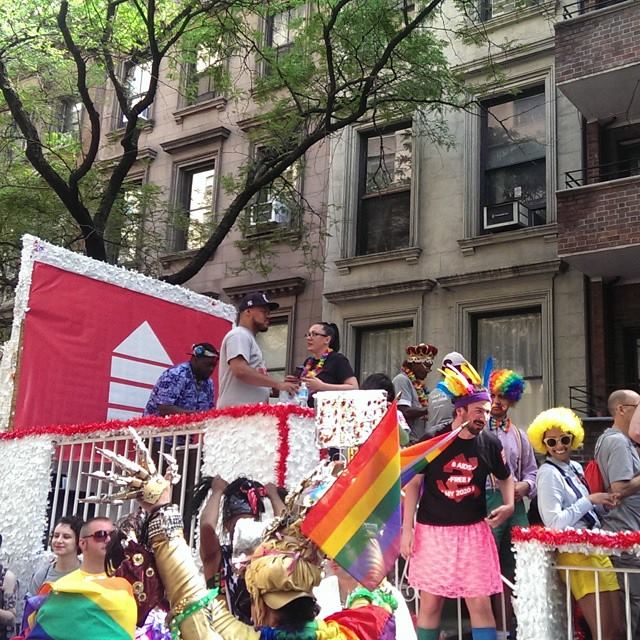
The Housing Works float, during the long wait to march at #NYCPride, June 28, 2015. I think the thing that may have moved me most at Pride was the young kids we kept meeting throughout the day, strangers from Alabama and Arkansas and Indiana and even from New York or somewhere geographically closer, who kept thanking us and reaching over the police barricades to high-five us or hug us because they were so happy and they know what a big deal this marriage equality is. I couldn’t pinpoint what it was about their joy that was so beautiful and then I realized: They looked hopeful. Photo by Jennifer L. Anderson.
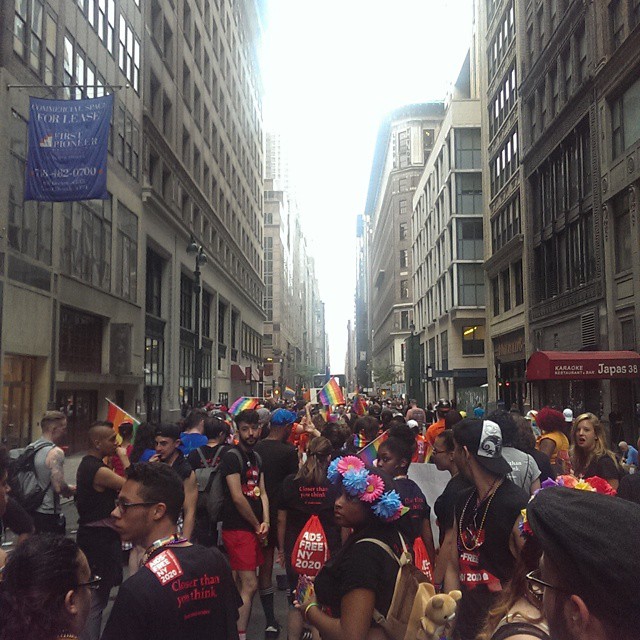
Housing Works in the #NYCPride house, getting ready to march down Fifth Avenue, June 28, 2015. Photo by Jennifer L. Anderson.
Days like yesterday, which was and is a very personal celebratory moment for me and for many people I love, are also a reminder that when we work for the greater social good, year after year, decade after decade, century after century—even when it seems like we’re going nowhere because so many who wield power and wealth use those things to reflect all the hate in their hearts—when we keep at it, change does come. Excruciatingly slowly. But nevertheless.
To get there, though, we have to keep showing up, even when we seem to be in the darkest of tunnels. When all the news we see and hear is bad, unjust, unconscionable, shameful.
That being the case, this seems the perfect day to begin my fundraising for this year’s BRAKING AIDS® Ride.
I also marked this post-SCOTUS victory day with a 68-mile training ride to Nyack and back. There are no cute photos. It rained on the way back. I was alone, woefully behind on my training this season, slow. I didn’t break any records with my astonishing speed or hill-climbing prowess. I wasn’t special. Or charming. Or intelligent. My ego felt bruised at various points. I kept going. I climbed through Palisades Park for the first time this season. I ate my bagel at The Runcible Spoon and as I sipped my iced coffee, I texted everyone who was on my mind because I felt sad and a little lonely and a little scared about how I would feel on the four miles of climbs going back home. Not every fucking moment is a victory lap. Most moments aren’t. Most moments are training, which is work. I showed up. I worked. That is all.
This will be my eighth year doing this 3-day, 300-mile journey by bicycle to raise money for Housing Works and to raise awareness about HIV/AIDS. When I started back in 2008, I’d never raised this kind of money or ridden a bike this far or this hard. In the years since then, I’ve put in something like 13,000 miles on the same blue bicycle, and raised between $60,000 and $70,000.
My most generous supporters have donated with astonishing generosity year after year. Their support inspires and amazes me. Above all, it’s necessary, which is why I continue to ask for their help and the help of other kind people I know again and again, each time wondering whether they’re sick to death of hearing me ringing a relentless AIDS-fundraiser gong.
For now, I’m not going to belabor the importance of the cause and how this money helps people who need help. I’m not going to get into all the ways in which Housing Works lives out the belief that even the seemingly weakest or lost or most far-gone among us are deserving of second or third or fourth or however many chances it takes to change and make their own lives and the world they live in better. I won’t regale you with HIV statistics. For now, I’ll say this: We can end AIDS as an epidemic, even without a cure or a vaccine. Housing Works has been at the forefront of that movement toward an AIDS-Free New York, an AIDS-Free USA, an AIDS-Free world. This is our JFK moonshot. We will get there.
Change comes when people show up for the fights that need to be fought. The most important kinds of change are hard-won and require showing up again and again and again and again.
I’ll end with this: HIV/AIDS has been plaguing us for over 30 years. We’ve been fighting for a long time, and we’ll keep fighting until we reach an AIDS-free world. Change is coming.
TO SUPPORT ME FOR BRAKING AIDS® Ride 2015, CLICK HERE. My goal is to raise $10,000 to benefit Housing Works life-saving HIV/AIDS services by July 31, 2015.
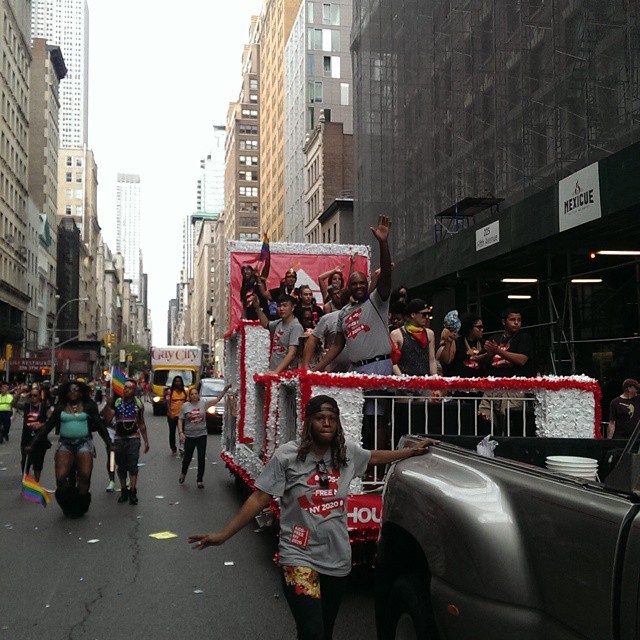
The Housing Works #NYCPride contingent, getting ready for lift-off, June 28, 2015. Photo by Jennifer L. Anderson.
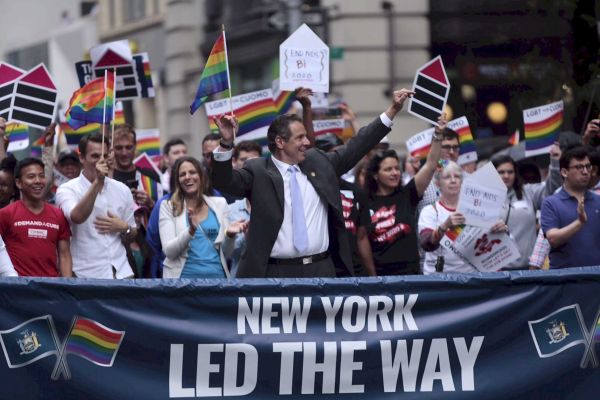
Is that a Housing Works sign or is the Governor just happy to see me? New York was the sixth state in the U.S. to make marraige equality legal and the most populous. It led the way for the domino effect of states that changed their laws to move toward the right side of history. New York can do the same for HIV/AIDS, which is as big and arguably an even bigger social justice issue than marriage equality. It’s also a battle we’re still fighting. Photo by Anthony Lanzilote.
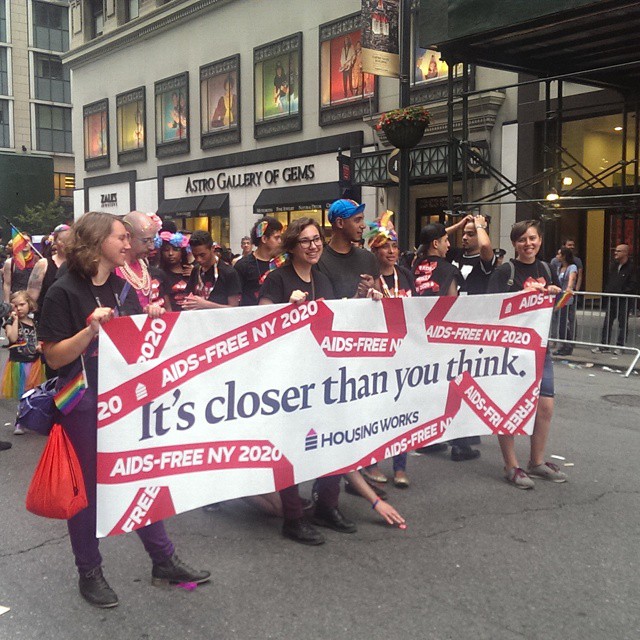
The Housing Works community, marching for #NYCPride, June 28, 2015. What’s next? Fighting for and achieving an AIDS-Free NY by 2020. Photo by Jennifer L. Anderson.

 The Blue Streak