
Braking AIDS 2013 Raises $250K and Counting for Housing Works

In the week since I bicycled 300 miles from Boston to New York and completed Braking AIDS Ride 2013, I’ve been bogged down in the usual, overwhelming post-ride wash of feelings—elation, love, gratitude, sadness, achiness (emotional as well as physical), exhaustion, bliss—and in catching up with regular daily life. (The latter, I confess, pales in comparison to the ride experience at the moment.) It remains close to impossible to try to convey the experience of the ride itself, which is far more of a journey than even the daunting physical 300-mile route suggests.

That being the case, it’s unsurprising that the ride leaves something of a chaotic upheaval in its wake. Each year, I find the ride’s aftermath—re-entry to a life without either the demands or the satisfactions of day-to-day training and fundraising—to be discombobulating. That shift too is hard to capture fully, as is the confusion elicited by the sudden change in my focus and emotional intensity. Still, the photo below of my living room, taken by my wife Jen the day after the ride, gives a pretty decent indication of what the first 5 to 10 days after Braking AIDS Ride looks and feels like, literally and metaphorically:

1233556_10151905010098656_805799789_n

Jen, commenting on our living room after we got home from closing ceremonies: “It’s like Braking AIDS 2013 just blarfed all over our apartment.” Photo courtesy of Jennifer L. Anderson.

As a result of all that tumult, internal and external, I haven’t been able to land for long enough to do a proper post-ride recap. One thing I can and will say right now is that even though this is my fifth Braking AIDS Ride, the experience of it is different and transformative in new ways every year, which is one of many reasons I keep going back. I had a physically challenging journey this year, but not in the ways I expected, and those obstacles and detours led me to rich places and feelings I haven’t had before on the ride. I plan to write more about the ride experience itself in the coming weeks, but in the meantime, I wanted to send word on the fundraising piece of the ride.

I am thrilled to report that as of September 29, 2013, Braking AIDS Ride 2013 raised $250,000 net for Housing Works.

As of September 30, 2013, Braking AIDS Ride netted $250,000 for Housing Works. Donations can continue to come in for the 2013 ride through the end of October: http://bit.ly/ZGvJZl.

As of September 29, 2013, Braking AIDS Ride netted $250,000 for Housing Works. Donations can continue to come in for the 2013 ride through the end of October: http://bit.ly/ZGvJZl.  Photo courtesy of Gant Johnson.

That $250,000 total is all thanks to the support of my dear friends and family who have been such generous donors to my ride efforts, and to countless others like them who contributed to the fundraising of other riders and crew members. They are my heroes, in the truest sense of the word, and all the donations and well wishes from every single one of them are what make the continued crucial advocacy and services that Housing Works offers possible. It is their good will and commitment that enable Housing Works to keep fighting the good fight in pursuit of the end of AIDS.

To those heroes who supported me this year and to the friends and family who were unable to contribute financially but who offered much-needed love and emotional sustenance: Thank you. Every time I think of the notes of encouragement so many of you sent, of the calls and voicemails, and yes, of your boundless financial generosity these past five months, I feel the way I did on Day 2 of this year’s ride when this photo was taken:
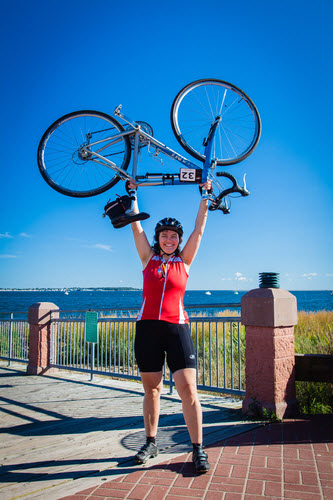
Me, celebrating near the end of Day 2, over 200 miles into the 300-mile ride, somewhere along  the Connecticut coastline. Photo by Alan Barnett.

Me, on Saturday, September 28, 2013, celebrating near the end of Day 2, over 200 miles into the 300-mile ride, somewhere along the Connecticut coastline. Photo by Alan Barnett.

Because I am both a wordsmith and something of a data geek, I have taken the liberty of doing some analysis, including some arithmetic number-crunching, in order to break down and illuminate what that $250,000 fundraising number means beyond the monetary one-quarter of $1 million total:

  • “As of September 29, 2013” refers to the fact that donations and matching gifts can continue to come in for Braking AIDS Ride 2013 until close to the end of October. That means 1) if you haven’t donated but would still like to, you can at http://bit.ly/ZGvJZl and 2) the final amount raised for Braking AIDS Ride 2013 will be calculated sometime in November and obviously will be higher than $250K.
  • To put that large $250,000 net figure into greater perspective: The 2013 ride consisted of 106 riders and roughly 60 volunteer crew members. Riders need to meet a fundraising minimum for the event, but crew members do not. That said, many of our amazing crew members raise money anyway.
  • Last year, the ride pulled in over $221,000, so this year’s Braking AIDS Ride 2013 total represents a 13% increase ($29,000 more) over 2012.
  • My contribution toward that $250,000 total, as of this writing, comes to $13,185. And that figure also may go up to $15,240 if the matching gifts from my own company go through. (We have a new owner and a new set of HR policies, including a matching-gift program. Technically, according to the program’s guidelines, Housing Works should qualify for matching gifts, but despite repeated attempts, I have been unable to get confirmation on that. With the help of many of my colleagues, I have been diligently sending in completed matching-gift forms anyway, and I made another phone call to the powers-that-be this morning. Stay tuned and fingers crossed.)
  • The $13,185 I raised was made possible by over 150 generous donors, all of whom are listed below. They inspire me and have all my gratitude.
  • Through the help and generosity of those 150+ donors, I achieved just shy of 132% of my original fundraising goal, which was already an ambitious $10,000. My typical beginning goal in past years has been $5,000.
  • This $13,185 represents the most I’ve ever been able to raise for a single Braking AIDS Ride, even exceeding the $12,500 I was able to raise back in 2008, when I was a first-time rider and the sheer fact of me attempting such a Herculean physical undertaking was an astonishing novelty to everyone who knew me.
  • Contributions to my ride efforts this year ranged in size from $20 to one mind-blowingly generous $1,000 donation. The average donation totaled at about $100. No doubt about it: Every dollar counts, and each and every donor helps make it happen.
  • The majority of the amount I raised this year came from individual donations—just over $12,000—with an additional $1,150 coming from corporate matching gifts. (That latter figure will increase to $3,205 if my company’s matches come through.) If you donated this year and forgot to see whether your company has a matching-gift program, please check with your HR department today, as if there’s still time to process these gifts and doing so can double your already generous contribution to Housing Works. My hope is that for future rides, I’ll be able to find more donors who are able to maximize their contributions through a corporate gift program. The paperwork is a minor nuisance and most HR departments don’t make it easy to even discover whether the company has a gifts program, what kinds of donations qualify, and what you need to do to process a gift for a company match, but as this year’s stats show, it is worth being persistent in finding out. Those matches add up.
  • Over $2,000 in donations came from my McGraw-Hill Education friends—colleagues, authors past and present, and work-based outside vendors and freelancers. That impressive sum does not include the possible matching gifts from MHE’s parent company. In addition to being stellar people to work with, these individuals are kind and magnanimous. Those who work with me in my Midtown office are also mostly nice enough not to make too much fun of me when I commute from Brooklyn by bike and show up to work in cycling gear.
  • Most of my donors are individuals, but I was also surprised and grateful to receive generous support this year from several local businesses in my Brooklyn neighborhood. I believe in using my own consumer dollars to support high-quality businesses that give back to the community—and it goes without saying that, in addition to being good samaritans, all of these organizations are fantastic in terms of the primary goods and services they offer—so I want to give a particular shout-out of gratitude to the following spots in and around South Brooklyn (Cobble Hill; Carroll Gardens; Columbia Street Waterfront; Red Hook):
    • Woofs ‘n Whiskers, a dog-walking business and “urban cat and dog retreat,” run by the big-hearted folks who have been caring for our dog Sadie for over a decade.
    • Elite Fitness Studio, my excellent neighborhood gym, where locals at all different stages of athleticism and fitness can feel supported and stay motivated.
    • The JakeWalk, a warm, welcoming Carroll Gardens restaurant and bar owned by the same folks who have brought us Stinky Bklyn cheese shop and the Smith & Vine and Brookyn Wine Exchange wine shops. Now that I am done with the ride and no longer in hard-core training mode, I plan to frequent all these establishments again with relish.
    • Papél Brooklyn, which, for those of you who have ever received a written missive, or gift-wrapped from me and exclaimed “what great packaging” or “what a perfect card/postcard/stationery design, is on my list of favorite paperies (and that’s a very short list, too).
  • Surprise donors, old and new, come through every year. The lesson this year, which I seem to keep re-learning, is that one can never be 100% certain who will be able to give or when, just as one doesn’t always know how many people’s lives are affected by HIV or AIDS. Parts of my donor base change every year and not always in predictable ways. For example, some people who gave in 2008 and then didn’t for my 2009, 2010, and 2012 rides returned as donors this year. Likewise, people I’ve solicited for all five years I’ve done the ride and who never donated before now gave for the first time this year. But these two statistics from this year especially blow me away: Nearly one-third of my donors this year were brand-new, a particularly moving figure when one takes into account the fact that I did not experience any of the life changes that often result in a significant expansion of my social network and a broader potential new donor pool—a new job or a move to a new city, for example. The flip side of that fraction leaves me dumb-founded with gratitude: Over two-thirds of my donors—that’s over 100 kind souls—are previous donors of at least one of my five Braking AIDS Rides, and many of them are people who have donated all five years I have done the ride.
  • Three donors, two of whom I am lucky enough to call family, made me cry when they wrote me to say they were each contributing a second donation this year.
  • The $13,185 my 150+ heroes helped me raise puts me in the #5 spot for individual fundraising for Braking AIDS Ride 2013. You guys rock.
  • This 2013 $13K+ total also means that since 2008, I’ve raised over $50,000 in the fight to end AIDS, averaging at $10K per ride event coming from between 80 and 150 donors each year.
EOAIDS

In spite of this post’s focus on money and financial results, I also want to emphasize to all my donors that your dollars are doing far more than paying for critical services and programs, though they are most certainly doing that. You are saving and improving lives in an immeasurable, spiritual way, not just a physical one. The emotional and spiritual toll that HIV, AIDS, and homelessness all take on a human being cannot be diagnosed using any medical test or shaped into concrete statistics to use for a jaw-dropping graph or fancy infographic. But it’s there nevertheless. No one describes that toll better than Housing Works President, CEO, and co-founder and fellow Braking AIDS rider Charles King, who spoke during our opening ride ceremonies and shared with us some remarks he made last month at a roundtable meeting on the end of AIDS convened by UNAIDS, the Joint United Nations Program on HIV/AIDS. He also included these same remarks again as part of a longer presentation called “Ending the AIDS Epidemic in New York State and Around the Globe” that he made in Montreal at North American Housing and HIV/AIDS Research Summit VII on September 26, the day before the ride began (and the full text of that presentation can be found here):

For too many years, we have insisted on treating HIV as a biomedical event, when in fact it is a biosocial phenomenon.  That is to say, that while HIV is indeed a virus, it is a virus that is driven, as we all know, by social violence, which is why it largely has spread through the most socially and economically marginalized members of our communities and wrecks even more poverty and marginalization in its wake, at a very great cost. 

We pay lip service to this phenomenon through our talk of key populations.  But we persist in largely biomedical and individualistic behavioral responses.  In order to end the epidemic, with or without a vaccine, we need structural interventions that address the social drivers of this disease.  To date, with the exception of vulnerable children and orphans, and pieties about human rights, we have resisted this approach both because of the attenuated nature of the causal links and because of the supposed financial or political cost of the required interventions.

In fact, we have to recognize that these key populations represent the nexus between the goals of ending poverty and ending AIDS.  It is not so much new money we need.  It is targeting our development dollars at the right people, both to eliminate poverty and to stop transmission of the virus, and taking seriously the commitment to human rights.  Structural interventions, properly applied, can serve not only to keep millions of HIV+ people in care and ultimately virally suppressed, but they are also an effective prevention strategy.

I believe I am on solid scientific and economic ground for my case, being neither a scientist nor an economist.  But the Baptist preacher requires me to speak not just of science and economics, but also to the human condition.  You see, when I speak of the cost of social violence, I am not just speaking of the economic cost or the disease burden.

Think about what it means to be subjected to social violence.  Homelessness not only deprives you of the means to organize your existence, it deprives you of your very dignity.

Not being able to feed your children not only deprives them of essential nutrition, it signals that you are not fit to be a mother.

Being unable to get a job because you are an obviously gay man or a transgender woman not only deprives you of a livelihood, it says you have no value to offer society.

Hiding from punitive laws because you are addicted to drugs or survive by selling sex not only forces you underground, it destroys your sense of self-worth.

We talk about living well as both a measure of disease control and of economic development.  But social violence not only spreads HIV and poverty, it destroys one’s soul.  We will not end the devastation of AIDS until we allow those who have been impacted to reclaim their most sacred part, their very souls.

That is what ending AIDS is most about.  Not just stopping a virus, but allowing people who have been cast to the margins to reclaim their place in our communities and in the world.

[emphasis mine]

With that, I have one final, simple message for my many benevolent donors: Please don’t ever doubt the impact and the ripple effect of your contributions to this cause. In being part of this fight to end AIDS and homelessness, you are doing more than helping people in need survive. You are helping them to live. Thank you again, all of you, for all you do.

My Braking AIDS Ride 2013 Heroes

Jessica Abel & Matt Madden*
Chris Anderson & Mel Stupka*
James Anderson & Suzy Turner*
Jennifer Anderson*
Renée Anderson*
Anonymous* (4 donors)
David Anthony*
Tansal Arnas*
Kate Asson
Janis & Dave Auster*
Jennifer Baker*
Paul Banks
Leah Bassoff*
Charles Baxter*
Jon Bierman*
Deirdre Birmingham
William Bish*
Claire Brantley
Aviva Briefel
Kelly Burdick*
Steph & Bill Carpenter*
Jess Carroll & Sharon Glick*
Stephanie Carroll
Lynne Carstarphen*
Carnegie Corporation of New York†
Clare Cashen*
Betty Chen*
David Chodoff*
Danielle Christensen*
Laura Coaty*
Susan Conceicao*
Barbara Conrey*
Janet Corcoran
Nancy Crochiere*
Anneliese & David Daskal
Joe DeIorio & Thos Shipley
Nicole Dewey & Bill Seely*
Carol Diuguid*
John Dunn
Christie Duray
Mariamne Eliopoulos*
Elite Fitness Studio*
Julie Englander*
Rachel Falk*
Michael Fisher
Terence Fitzgerald*
Timothy Fitzpatrick*
Jimmy & Chris Flavion
Ray Flavion*
Kory Floyd*
Kerri Fox*
The Well-Placed Word
David Gifford & Svenja Leggewie*
Michael & Nicola Gillespie*
Rebecca Gilpin*
Goldman Sachs†
Google†
Susan Gouijnstook*
Penina Greenfield*
Dawn Groundwater*
Amanda Guinzburg*
Scott Harris*
Karen Henry*
Chris Herrmann & Joseph Lorino
Frank Hopp*
Tom Hyry*
The JakeWalk
Andrew Janke
Andrea Vaughn Johnson & Eric Johnson*
Kristopher Kelly
Laura Kennedy
Elizabeth King
Judith Kromm
Debra Kubiak
Jon Lowy
Sylvia Mallory
Matt Martin
Derek McNally*
Dave Meier*
George Meyer*
Michelle Misner & Jason Baluyut*
Richard Monreal
Lorraina & Ben Morrison*
Susan Muller-Hershon
James Murdock
Elizabeth Murphy*
Liz O’Brien*
Eva & Tom Okada*
Jacob Okada*
Stephen Okada
Michael O’Loughlin
Papél New York
Gregg Passin*
Anne Paterson
Nancy Perry*
Lisa Pinto*
Eileen Pollack*
Mary E. Powers
Kirstan Price*
Catherine Groves Ramsdell
Josie Raney*
Jessica Bodie Richards
Rhona Robbin*
Greg Romer*
Stacy Ruel*
Mike Ryan*
Carla Samodulski*
Danielle Scaturro*
Terri Schiesl*
Duane Schrader
Roger Schwartz*
Brian Seastone*
Samantha Shaber*
Jane Smith*
Janet Byrne Smith*
Fred Speers & Chase Skipper*
Lynn Stanley*
Katie Stevens*
Carylanna Taylor
Jeannine, Bil, Kade & Jack Thibodeau
Matt Trokenheim & Jen Simon*
Woof ‘n Whiskers*
Kelly Villella*
Sherry Wolfe*
Yu Wong*

† matching gift

Red Hook, Bklyn, Post-Hurricane

It is 5:40pm on Saturday, November 3. The worst of Hurricane Sandy has been over for five days. Jen and I just got home from walking to the southern part of Red Hook in Brooklyn, where the post-storm devastation is ongoing.

We didn’t stay home during the storm. We spent the days of the hurricane with generous friends who live inland in Brooklyn, two neighborhoods away. The rear side of our apartment building faces west and is on the eastern side of Columbia Street, a narrow, two-lane street that runs parallel to the waterfront. Prior to Hurricane Irene last August, a close look at the city’s hurricane zone street maps revealed that this location places us exactly on the border of an evacuation zone. Everything north, west, and south of the west side of Columbia Street is designated as part of the mandatory hurricane evacuation area—and with good reason. It is one block from the water. The only street located west of Columbia in our little part of the neighborhood is Van Brunt Street, which runs parallel to Columbia and overlooks the commercials piers and stevedores that dot the south Brooklyn waterfront.

In the Google map I created below, our section of the neighborhood—distinct from the more gentrified Carroll Gardens because it is located west of the Brooklyn Queens Expressway, and only accessible by four overpasses and one pedestrian footbridge going over the highway—is marked in green. The dark red line marks the division between where we live and the red mandatory evac zone to the west. Our little green plot is technically the northern section of Red Hook, but because it is just north of the Brooklyn side of the Brooklyn Battery Tunnel and Hamilton Avenue, a commercial thoroughfare that runs directly underneath the BQE (Route 278 on the map), it is also cut off from the main part of Red Hook. On the map, Hamilton is denoted by the diagonal lavender line, and the primary parts of Red Hook, all part of the mandatory evac zone, are to the left of that line, marked in red.

I like maps, but I also understand them well enough to know that many of their borders are artificial; just because a map says we live, just barely, on the advantageous side of an evacuation line doesn’t guarantee a hurricane will pay any attention to that particular distinction and stay on its side of the divide. In addition, the two drains in our building courtyard are partial to flooding during thunderstorms, and we live on the first floor. That being the case, both last year during Irene and this past week during Sandy, we decided to be on the safe side and move inland because we could. We spent from Sunday to Tuesday evening safe and dry, six flights up in downtown Brooklyn. By Monday morning, long before the landfall and the worst of the storm, we were seeing photos from the southern part of Red Hook that looked like the one below, which was taken by a local resident from the southern-most end of Van Brunt, where the Fairway supermarket is located. Our building is a 15-minute walk or a three- to five-minute bike ride from where this snapshot was taken, so we had no idea what to expect when we finally returned home.

Nick Cope

A now infamous image of flooding in southern Red Hook, Brooklyn, the morning of Oct. 29, 2012, from the southern-most end of Van Brunt Street near the Fairway supermarket. Photo by Nick Cope/Green Painting

In the past three days, I’ve said, emailed, and texted—more times than I can count—that we were very lucky. Our little stretch of Columbia Street was spared. Amazingly so. No flooding. No power outage. Our minor difficulties have all been inconveniences rather than genuine, serious problems. The lack of any viable transportation to Manhattan has kept us at home. The cable has gone out periodically, our internet signal was out entirely until this afternoon, and phone service all over the neighborhood has been and remains spotty at best. All week, I sent and received email sporadically via a weak and equally spotty 3G signal. Texting has proved to be the most reliable communication channel—even though it takes three to six failed attempts before any message goes through and incoming messages often don’t show up for hours if at all.

We spent most of Wednesday at home; I don’t think we realized how stressed out we were about what might be happening to our apartment until we got back. On Thursday morning, my work laptop and I headed to Maybelle’s, the one local coffee house with both wifi and electrical outlets for three-prong computer plugs. The small place was mobbed all day and freezing, but I spent most of the day there anyway, grateful that I had anywhere to go where I could attempt to get some work done. On Friday, we were out of luck again in trying to find an online hook-up; Jen trotted off to Maybelle’s in the morning only to return a while later saying their wifi signal was kaput.

These are all good problems to be having. When we were still at our friends’ house on Tuesday morning, our friend and neighbor Andi, whose building two blocks from ours had also held up fine, relayed to us via text that everything south of Hamilton Avenue and the Brooklyn Battery Tunnel, just a five-minute walk from us, was a mess. “…Red Hook looks pretty bad,” she reported. “Power out there, bad flooding, gas/oil/chemicals on the sidewalks.” The photos that have been posting online in the days since then have confirmed that description and documented worse.

We didn’t doubt that the damage was severe. When I went to the bodega next door on Wednesday afternoon to pick up milk, the owner, Mrs. Li, asked, in her halting English, after me and Jen. As we were talking about the storm, she told me about a customer from that morning who lived on Staten Island. The winds were so strong that the woman’s brand-new outdoor fence was carried away hours before the main part of the storm hit. The surge that followed was so encompassing, boats from the marina smashed into floating cars and drifted into her yard. The flood level in her house was soon so high, she and her family had to swim out to safety.

Hearing a harrowing story like that made it all the more strange to be walking around Carroll Gardens, where everything was mostly the usual. Aside from the huge, downed trees and the shelves at local stores that are low on stock if not entirely out of certain key items—batteries, flashlights, bottled water, candles—the signs of damage and storm impact are minimal. Even on our grittier side of the highway, although the streets are quieter than usual and many of the local businesses remain closed, you wouldn’t know from appearances how truly lucky we are. The only visual signs that something is amiss are increased bicycle traffic and long lines at the grocery stores, bakeries, and restaurants that are open. The view from our bedroom window facing the street doesn’t show how close we are to staggering losses, places where people are still living under terrible, near-unimaginable conditions that show no signs of dramatically improving any time soon.

Like a lot of locals, we thought it was important, essential really, to show our gratitude for how unscathed we are by trying to offer some help to our neighbors. As Jen put it to me last night, “I was scared for us. For our home. For what could have happened to everything we own. I don’t think I could show my face in the neighborhood if we didn’t do something to try to help the people down the street.” Jen has been following the Twitter feed of the Red Hook Initiative (RHI), a local community center that offers a range of health, education, employment, and neighborhood development program. In the wake of the storm, RHI is redirecting all its efforts and resources toward hurricane recovery work, becoming a de facto focal point for relief efforts and support, so that’s where we headed. The Twitter updates have offered up useful  information about the kind of volunteer work that is available, about the kinds of supplies and help that are most needed, all in real time.

Our first stop was the Met Food on Henry Street in Carroll Gardens. On our way there, we passed by Maybelle’s again. Crystal, a student who we know because she’s worked part-time at various cafes in the neighborhood, was sitting on the bench out front having a cigarette, so we stopped to chat and ask her how she was. “Your expression looked so serious,” remarked Jen, “I almost didn’t recognize you.” Crystal works in and around Carroll Gardens, and her mom lives there, but Crystal herself lives with her aunt and uncle on Staten Island. She’s spent the past few days shuttling between her mom’s and trying to repair the severe damage back in her own neighborhood, where many people have lost their homes altogether. Those who haven’t are still waist deep in flood water, with no running water or heat, and the only people with electricity are those with generators. Crystal described trying to drive through there at night to pick up salvageable clothes and supplies. “It’s pitch black, no light at all except from the headlights of my car. It looks like the zombie apocalypse.” She told us she’s been pretty freaked out, and today was the first day she could even talk about it without choking up. But she also noted that nearly everyone has been resilient and helpful. “We wouldn’t have any power at all at my house if our neighbors didn’t have a generator that they loaned to us. I bought a bunch of blow-up air mattresses, and I’m telling friends they can crash at my house for as long as they need to. We’re all doing what we can and what we gotta do. Last night,” she said, pausing to grin in a mixture of what looked like self-consciousness, shyness, and pride, “we made twenty pounds of pasta and then spent all night serving dinner to anyone who needed to eat.”

After hearing that, suddenly our trip that afternoon became more real, more urgent, more sober. Jen had a list of supplies that were atop the RHI want list for the afternoon, and first at Met Food on Henry Street and then at Winn Discount on Court Street, we filled our granny cart with as much as we could find. It sounded like a lot of people were already bringing in bottled water and food that won’t spoil easily and doesn’t require cooking, so we focused on the other miscellaneous things one wouldn’t necessarily think about under normal circumstances: dry dog and cat food, maxi pads, diapers, mops, replacement mop heads, rubber gloves, sponges, bleach and other cleaning supplies, industrial-strength garbage bags, buckets, batteries, flashlights, candles, matches.

RHI is located on the corner of Hicks and 9th Streets in the heart of Red Hook. It’s mere blocks away from the NYCHA Red Hook Houses, the biggest public housing project in Brooklyn, with between 5,000 and 6,000 residents, and also among the poorest and most dangerous and crime-ridden. Because Met Food and Winn Discount, both located in Carroll Gardens east and north of our apartment, were the best places to stop and get cleaning supplies, we took a more indirect route to get to RHI than we might have, had we gone straight from home. After leaving Winn Discount, we walked south on Court Street, Jen pushing the heavy shopping cart, and then we took a right at 9th Street, crossed the treacherous, heavily trafficked Hamilton Avenue, and continued heading back west down 9th until we reached Hicks Street. We passed by the Red Hook shelter on the way, and the lines of people waiting outside to see if they could get a place to stay for the night were four and five people deep and extended all the way down the block in both directions.

We hadn’t been to RHI before, but we didn’t have to look at the street signs to find it. The crowds of people, the flash of emergency lights from police cars, and the cluster of double- and triple-parked vehicles told us. Volunteers were unloading cars and vans full of aluminum trays of food, pallets of water and paper towels, blankets, and clothing. Inside, through the windows, I could see an elaborate assembly line set up for feeding people, and the line of hungry locals waiting to get a meal snaked out the door. Supplies were in such high demand, most weren’t even making it into the facility. They were being organized by category by the wall outside, so people could drop donations off quickly and others could easily locate and pick up what they needed. Everyone was carrying something, bags laden with food, shopping carts, backpacks, and they were all moving quickly, trying to make it to safety, wherever that might be, before the sun went down and the neighborhood became pitch-black again.

It was a sobering sight. A far cry from Maybelle’s and Carroll Gardens, where some of the local kids had been able to go trick-or-treating on Halloween. Once our cart was empty, Jen and I kept walking west on 9th Street, where two blocks later, another clog of people and city buses being used to transport resources was clustered in front of a Catholic church that was also offering recovery assistance. We didn’t say anything to one another as we walked along. There wasn’t anything to say. The air was clammy and cold. The sky looked strange, sunny and piercingly blue in some stretches, and in others, swollen and claustrophobic, heavy with menacing, low-hanging clouds shaped like giant tunnels. We took a quick right onto Columbia Street, and a left at Verona Street, which runs along the northern edge of Coffey Park. Earlier in the day, people had been distributing food and water there, but now that nightfall was only a few hours away, the park was empty, littered with fluttering, yellow police tape and massive downed trees. We stayed on Verona until we hit Van Brunt, which is the main drag and which offers the quickest access back north, across Hamilton Avenue and to our side of the neighborhood. It’s also the primary part of the regular route we take on weekends when we walk Sadie down to Louis Valentino Pier, a park beautiful park overlooking the harbor, with the Statue of Liberty in the distance.

I’m not sure what we expected as we walked up Van Brunt. Because we had accomplished our small mission, because five full days had passed since the worst of the hurricane had subsided, because that particular spot is only four blocks south of Hamilton Avenue, some six or seven from my house, some part of me must have thought, hoped really, that what we were to encounter there would be an improvement, well on its way to being back to normal. I had heard about and anticipated the waterlogged debris and garbage sagging in clumps on street corners and on curbs, pools of gas and oil on the sidewalks. I didn’t expect the steady stream of runoff water tricking along the street gutters, not from street flooding, but rather from all the water still being pumped or carried out of the surrounding houses and properties. I didn’t expect to find our friend Danielle, surveying her demolished front yard, sorting through her waterlogged, mostly ruined belongings, fielding calls from her kids, who have been spending their nights at friends’ houses.

We don’t hang out socially with Danielle and her husband, but we have known them and been their clients and neighbors for many years. They own the local dog and cat daycare place, just a block from our house; they do dog-walks, too, and they have cared for our dog Sadie for over a decade. Their business space, located on our side of the highway, was, like our building, spared: no flooding, all the animals were safe, and they were open for business again by Wednesday. Because Jen and I didn’t know whether we would or wouldn’t be able to go into work each day this week, we’d exchanged emails with Danielle each day, first with her letting us know when everything was fine and up and running at her end and then confirming whether we needed to have Sadie walked. Those exchanges were so business-focused, and so stoic, we had no idea until we walked by this afternoon that Danielle’s house, located just five minutes away from our house, had been pummeled by the storm.

That Danielle and her family still have no power isn’t surprising. No one on that side of the highway does right now. But the only source of heat is a makeshift wood fire she and her husband built on a barbecue grill. When we walked by, the grill was positioned at the foot of their front steps, and an elderly person we didn’t recognize, presumably a neighbor, was sitting on the stoop in front of the grill to keep warm. Most startling of all was the noise, the buzzing and rattling of an enormous electric pump, with one hose leading into the basement to siphon the water out and another pipe extending out the front yard, which was still belching flood water out of the house and into the street. Danielle’s house is two stories, plus a basement. The hurricane water surge filled her entire basement, floor to ceiling, and the first floor where they live was filled with nearly two feet of water. A fog of confusion drifted over Danielle’s face as she tried to describe the peculiar flood path of ordinary household items. The heavy, plastic container full of dog kibble that floated and drifted into another room. Her Christmas ornaments that ended up on the lawn, where she later caught a stranger looting through her soggy stuff, rooting through holiday decorations to steal the ones she wanted.

We tried to offer her help if she needs it in the coming weeks. Clean-up help, baby-sitting, somewhere for her kids to crash, a place to do laundry, an hour or two away from the mess to have a drink, take a nap, soak in a warm bath. For the moment, all we did was take in her pet love bird. The bird had been moved from Danielle’s house to the business space for safety reasons, but Danielle noted that the bird was probably unhappy there, from lack of attention and an overdose of barking and whining from the menagerie of other animals. So we picked up Izzy on our way home, and she’s chirping away in our office as I type this.

Aside from the Google map I annotated to give readers unfamiliar with the area a sense of its geography and scale, and the already widely posted photo of Red Hook flooding that went viral on Monday morning, I intentionally decided not to post any other images of the wreckage or the poignant, unsettling relief efforts. A ton of grim photos online mirror elements of the narrative I’ve tried to relay here—and these startling images have their place in helping to show how dire things are in certain parts of the city and how  much help is needed and where—but I am not a neutral journalist, conveying news objectively. I decided not to re-post those pictures for the same reason I didn’t take any photographs when I was walking through the neighborhood myself. It’s the same reason that it gave me the willies to see how visitors flocked to stare at and take their pictures in front of the 9/11 site while it was still a smoldering crater of dust and debris in the ground. Because the act of doing so, as someone who isn’t either a resident or a journalist, would have felt distancing, dehumanizing, and voyeuristic, like I’m some sort of disaster tourist coming to visit other people’s misfortune and suffering and observe it from afar like it’s a safari or an exotic Survivor-esque museum. It’s not a diorama. It’s not a made-for-TV disaster film. It’s not yet history. It’s real, daily life for flesh-and-blood people, many of whom don’t know when or where they’ll get their next warm, home-cooked meal or if they’ll have a dry, safe, heated place to sleep tomorrow night.

Likewise, I am not writing about any of this because of a lurid fascination with catastrophe sites. Or because it makes a good dramatic story. Or because I think it’s newsworthy that we spent a few hours helping out in our own neighborhood. In fact, none of this is about me or Jen or our family, except that it’s no more than mere chance that we’re fine, and Danielle and her family and lots of other neighbors are not.

This is why I’m writing: The hurricane will soon become old news in the media, especially once all the subways are up and running again, and most people, myself included, are able to get to work on Monday. It won’t be old news for Danielle or my other neighbors on that side of the neighbor hood. Those damaged sections of Red Hook may not have power again until at least November 11. No running water, no electricity, no heat, virtually no transportation, no fuel, and uneven, limited access to food, potable water, and supplies. The lack of power also means that all recovery work needs to take place during daylight hours, even as the days are getting shorter. I’m certain other similarly devastated areas are facing comparable challenges.

I am writing about all this because based only on the little I’ve seen, and I have seen very little of the worst pieces of what’s happening out there, I can say firsthand that the storm damage is deep, wide-ranging, and long-term. Help is needed now, a lot of it, and it’s going to continue to be need for weeks and months to come. And it’s pretty easy for most of us to help because there are a ton of places where people can do whatever is within their means, as well as a range of ways to contribute.

Please: If you are able, go find a way to help that works for you and do something. If you have time to volunteer, go spend a few hours helping with clean-up, or shelter efforts, or distributing food, water, and supplies at one of the relief centers. If you don’t have time, but have material goods you can either donate, or purchase and then donate, go online and look up what’s needed where, and give some clothing, food, water, cleaning supplies, toiletries, etc. If you’re unable to give time or donate supplies, and/or you’re too geographically removed from any of the disaster sites to be able to help physically, donating money is an equally helpful option. Every little bit counts. The point is that we all should do something if we can—because we can. At the end of this post, I’ve included some links to a handful of place where you can start exploring help options, but a simple Google search and scanning of news articles about the storm aftermath will yield more as well.

In addition, please expand the support network by re-posting information and links to available volunteer and donation options anywhere and everywhere: Facebook, Twitter, email.

Ways You Can Help

Because the national efforts via government agencies and large relief organizations like the Red Cross are already widely publicized in the press, and because they are farther removed from the actual sites needing help and it may take them longer to get their resources to where they need to be, the initiatives listed below focus more on localized, on-the-ground efforts:

Red Hook Initiative: http://www.rhicenter.org/.

Red Hook NYC Recovers: https://redhook.recovers.org/, an online resource coordinated by the folks at OWS and community organizations on the ground that was built to enable people to both offer and request assistance. Sites for donations and volunteering have been set up in multiple locations, some in Red Hook, but also in other areas like Sunset Park, the Rockaways, and Staten Island.

CityMeals-on-wheels: https://www.citymeals.org/, an organization whose mission is devoted to getting food and human company to home-bound elderly New Yorkers. This is one of the most vulnerable and least visible populations affected by the hurricane, especially elderly people living in high-rises that have lost functional elevators and power. Here is a great overview on the emergency services CityMeals is providing: a release on the CityMeals website about their post-hurricane response.

For tomorrow, Sunday, November 4. NYC Marathon of Relief Efforts (NYC MORE 2012): www.nycmore2012.org, a group of runners and volunteers who have turned the cancellation of the NYC Marathon into an all-day volunteer opportunity, with options to volunteer in the Rockaways, Staten Island, and Coney Island. Also includes ways to donate goods and funds.

Occupy Sandy Relief: http://interoccupy.net/occupysandy/, another online resource built by a coalition of people Occupy Wall Street, 350.org, recovers.org and interoccupy.net. Its offering are similar to Red Hook NYC Recovers, but its information is on facilities serving other affected areas, not just Red Hook. Includes volunteer and drop-off locations in Chinatown, the Lower East Side, Rockaway, Coney Island; drop-off-only locations in numerous locations in Manhattan, Queens, and Brooklyn; and a portal to help in New Jersey.