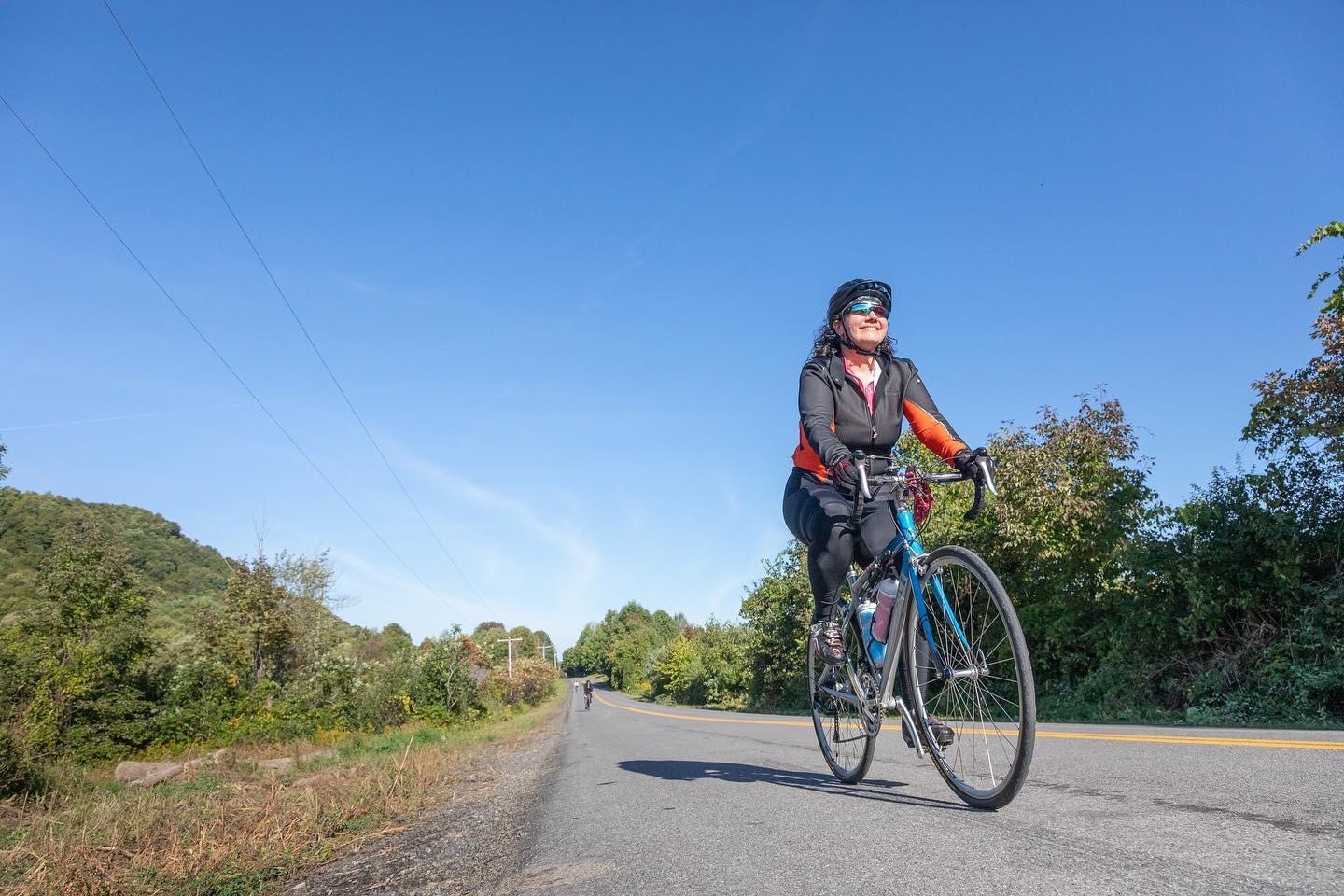
VIDEO: BRAKING AIDS® Ride 2022, opening ceremony remarks


BRAKING AIDS® Ride 2022 took place yesterday, and I was reminded again of all the reasons it’s always one of my favorite weekends of the year. I had the privilege of being asked to give some brief remarks at the opening ceremony kicking off the ride . My dear ride husband and fellow rider Clay Williams recorded and shared it via Facebook live (thank you, Clay), so I’m able to share it here. Below the video is a written transcript of the full speech.


Good morning,

The first person I knew who had AIDS was my mom’s childhood friend Dennis. Dennis, like my mom, came from an immigrant family, and was like an uncle to me. When he and my mom got together, the air thrummed with laughter and loud yakking in Romanian.

Those gatherings were infrequent because Dennis’ job as a journalist had him jumping from one global political hotspot to the next. But then he’d breeze into town and spark a jam session of multiple languages, dancing, eating, drinking. His laugh was a high-pitched cackle, one that would turn your head to see who had made that sound.

He confided to my mom that he was bisexual, but she believed he was gay. Regardless, his sexuality was a secret. And then, in early 1987 Dennis got sick and he stopped globetrotting. He died in December, and his NY Times obituary led with a common lie: “Dennis A. Volman, a reporter for The Christian Science Monitor, died of cancer Monday at the Mount Sinai Medical Center. He was 37 years old and lived in Washington.”

Dennis died a horrific death of physical agony from AIDS. If he had a partner, he took that secret with him. Only Dennis knew how much his soul suffered from shame and fear. I can only imagine it made a difficult dying process far lonelier.

This next bit I’ve never shared publicly. In 2012, I launched a blog about the ride, and I wrote an entry about Dennis. The blog’s main audience is my network, so imagine my surprise in 2013 to get emails from two strangers. One was a former girlfriend of Dennis’ who found the blog through a google search; she shared the post with the other stranger, an old friend of Dennis’s mom. They each emailed me to debate the historical record: Dennis had died of pneumonia while battling cancer. And why did I think Dennis was gay? The family friend was especially insistent it couldn’t have been homosexuality or AIDS. She cited his affairs with women, his poor health in childhood, his chronic pain from a back injury. From these women, I learned that Dennis had kept his illness secret, too. Only his nearest and dearest heard he was sick with “cancer” shortly before he died.

Our email exchanges ended quickly in a stalemate, but they unnerved me enough to ask my mom how she knew Dennis had AIDS. Apparently, she saw he had KS lesions when she visited him in the hospital.

I don’t judge Dennis for keeping secrets. Homophobia and AIDS stigma were prevalent enough that those choices may have protected him, whatever emotional price he paid. But by 2013, he’d been dead for over 25 years. His parents were dead. He had no children. No siblings. How had stigma, fear, and homophobia re-emerged, overshadowing sense and reason, when those lies protected no one anymore?

So why share this fucking heartbreaker of a story?

Because the shadow side of people’s humanity isn’t the only story. That is never the only story. Seeds of social justice were being planted even then. While Dennis was dying in March 1987, the first meeting of ACT UP was held in the West Village. Three years later, Housing Works was founded out of ACT UP’s housing committee. Both organizations demanded action from a government that ignored AIDS for years. These fiery activists didn’t wait for a grand utopian future; they acted with courage in a seemingly hopeless present, defying the cruelty and ignorance around them. They used civil disobedience to demand better drugs today, not tomorrow. They won those fights and saved countless lives.

Today the fight goes beyond medication; it’s a social justice battle—fighting the racism, homophobia, transphobia, and misogyny that fuel the AIDS epidemic in spite of our medical progress. For over 30 years, Housing Works has fought for social justice, anchored by this belief: that whether we are dying or healthy or somewhere in between, all human beings are deserving of housing, food, healthcare, and basic dignity and respect. Whether it’s AIDS, homelessness, the opioid crisis, COVID-19, or the next challenge, I trust Housing Works to lead with compassion, doing what needs to be done.

All of you are full of those same passions. The same courage, kindness, fierceness. The same miraculous blend of love, laughter, grief, and audacity. I see it every time Beth mentions Ira; when Clay passes me on a hill, again; when I see Cheyenne’s dazzling smile; when Amelia or Amy shouts something lewd at me on the road; when Linda envelopes me in a hug; when Wendy makes a bacon joke; when I see Jim stopping on the road to tell someone why we’re riding and when they say, “I don’t know anyone with HIV or AIDS,” he says, “yes, you do. I live with HIV.” What I see all around me is love—and I see it in every one of you.

These stories, our stories, are worth writing, sharing, expanding, and retelling. We come together on this ride to commemorate our dead and honor our best selves by showing up for those in need, and for one another. This ride is citizenry of the highest order. We have been writing that narrative together as a ride family for years, and the time I spend here with all of you every year heals my own soul on its darkest days. So let’s go write the next chapter.
Audacity has no age: BRAKING AIDS® Ride 2022, $50K for my 50th & a Timeline of Housing Works Milestones, 1990-present

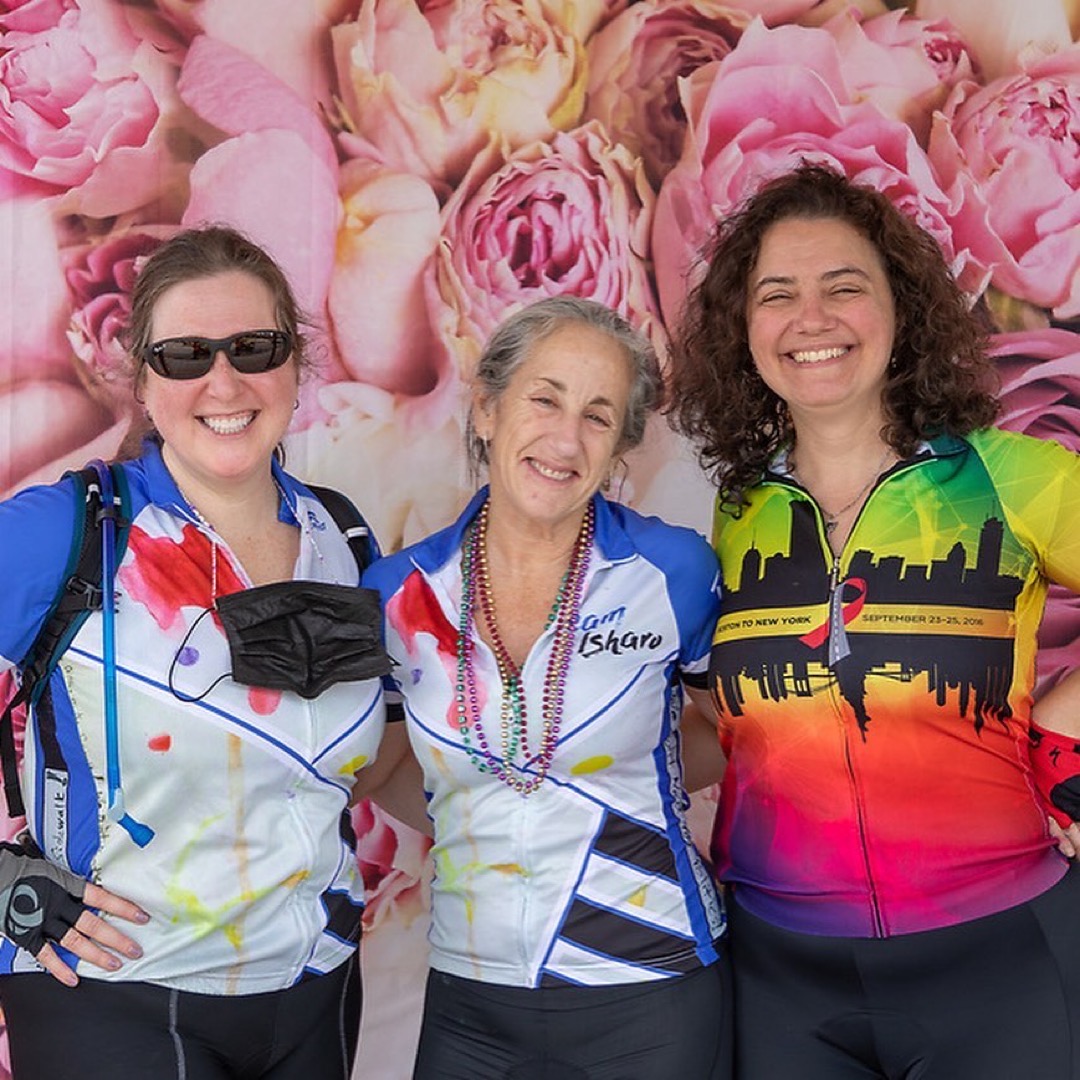
L to R: Friends from the ride Beth Shapiro and Amy Danziger Tenenbaum and me, mugging for the camera during BRAKING AIDS® Ride 2002 :

In less than 40 days, I will be participating in BRAKING AIDS® Ride 2022, benefiting Housing Works, with an aim of raising $50,000 to support Housing Works’ mission to end AIDS and homelessness.

You read that right. 

As most of you know, I’ve been participating in this bike ride fundraiser since 2008, in memory of Dennis and Curtis, two family friends who died of AIDS-related illness in 1987 and 2003, respectively, and for many close friends who live with HIV. In recent years, I upped my fundraising goal significantly and thanks to hundreds of folks like you, I’ve raised $23,000 and $26,000 every year for the last three years running. Those fundraising results year after year represent a collective citizenry and good will—a steadfast, commitment from everyone in my social orbit to help make the world a more healing place for our communities, especially those in greatest need.

This year, I’m doubling down and asking everyone I know to help me raise $50K.

$50,000 for my 50th Birthday

I turn 50 in early December. My age each birthday is a number like any other, and 50 is no different. And yet, like my friends who are my age, I’m finding the imminent half-century marker is prompting greater introspection and reflection across all different parts of my life.

I try not to spend a lot of time contemplating my mortality. Death comes for us all eventually. Most of us have no control over when and how. In my experience, there’s little rhyme or reason, much less fairness, to the details of how those cards play out. What I do know for certain: Best-case scenario, if I’m lucky as hell and get to live a very long, well-lived and well-loved life into my 80s or 90s—hopefully keeping my marbles and with the anatomy plumbing still functioning—I’m already more than halfway through my time on this plane of existence.

At this point in my life, I know who and what I care about most, and I want to make the most of the time I have.

My network of friends, family, and colleagues hasn’t gotten significantly bigger. My personal pockets haven’t grown deeper. What has grown deeper is my willingness to believe in radical hope—to know in my core that when it comes to facing serious societal problems head on, audacity in the face of uncertainty and even amidst the grimmest realities has no downside.

I know what I’m asking for is a lot. I’m asking anyway.

DONATE VIA MY FUNDRAISING PAGE: https://give.classy.org/mika2022.

Donations of all sizes are welcome, but a gift of $250 or more will go a long way toward reaching my $50,000 goal and enabling Housing Works to do more of the amazing work they do. (For more on what a gift of $250 or more can fund, scroll down to the end of this post.)

Why now? Because audacity makes things happen—and audacity has no age.

I did my very first AIDS ride when I was a 26-year-old graduate student getting an MFA in creative writing. I had no money, no salaried, full-time job, no health insurance. My network of possible donors was small, scrappy, dedicated, and mostly youthful, but not affluent. I worked my tail off hounding everyone I knew. I trained on my bicycle in 90-degree heat, having never gone more than 50 or 60 miles. I raised somewhere between $4,000 and $5,000, more money than I could have conceived of raising and more than double my original goal. My biggest single donation came from a surprising source. Not family or a close friend. Not someone who was wealthy. It was someone I knew through work, a person of modest means who had for a number of years been homeless himself.

Nearly 25 years later, I’ve logged tens of thousands of miles on The Blue Streak, my bicycle, and with the help of hundreds of kind souls like you, I’ve raised over $170,000 and counting to end AIDS and homelessness.

The biggest lesson that first AIDS ride taught me:

To accomplish the extraordinary, you have to do something pretty ordinary—ask people for help and tell them why it matters. The trick is having to do that ordinary thing over and over again. You have to keep showing up, even when it feels tiresome. You ask *everyone* you can think of for help. And then ask again. There’s no downside to that audacity. You never know who will step up to join you.

Why supporting Housing Works specifically, now, is more crucial than ever:

Many people, myself included feel like the world as we know it is on fire, literally and figuratively, in almost every arena, which can make it hard to prioritize a focus. We may support many issues, but our day-to-day time is not infinite. So it’s worth taking a moment to reflect on where we give our time, energy, and financial support and why.

We’ve all spent the last two and a half years and counting under the shadow of a new pandemic, another infectious virus that doesn’t care if our elected officials make sound decisions in the name of public health. If COVID-19 has underscored anything, it’s what AIDS has already taught us over the last 40 years—that communicable disease thrives, above all else, in poverty, injustice, stigma, racism and all other forms of discrimination, hate, and seemingly benign neglect that’s complicit by virtue of silence and inaction.

I was drawn to Housing Works initially because of its holistic approach to its clients and its inclusive and welcoming environment. Most AIDS organizations focus on one or two core services and refer their clients to other agencies for other needs. Housing Works provides a range of integrated crucial programs—the key services clients need not only to survive but to thrive: housing, job training, health care (including primary care, dental, and mental health, not only HIV-specific services), free legal help, substance use treatment, and more. 

What makes Housing Works special, however, goes beyond its life-saving HIV/AIDS and housing services; it’s the intense commitment to social justice and compassionate care. Those guiding principles and values date back to Housing Works’ cultural roots beginning in the early 1990s—so social justice and compassion are deeply embedded into all their life-saving services and in how they provide them, with as much dignity, accessibility, and equity as possible. That same fiery social justice and expansive compassion are also reflected in when and how Housing Works shows up during emergency-level social crises, even those that extend beyond the issues of AIDS and homelessness.

When emergencies happen, as they inevitably do, Housing Works doubles down on their audacity and commitment to being a force for healing.

Housing Works has boots on the ground, thoughtful and strategic expertise to offer, and a willingness to pursue and invest in innovations today that become tomorrow’s wisdom.  

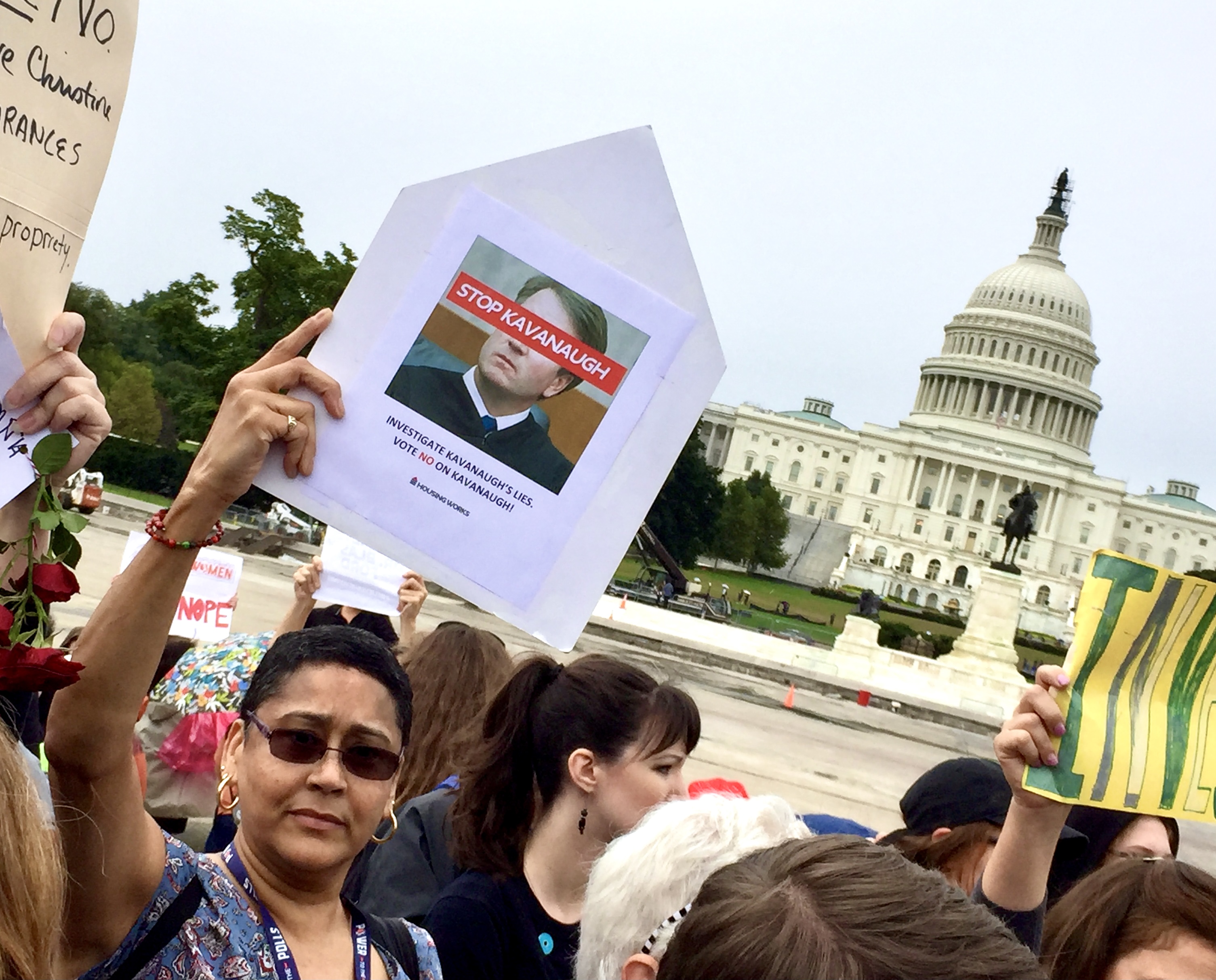
My friend and former colleague, incredible HIV advocate Valerie Reyes-Jimenez, in DC in Sept. 2018, during one of several protests against Brett Kavanaugh’s Supreme Court nomination

Year after year, decade after decade, audacity and compassion are how Housing Works shows up. During my five years working at Housing Works heading up the Advocacy Department’s initiatives, whatever social crisis came our way—from mounting annual “Get Out the Vote” campaigns, to supporting the Black Lives Matter movement, to bussing hundreds of New Yorkers to DC for The Women’s March, to protests on Capitol Hill to fight off repeated attempts to repeal the Affordable Care Act, to organizing non-violent civil disobedience actions in response to the nomination of Brett Kavanaugh to the Supreme Court—the approach was the same. (If you need a visual reminder of how Housing Works has embodied audacity in support of social justice for 30 years and counting, check out the timeline at the end of this post.)

Housing Works takes on the expected and the unexpected in equal measure.

When new, unanticipated challenges arise, Housing Works doesn’t say “or,” they say “and.”

THE BIRTHDAY PRESENT I WANT FROM YOU: To Say “And” Instead of “Or”

Housing Works has my deep, ongoing commitment not only because I believe their mission is comprised of one of the most critical social justice issues of the past half-century—but because I trust them to always be on the front lines, doing what needs to be done and then some—for ending AIDS and homelessness as well whatever other unexpected challenges and related causes arise. I know that whatever additional emergencies come our way, Housing Works will step up without hesitation and rise to the occasion to do what’s needed.

Me being goofy during NYC Pride, June 2022

I don’t have the mojo to expand or remake SCOTUS. I don’t have the immunology genius to cure AIDS or COVID. In lieu of that, I want to do as much as I can during my lifetime to stem that rough social-justice tide, even just a bit. A big part of that for me takes the form of deepening my existing commitments. 

In that spirit, I kicked off my own fundraising with a donation of $1,000. Only $49,000 to go!

Please donate todayDonations of all sizes fare welcome, but a gift of $250 or more is especially helpful. Some info on what your gift underwrites:

$250—Pays for 50 hygiene kits for homeless youth, with daily essentials like soap, deodorant, and a pill-sized tablet cloth that expands into a towel when you add water

$600—Covers the cost for 50 rapid HIV tests

$750—Feeds 375 homeless youth during evening drop-in hours at Housing Works’ East New York Health Center

$1,000—Provides 1 month of supportive housing for HIV-positive individuals

$1,500—Completely outfits 5 new single-unit apartments with household items

$2,500—Provides transportation for a week for HW’s mobile COVID teams

$3,500—Funds a bus and stipends to send 54 advocates to Albany

$5,000—Funds a bus and stipends to send 54 advocates to Washington, DC, and provides bail money for 10 advocates to take an arrest for civil disobedience

Thank you in advance for your time and support. I can’t do this without you. 

Yours in solidarity,

Mika