Reasons to Ride, Reason 5 of ??: A Lil Help from My Friends

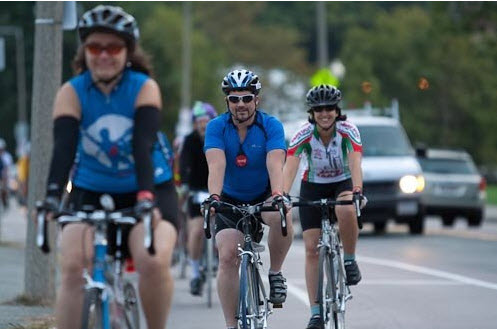
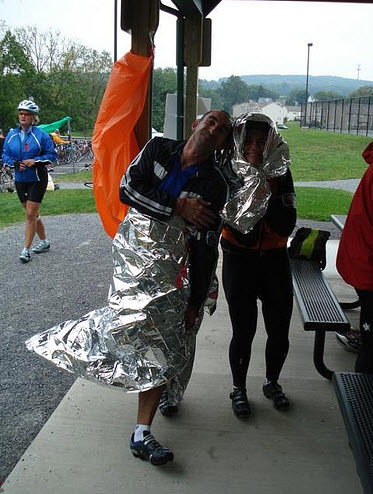
Cycling: ALL ABOUT FASHION. Me and a fellow rider wearing shiny mylar duds, BTC 2008.

This one reason alone might be incentive enough to spend my weekends from April through September doing things that would seem crazy otherwise—drinking smoothies by 6am, cycling out into the morning while the sun is coming up and I’m still half-asleep, having “lunch” before 11am, spending five or six hours riding instead of eating brunch with my spouse, and wearing Fashion Victim cycling spandex, cycling shoes, and a helmet for most of the day: The people, the people, the people. The number of fabulous people I come into contact with because of the ride and the training it necessitates is staggering. Here’s who I’m talking about:

The people at Housing Works, the beneficiary to the ride this year: amazing. They do everything in the name of fighting homelessness and AIDS. Housing. Medical care. Behavioral health services. You name it. They do a ton of stuff locally—many of you know them through their numerous retail thrift stores around the city, but they do a lot more than that so it’s worth checking out the NYC section on the primary website—and they do a great deal of national work (e.g., lobbying Congress on AIDS/HIV-related legislation) and international work as well (e.g., they have been doing major initiatives with Haitian activists living with AIDS since 2008).  The scope of their programs surprised even me and made me proud to be working to support all they do.

The Braking the Cycle participants who ride and crew this ride, which supports what Housing Works does: amazing.They are my fellow riders, and many have become close friends who are more like family. Cliché as it is, they make me smile and laugh, they inspire me, and they give me a hug and comfort me when I cry. They also dress in drag and ride bicycles (yes, some of them at the same time!), which is a definite plus, too, though it’s somewhat dispiriting when a gay man in fish nets has better legs than I do.

And yes, all the people like you, dear Reader, who have supported me in the past and who are supporting me doing this ride: amazing. A million thank-yous wouldn’t be enough to express my gratitude and how much your encouragement helps. Donations and contributions are coming in from family, from friends, from old friends who have resurfaced, from colleagues, from second-hand connections I’ve never met. Case in point: Just the other day I had an email exchange with the lovely people at the jewelry shop when Jen and I got our wedding rings, and I mentioned the ride when I was asked what was new with me; I didn’t even think to ask for a donation in that moment, but the ride links are in my email signature, and the next day, a contribution was posted on my First Giving page. All my supporters out there, each and every one of you: you rock.

Equally important, I’ve been in touch with hundreds of people about this cause and in the process, I’ve gotten more messages of love and support and cheer-leading from all of you than I ever could have imagined. As I’ve noted, it’s been a physically challenging season, so the gestures of support really been a wonderful boost. Your words keep me going on the days when I’m exhausted, cranky, or feeling demoralized and wondering why the hell I’m doing this. So thank you thank you and thank you again—and keep it all comin’… I’ve still got a month to go here before the ride! Hundreds of miles and thousands of dollars to go before I take a ten-minute break and sit on something that isn’t a bike saddle.

If I listed all the lives touched through this process, my individual Braking the Cycle process alone—of training, of asking for donations, of blogging, of talking about AIDS and Housing Works, of reminding people to donate—all by name, you would be scrolling for eons through pages and pages of names.

Instead I’ll leave you with a photo array of images from the three Braking the Cycle rides I’ve done in past years. They are far from comprehensive and only begin to scratch the surface of what the actual Braking the Cycle ride experience is like, but they are a concrete reminder of why showing up is always worthwhile and meaningful. You never know what will happen on the road, where the possibility of change is ever-present; what seems impossible one morning can feel welcoming the next.

When I signed up the first time in April 2008, I had no idea it would change my life. I didn’t know a bike ride of all things could change me. I truly hadn’t a clue that four years later, I’d have logged nearly 9,000 miles on a bicycle and raised nearly $30K to support services for those affected by AIDS/HIV. (That $30K figure does *not* include this year’s ongoing fundraising, by the way, which exceeds $4K as of this writing and, like me on my bike The Blue Streak, keeps climbing.)  I get kind compliments from people sometimes about what I’m doing and what I’m giving, and it’s flattering and energizing to be praised. But the fact is, I’ve always received and gotten back far more from doing this than I’ve given, for which my gratitude is immeasurable. The pictures will, I hope, give you just a tiny taste of what I mean by that.

Yep, that’s me in the foreground. So fast I’m blurry… When arm warmers come back into fashion, I will be so ready.

The fabulous Tim Fitzpatrick who kicks my ass going up hills every time. My better half Jen, also a Braking the Cycle crew member, is giving him a pep talk.

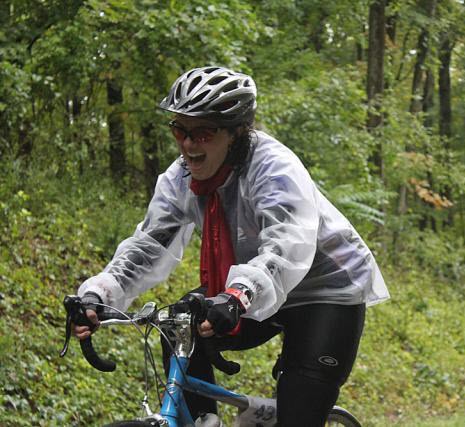
Yes. Photographic evidence. I hollered my way up this beast of a hill in Connecticut. Twice. In 2009. And then again in 2010. Successfully. Perhaps the screaming helps? Mount Archer (AKA Mount Eric), which I’ll be facing again on September 29, still scares the crap out of me.

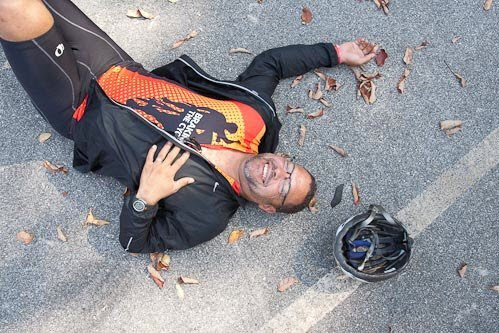
William Thompson, flat on his back, for a change. Would you believe this guy has done multiple marathons, triathlons, and Ironman events? He always looks as fresh as a daisy, too. I am certain a painting of him is sitting in a closet somewhere, aging.

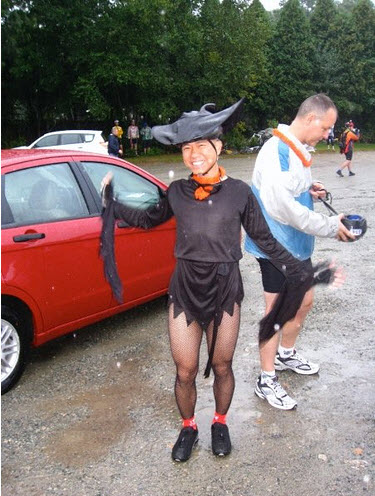
Trust me. Simon Chung, who does, in fact, ride his bike very well in outfits like this, is a very, very Bad Witch. He also has fabulous legs.

Believe what you read. 90 miles and still smiling.

If you’re friends after 300 miles on the road, most of it through rain, you’re really friends: Terry Christopher, Kerri Fox, Gregg Passin,me, Rich D’Amico.

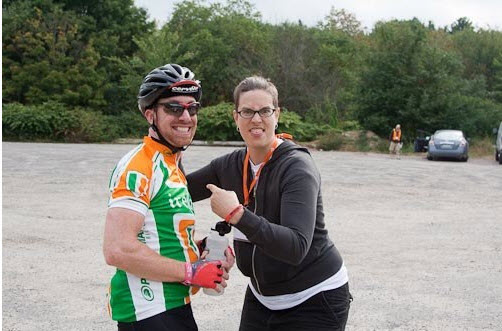
Look! A Braking the Cycle ride day when it’s not raining! We look pretty decent considering we’re about four miles from the end of the ride. Thomas Capobianco, me, Gregg, Rich Monreal, Terry, Kerri, John Gonzalez, ?, Steve Kolbo.

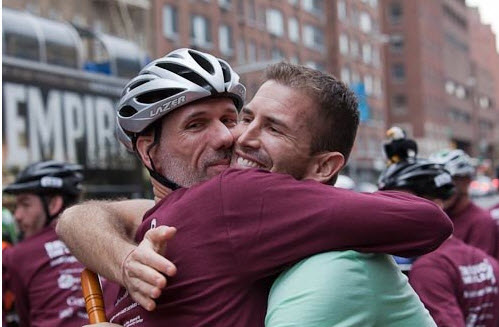
My friend Clay Williams hugging previous BTC rider Greg Baker at closing ceremonies.

This isn’t a photo from the ride. Obviously. But this is my family, and all this biking and training and fundraising and all the rest wouldn’t be possible without their love.

How often does one get to participate in something that make one feel like this?

Reasons to Ride, Reason 4 of ??: In Memory of Dennis (1950–1987)

Dennis was the first person I knew who was HIV+. He is also the first person I knew who died of AIDS.

I was nearly 15 when Dennis became ill. I don’t even know how long Dennis was sick before he died. My hazy memory and my instincts tell me it wasn’t very long.

In point of fact, I didn’t and don’t know much about Dennis first-hand, except that he was a constant in the thread of my family’s history while I was growing up. He was a journalist, and he spent most of his adulthood traveling the world, hopping from one political conflict and hotspot to the next to report on what was happening. So I didn’t see him often, but I had known him my entire life. Dennis was one of my mother’s best friends from childhood. My mother, who was born in Bucharest, had only two friends who date back to that early part of her life. Dennis was one of them. When the two of them got together in person, the air was filled with a dizzying barrage of Romanian. My mother has no siblings, and Dennis as close to an uncle as I ever had on that side of the family. Which is what he was, really. Family.

My mother could say a lot more about who Dennis was than I could and has enough personal memories of him to make up a book. These are the things I know about Dennis:

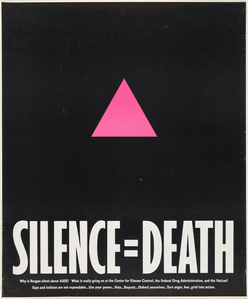
Silence = Death Digital ID: ps_mss_cd15_218. New York Public Library

Silence = Death ACT UP poster, c. 1987-1995. Courtesy of New York Public Library Digital Gallery.

  • He was funny.
  • His full laugh was a high-pitched giggle that went on and on and somehow gave everyone in the room permission to laugh no matter how silly it sounded.
  • He was fiercely intelligent.
  • He loved politics and debating.
  • He loved holding court with people.
  • He had secrets.  Before moving into journalism, he worked for the State Department. He was often evasive about where he was going for work and why. But it seemed that wherever major political trouble was brewing, there he was. I remember my mother musing that it wouldn’t surprise her at all to discover Dennis was some kind of covert ops spy.
  • He knew many languages.
  • He seemed to know everyone and have friends everywhere.
  • He wasn’t handsome, but he had a kind face.
  • He loved to have fun. One of my few concrete memories of Dennis takes place at a party. I remember Dennis’ insistence on dancing, even though no one else was.
  • He was closeted, both about his sexual orientation and later on about his HIV status.
  • No one talked about Dennis being gay.
  • No one talked openly about the cause of Dennis’ mysterious illness when he got sick. His obituary in The New York Times was three paragraphs long and said he died of cancer.

Dennis was 37 years old when he died. I am nearly three years older than that now. If he had a romantic partner, his obit didn’t mention it.

A lot of things were different in December 1987:

AIDS and HIV had been around for six years, since 1981.

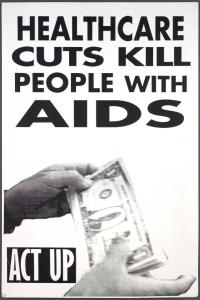
AIDS Treatment for All!  ACT U... Digital ID: 1635828. New York Public Library

An ACT UP poster, c. 1987-1995. Courtesy of New York Public Library Digital Gallery.

President Ronald Reagan had been in office since 1981.

By December 1987, 71,751 cases of AIDS had been reported to the World Health Organization. The greatest number, 47,022 (65.5%) were reported by the United States. Both those figures are cumulative, since the first cases of the disease were reported in 1981.

When you contracted HIV in 1987, you were pretty certain you’d not only die, but die relatively quickly.

AZT, the first antiretroviral drug to treat AIDS, had only been FDA-approved for nine months.

ACT UP (AIDS Coalition to Unleash Power), the influential advocacy group devoted to working on behalf of people with AIDS and to shaping public policy, medical research, and treatment for the AIDS pandemic, had only existed for nine months.

The American Foundation for AIDS Research (amFAR) had only existed for two years.

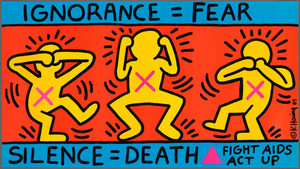
Silence = Death Digital ID: 1577323. New York Public Library

Silence = Death, Keith Haring, 1989. Courtesy of New York Public Library Digital Gallery.

Artist Keith Haring was still alive and would be for another 27 months.

Housing Works, this year’s Braking the Cycle beneficiary, had not yet been founded.

Gay rights activist Cleve Jones made the first panel for what would become the AIDS quilt, in memory of his friend Martin Feldman.

April 1, 1987, marked the first time Reagan gave a public speech on the disease.

Reagan’s second major address about AIDS was given on May 31, 1987, at a dinner honoring the American Foundation for AIDS Research (amFAR).

Abstinence and morality were emphases in both of Reagan’s speeches.

Even if Reagan’s claim on May 31 that “spending on AIDS has been one of the fastest growing parts of the budget,” was accurate, it was because there was nowhere for the numbers to go but up. The proposed allocated monies for AIDS in 1987 was $416 million, and only half of that was at the urging request of the Reagan Administration; Congress requested the other half.

United States government federal budget, 1987. Federal funding for AIDS accounted for .0038% of the total health budget for that year and .000416% of the overall federal budget.

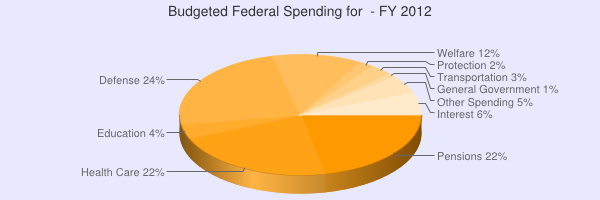
Without any context, $416 million might not sound so bad. To put it in perspective, total federal spending on health that year was $110 billion, 11% of a $1 trillion ($1,000,000,000,000) federal budget. What that means? The federal budget’s spending in 1987 on AIDS, which Reagan boldly pronounced to be “Public Health Enemy #1,” accounted for .0038% of the federal government’s spending on health and .000416% of the overall federal budget. So little it wouldn’t even show up as a sliver on the pie chart reproduced here.

Federal defense spending in 1987 was 33% of the budget, or $330 billion.

People were so scared of HIV at the time and the ignorance about how one got it was still so common, many were afraid to touch with someone with HIV. Which is why it was a big deal that in 1987 UK Secretary of State for Social Services Norman Fowler became the first person to publicly shake hands with an AIDS patient. Even some of the educated, knowledgeable friends and family of those with HIV or AIDS were terrified they would contract it because at some point, they’d kissed the patient on the lips as a social greeting.

United States government federal budget, 2012. Federal funding for AIDS accounted for .034% of the total health budget and .0075% of the overall federal budget.

It’s 2012. Federal spending on health today is 22% of a budget of $3.8 trillion, or $836 billion. Of that, some $28.4 billion is being spent on AIDS and HIV, for both domestic and global activities combined.

Compared to where we were in 1987, that’s a huge leap. And yet: That’s a mere .034% of the health budget and .0075% of the overall federal budget.

Today, the reports that are released each year tout the fact that the annual rate of new HIV infections in the U.S. is relatively stable, as opposed to increasing each year. This is regarded as the good news. It is good news, but that number isn’t a reason to celebrate when you examine the historical trajectory either. Some 50,000 Americans become newly infected each year. That stable annual rate is bigger than the total number of AIDS cases reported in this country by the end of 1987.

Here is a fact that’s neither good news nor bad news, and after 31 years, it’s not even news at all: We still have a long road and a lot of work to do.

Sources: PBS Frontline; federal budget spending data from usgovernmentspending.com, 1987 and 2012AIDS.govAIDS/HIV data from The Henry J. Kaiser Family Foundation.

Inhaler Deeply: On Reassessing Goals

It’s been weeks since I wrote a post focused on my actual physical training. Despite my blogosphere silence, I have been diligently putting in weekend miles the past month, and I’ve been riding to work when I can as well.

It’s telling that I wince at the thought of admitting to physical training challenges. And humbling. It has been, and remains, an uneven, tough season. The causes are the predictable ones:

  • I started late. My riding season began in April, but the methodical, bulldog-like, and progressive training that I fall into when I have an event on the horizon began later than usual this year, in early July.
  • We traveled in June, which is atypical, and I didn’t ride much for the first half of the month.
  • I’ve been busy with work and life and out-of-town visitors, too, and my night-owlish tendencies have been worse than usual.
  • The erratic, hot weather hasn’t helped. Our air conditioner usually stays in storage until mid-July; this summer, it was going full blast before mid-June.

I didn’t think much of it at first that my riding wasn’t feeling strong most weekends in July. In previous years, I’ve experienced some kind of boost in June or by mid-July, rides during which the time and effort I’ve been putting in kicks in visibly—faster average speeds, better stamina, stronger performances on hills. Sometimes, it’s been as amorphous as feeling fantastic and fearless while riding, as though I could ride on for hours even if it is 100 degrees out.

Nothing like that happened this season. I haven’t been putting in the miles and time consistently as I had in past years, and I figured that was catching up with me. The hills felt harder. The heat felt hotter. It all felt harder. I assumed I knew all the reasons why.

The above reasons have been playing their part, no question. But the past month, a new, unexpected factor emerged: mild, intermittent asthma.

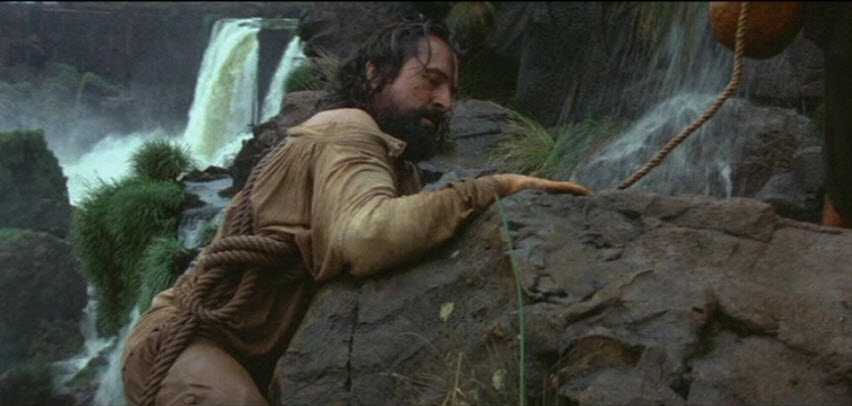
An advantage of riding the same route frequently is that I have a good sense of my performance at various, specific geographic points on a given day. On a strong day, I might be able to take a certain stretch of road at 18 mph instead of 16 mph. Or I can eat a hill like it’s a delicious breakfast one week, but the next, I feel like I’m the martyred Robert De Niro character from The Mission, dragging myself up a cliff while weighted down with heavy metal weaponry, slipping every few steps.

Robert De Niro as Rodrigo Mendoza, The Mission (1986). Mendoza schleps a net full of metal weaponry up the cliffs of Iguazu Falls. On difficult days, of which there have been many, this is what training has felt like this season.

On July 22, when I rode on a Sunday after taking the previous day off, I felt okay but not great. Slow. Easily winded. Hot. Nothing dramatic happened, but I noticed I was dragging a little. My pace on hills wasn’t great. I didn’t feel right. My chest felt a twinge tight. I had a slight cough and a tickle in my throat. I figured I had picked up a low-grade version of the virus floating around my office.

That week, I continued to feel iffy, more tired than usual, but then again, so did everyone else. It was a hazy and soupy July. No one on the streets or the subway or in my office looked energetic. They looked put upon. I was still bothered by an intermittent barking cough. Stranger still, my chest stayed tight. A few times during the nights that week, I was awoken by something that was halfway between a cough and a choking episode, as though I had swallowed water the wrong way in a dream and woken up in the middle of it.

The following Saturday was much the same as the previous one, except that it was humid as well as hot, and the uneasy feeling I had while riding the previous week kicked in again full force. I was meeting my friend Terry, who lives in New Jersey, we meet at the southern entrance of Palisades Park. It’s roughly 15 miles between my Brooklyn apartment and the park entrance.

Because the West Side bike path is pretty heavily trafficked any time after 7:30am and because the terrain is flat and forgiving, a lot of cyclists refer to these miles getting out of the city as “junk miles.”

As early as pancake flat Mile 6, where I ride by Chelsea Piers, I was having trouble keeping up my usual pace. I was winded, sweaty, lethargic. I felt awful. I was 15 to 20 minutes late to meet Terry even though I left on time. I hadn’t slept well the night before and was riding on less than five hours of rest. At first I chalked up my exhaustion to that and to the humidity. I stopped with Terry for a few minutes to catch my breath, cool off, and drink some Gatorade, and then we rolled out again.

The eight-mile stretch of road through Palisades Park, also known as River Road, is popular with cyclists because it’s scenic and beautiful, trafficked by few cars, and it offers enough hills along the way to be excellent training for athletic goals and events of all kinds. Two of those hills are generally regarded as the most challenging: Dyckman Hill, which is moderate enough in duration but is still the first incline that’s visibly steep enough to make me take a deep breath if I haven’t been on my bike in a while, and Alpine Hill, which is a mile-long climb at the northern end of the park. Alpine is a little like the Magic 8-ball of hills. It can kick my ass on a tough day, it can still feel arduous even on a decent day, and it’s also the hill where it shows if I’ve been putting in a lot of time and am starting to make notable progress.
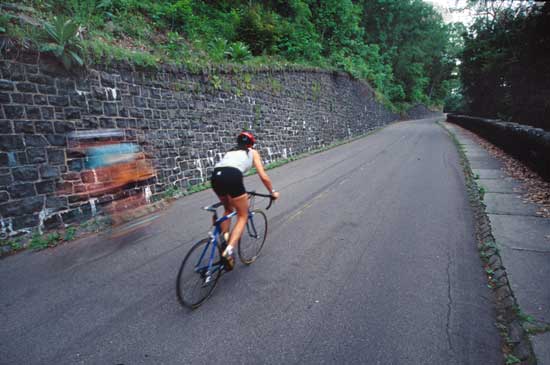
A cyclist going up Dyckman Hill Road, Palisades Park, New Jersey.

Dyckman Hill felt like Alpine Hill to me. I was able to pull myself up, but I sagged the whole way. Inside, I felt like my body was creaking. I stared at my odometer the whole time to keep myself from focusing on the remaining distance up the hill. It didn’t register in my head until later on that my speed uphill was a solid half-mile to full mile slower than usual. This summer, Terry has been in the best shape he’s been in since we met. He zipped his way up the hill. I didn’t try to catch him. My chest felt tighter than it had before. It occurred to me that the chest tightness from the previous week had never fully left me at all.

Alpine Hill was harder still. Terry was out of eyeshot quickly. Knowing I’d meet him up at the park rangers station where we usually stop for water and a bathroom run, I let him go. I cranked up at my own meager pace, frustrated, pedal rotation after pedal rotation. A few other cyclists passed me going up, but soon enough, I was too tired to care. I just wanted to make it without stopping. I cycled up Alpine the first time in 1999, and I’ve done it with regularity since 2006 or 2007; in my worst shape, without training, riding on a mountain bike that might as well have been made out of cast iron, I’ve never stopped mid-hill.

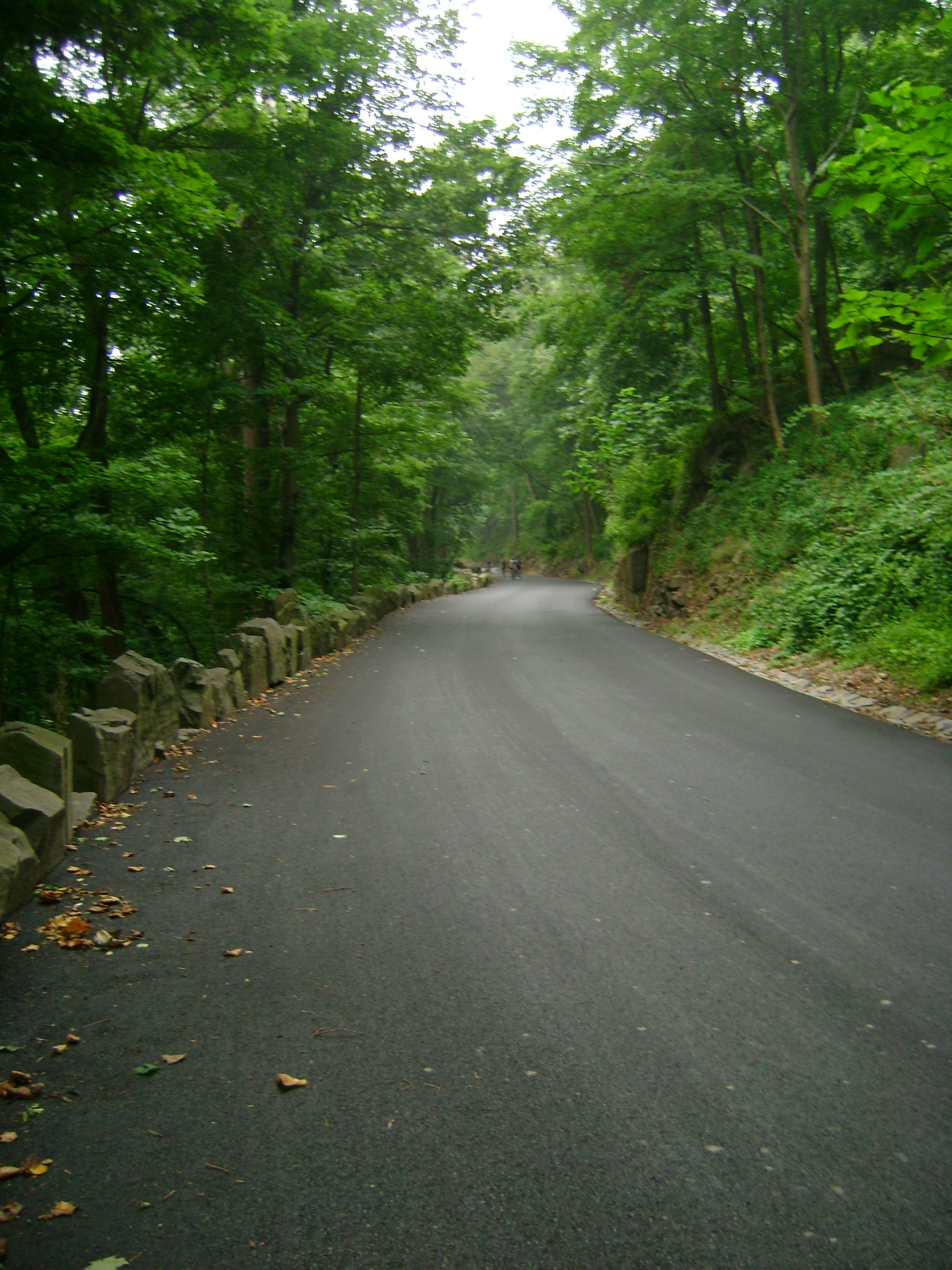
The view from near the crest of Alpine Approach Road, Palisades Park, New Jersey, July 2012.

I had brought a camera with me to take some photos along the road for this blog. The last hiccup of the Alpine Hill incline has a bend in it, so I stopped just shy of that and turned around so I could get some clear shots of the rise of the hill grade and of a few cyclists pedaling up it. As soon as I heard the shutter click on the last photo, a wave of dizziness, sweats, and nausea rolled over me. I almost thought I was going to pass out. I leaned over my bike frame and waited until it passed, but I was shaken by it, literally and emotionally. Something wasn’t right.

Another view of Alpine Approach, Palisades Park, July 2012. I took this photo right after I cycled up the hill myself, and I almost passed out right after hearing the shutter on my camera click.

Someone who isn’t me might have turned around after that and gone home. But I was 24 miles from home, at least 10 miles from any decent public transportation, and I was hungry. It made more sense to continue to Nyack, get something to eat, take whatever rest I needed, and then make my way home as slowly as I needed to. That’s what I did. Nothing remarkable happened except that I was now afraid. Even on a strong day, the five miles between Piermont and Alpine, headed south to go home, are the hardest for me out of the whole 70-mile trip. The road out of Piermont is a series of climbs of varying length and grade, one after the other; perhaps because of their back-to-back succession, as well as their appearance more than halfway through the route, they all seem more difficult than any of the hills in Palisades Park. So my only goal was to take my time and make it home safely.
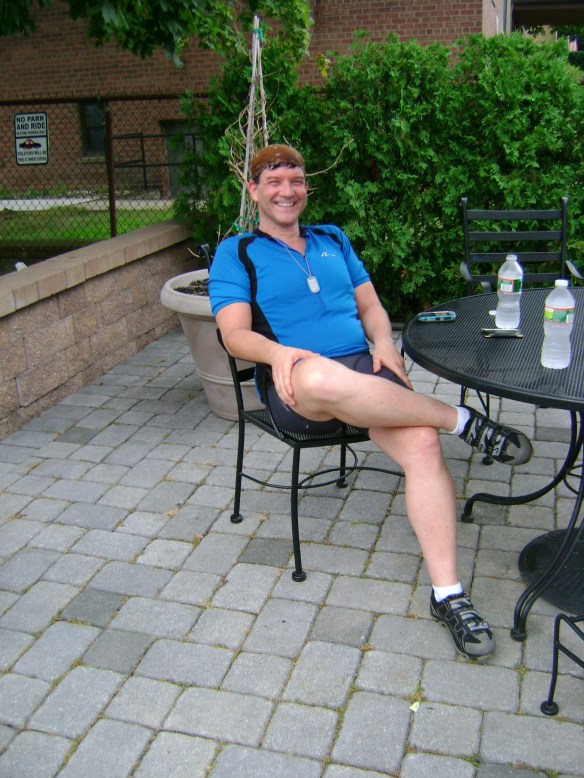
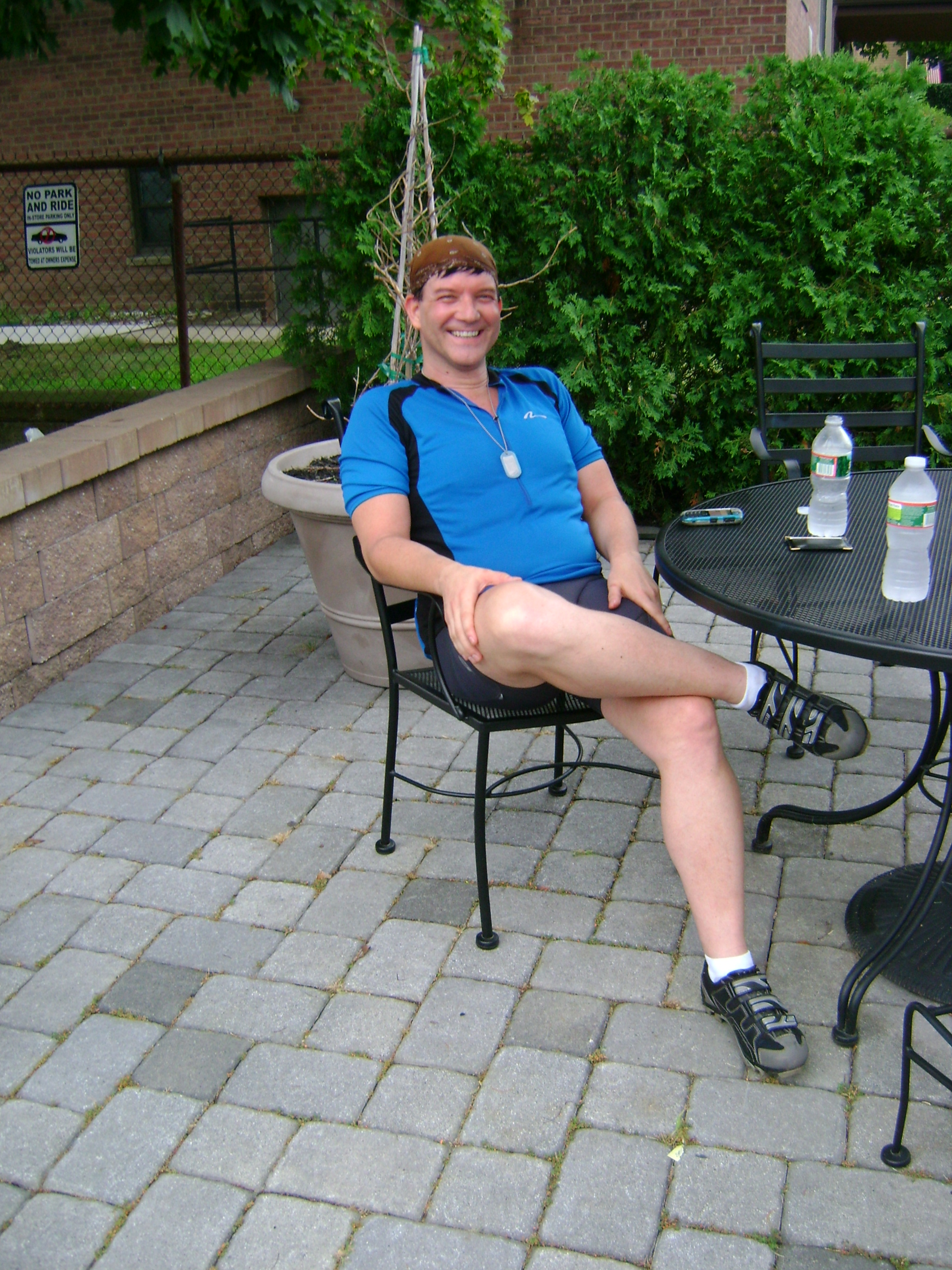
My friend and one of my training partners, Terry Christopher, kicking back at one of the outdoor tables at the Strictly Bicycles bike shop. Don’t let the easygoing look he has fool you. He is a fierce rider. About two minutes after I snapped this, the sky opened up, and it poured so hard, we huddled together under the table umbrella.

I did it, but it felt the same as the first 35 miles had. Like the cycling equivalent to a root canal. The sun burned off the cloud cover on the way back. By the time we got back to the GW Bridge area, it was sweltering so we stopped at the bike shop near the bridge for water and to cool off. At that point I didn’t care what time it was, or how slow I was going; I wanted to rest. Terry and I chatted and caught up. He made me promise to call the doctor first thing on Monday. I didn’t argue with him. We sat long enough for a storm to sweep in, and it poured and poured, hard enough that we waited until it lightened before we headed out again.

In an email exchange later that same day with my brother, he pointed out that any number of environmental factors could be causfor of the symptoms I was having, too: the heat, the humidity, old air filters in the air conditioners, high pollen count, dust and detritus from the building construction site down the block.

Terry, ever loyal, sent me messages in the two days that followed, as he promised he would, imploring me to make sure I made an appointment and kept it. I went to the doctor that Tuesday. She checked me out, had me blow into a spirometer, asked questions.

The semi-likely verdict: mild exercise-induced asthma. She gave me the choice between coming in for more pulmonary testing to narrow the possible causes or trying an albuterol inhaler before exercising. She said that asthma was the most likely cause because my symptoms were intermittent and only really showing up during exercise, with bouts in between during which I felt fine. “If it was anything more serious, it would be more constant and it would be progressive,” she said, “getting worse the longer it went untreated.” She told me the inhaler wouldn’t hurt me, and if it didn’t help, I could still come back in for more testing. I got the prescription filled the same day.

My new albuterol inhaler.

I’ve used the albuterol inhaler every weekend since then, before each of my long rides. It’s a simple enough device and yet the detailed instructions and diagrams seem worthy of a Master’s Degree. Nothing on them says what I’m supposed to do about the fact that, as I try, per the instructions, to coordinate simultaneously depressing the canister on the inhaler, sealing my lips over the mouthpiece, and breathing in deeply, fully, and quickly, my tongue gets in the way. In the 20 seconds that the two inhales of magic medicine take, I am overcome by the nagging feeling I often get when I do my own taxes or fill out bureaucratic forms at work: that I’m doing it wrong. Still, whatever level of albuterol is making it into my system, it seems to help. For which I’m grateful.

Of course, I’m still slower than I’ve been in past years. I’m just no longer dizzy and winded. I try to keep in mind that all the other factors—exhaustion, weather, inadequate training time—are still influencing my performance. It’s occurred to me that these symptoms may have been with me for longer than I realized. My lungs feel more expansive, which is great, but it also means that I notice the effects of my broken nose more. I’ve broken my nose multiple times, and the result is that my nasal passages are stuffed up most of the time. It never mattered much until I started getting more serious about athletic pursuits. I’ve had a referral to finally get my nose fixed since last December. It’s time to make the call.

I know how lucky I am that the physical health obstacles I’m encountering are minor and manageable. Everything I’m experiencing is treatable. It’s not even close to a small glimpse of what it must be like to wake up each day with a genuine, progressive illness, not knowing whether today is a day when your own body is going to betray you.

I’m also aware that the timing of all this means I need to recalibrate my own expectations for the actual Braking the Cycle Ride in September. At some point during the past month, Jen observed to me, gently, “You know, you might not have the ride you want to have this year.”

The first time I did Braking the Ride in 2008, I trained like hell from April onward, but I still went into the event terrified that I wouldn’t be able to ride every mile. Completion was my only goal. I was more shocked than anyone that as hard as the ride was, I could do it. The second year I signed up to do the ride, I experienced some injuries partway through the summer, and it also rained torrentially all season; I wasn’t sure what to think going into the ride itself, but again, I surprised myself by exceeding my expectations. Not only did I finish, I rode strong and fast, faster than I ever thought possible. That was a big deal because I think I needed to prove to myself that the first year I rode wasn’t a fluke. My third year, I knew I could complete the ride, and I trained less than in previous years, but I still put in a lot of bike time and miles. As always, I was nervous going in—a lot can happen in 300 miles, after all. The obstacles were different from previous years; I had a futzy stomach the whole ride, and the heat got to me and slowed me down. I still rode every mile, though.

Jen wasn’t trying to tell me not to ride or to give up or to stop training. She was trying to get me to come to terms with the possibility that I might bump up against my limitations in a new way this year.

My partner Jen, who is my biggest cheerleader in all things. This photo was taken during Braking the Cycle 2010, on Day 3, Mile 250 or so; Jen was on the volunteer crew. What a huge pleasure it was to ride into a rest stop and be able to see her smiling face. She’s crewing again this year. Lucky me. Photo by Alan Barnett.

Because I know Jen is right, I had a useful chat with my friend and rider coach Blake about the season I’ve been having. Blake Strasser is an athlete extraordinaire. She’s done the New York City Triathlon, the NYC marathon, more long-distance cycling events than I can count. She’s a two-time Ironman finisher. An Ironman is the pinnacle of triathlons: It’s a 2.4-mile swim, followed by a 112-mile bike ride, followed by a full marathon run (yes, that’s 26.2 miles), done in that sequence, without a break. Blake has been a hardcore, disciplined athlete for a long time, so I figured she’d also run into her share of challenges along the way.

I told Blake I was nowhere near where I’d like to be or where I’ve been in the past, that the riding has been harder, physically, than it’s been any other season. I know this comes with the territory sometimes, but it’s frustrating. So I asked her, “How do you deal with it psychologically when, for whatever reasons, you have a tough season?”
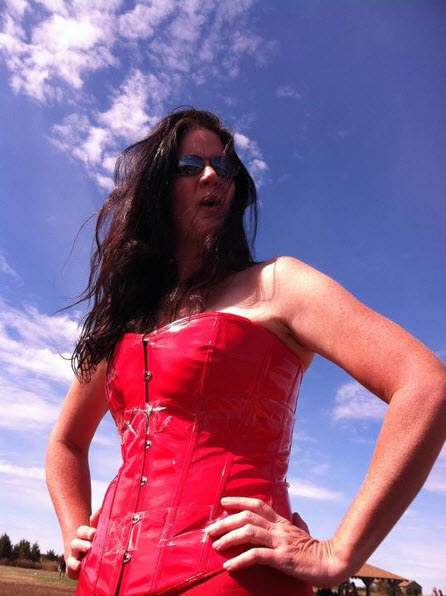
Superhero Blake Strasser, my friend and the Braking the Cycle rider coach, who convinced me to sign up for my first Braking the Cycle ride in 2008. At the time, I knew no one on the ride and had never attempted anything this physically ambitious. Blake is a hero of a human being and a kick-ass athlete to boot. I am posting this photo from BTC 2011 partly in the hopes that she will wear this outfit again during this year’s ride. If you are a  marathoner and two-time Ironman finisher, you too can look this h-o-t!

Blake didn’t tell me anything I didn’t know, but it helped to hear it from someone who has attempted and succeeded at events far more arduous than anything I’ve done. The main thing with tough seasons, she said, is to reassess goals and remember why I’m doing it. She also shared that she’s had a lousy training year, too—some big health issues and few smaller things, which led to being under-trained, under-rested, etc.

It all sounded very familiar to me.

“My body is just not responding to training,” Blake said. “I’m getting it done, but not seeing gains. I started the year gunning to finish my Ironman in under 13 hours. Now I’m just going to finish it—be healthy, have some fun, help some people along the way. And enjoy a beautiful route. New plan. Good plan. A not-beating-myself-up plan.”

Blake is one of my heroes. And she and Jen are both right. So it’s time to reassess my reasons for riding.

This reassessment isn’t about giving up. It’s not even really about changing my goals exactly. It’s more about recalibrating how I deal with roadblocks as they arise and the possibility, likelihood even, of not achieving what I’d like. It’s about showing up even when I’m not sure if I can get it done—and showing up anyway. And riding my hardest anyway.

  • I ride to raise money that makes a huge difference for a lot of people who get services through Housing Works.
  • I ride to raise awareness about a disease that’s been with us for far too long.
  • I ride because people with bigger obstacles and challenges ride despite those difficulties. When they can’t ride, they walk. When they can’t do that, they cheer on other riders. They show up, however they are able. That inspires me.
  • I ride because I love the compassionate, courageous riders and crew who do this ride.
  • I ride because even on my worst day, I love to ride and have a great time.
  • I ride because showing up when I’m struggling and feeling weak and trying my hardest to ride strong anyway might be a bigger act of will and grit and even courage than riding when I’m feeling my healthiest.

My literal goals aren’t any different than they’ve been any other year. I am committed to reaching my fundraising target. I have been training and will continue to train every week. I will put in a 100-miler while I’m on Cape Cod next week. On the Braking the Cycle ride itself, I remain committed to riding healthy and strong, having fun with my friends along the way, and doing my best to complete every mile. Along the way, I will have to trust my body, my self, my training, the support of all the folks on the ride and on the road.

The rest isn’t up to me. That’s always been true. But in all my years of doing this, this might be the first time that I’ve fully acknowledged my lack of control over the outcome of all the efforts involved. It also might be the first time that is okay with me.

Past Braking the Cycle rides for me were about testing the waters in terms of my own fear, my determination, and largely, my own expanding sense of my physical capabilities. This ride is about those things, too, but the real challenge is about acceptance of and surrender to the many things that are out of my hands and still being willing to be present and curious about what I can do.

I’ve got a month left to fundraise and train. And then: Who knows what will happen? Not me. But I’m looking forward to finding out…
Reasons to Ride, Reason #3 of ??: In Memory of Curtis Wheeler (1950–2003)

…the ability to create something sometimes is a medicine in itself.—Curtis Wheeler

I know Curtis Wheeler, an African-American artist, through my brother Jacob, who spent three years, from 2000 to 2003, making a documentary short film about Curtis and his life. The film follows the final three years of Curtis’ life as he battled AIDS. When they met, Jacob was still in film school at NYU’s Tisch School of the Arts, and Curtis was then living at Rivington House, a health care facility for AIDS patients on Manhattan’s Lower East Side. They became fast friends and had known one another about a year before they decided to make a film together. Curtis’ goal at the time—and what became the goal of the film my brother made about him—was to be able to heal enough to leave Rivington and return to his home, a 17-room mansion in a historic district of Washington Heights, so that he could continue to live an independent life and to paint.

My brother Jacob Okada, who became Curtis Wheeler’s friend and made an award-winning short documentary film about the last three years of Curtis’ life.

I only met Curtis in person a handful of times, at Rivington House. What struck me about him is that he seemed to embody the ordinary and the extraordinary at the same time. The first time I met him, while I was visiting, I watched him get his hair cut—an everyday act that on the one hand is as mundane as it gets and is also oddly intimate. The scissors, the clippers, the towel, the cape draped around his neck to keep hairs from getting all over his clothes, the snippets of hair strewn in a halo on the floor around him as the hair stylist did her job. We talked about nothing and everything, him, my brother, his life as an artist. What I recall most about Curtis is that he was vibrant, philosophical, strong-willed, intelligent, colorful, and wickedly funny, all of which came through even as his physical body was deteriorating.

I also remember, with equal amounts of amusement, affection, and sadness, that he once asked me to get him a meal from one of the takeout joints down the street. Because he was sick to death of the monotony of the menu at Rivington. He was grateful for the care and kindness he received there, to be sure, but no one likes bland institutional food, and Curtis had been living there for ages, so one can hardly blame him. I went out for Curtis and brought back some Chinese; it was easy enough for me to do, so I did it—I was gone maybe 15 minutes and that was that. He thanked me, and I visited with him while he ate. It was such a small thing, this request, this favor, and yet the poignancy of it stayed with me. Perhaps because I was a near-stranger. The errand itself was easy and small and unremarkable, but the fact of his asking me said volumes. How strange our dependencies become when we are ill. How large even small acts of kindness can become. How one must rely on others, sometimes those we barely know or will never see again. How asking for help becomes something that’s necessary, likely even, nearly every day, even in those of us who are fiercely independent by nature. How the armor we usually use to hide our deepest vulnerabilities seems to fall away.

Curtis led many, many lives prior to his HIV diagnosis and the start of his illness—so many that the description of his bio almost sounded too fantastical to be real. Dancer. Teacher. Painter. World traveler—Curtis had traveled almost everywhere, through all of Europe, Russia, parts of Asia. My brother tried to describe Curtis’ love of the Italian Renaissance masters and how that showed up in his own painting to me. It wasn’t that I didn’t believe Jacob when he said it, but all the biographical facts of Curtis’ life seemed to contain some mythic element of the fantastical, the spiritual, an otherworldliness.

Michelangelo’s David, Florence, Italy. This Renaissance sculpture masterpiece is the sort of art Curtis studied and loved.

Those facts would have sounded pretty extraordinary even if Curtis hadn’t been slowly dying of AIDS when I met him. But I think their fairy-tale-like hue was amplified by how much they contrasted with his present-day life battling illness and just trying to get through the day, the week, the month. I didn’t consciously think it at the time, but those same aspects of Curtis’ experience—his extensive knowledge of European art and dance, his fierce intellect and passion for books and learning, the searching quality and curiosity that rose up out of so many of his conversations—bore no resemblance, seemingly no connection to the grim, earthbound realities of the setting in which I met him. On one level, of course I knew that HIV and AIDS happened to all sorts of people leading full, rich, interesting lives—not to one-dimensional stereotypes. And yet some part of me had trouble reconciling the exciting, mysterious past Curtis had led with the present-day one.

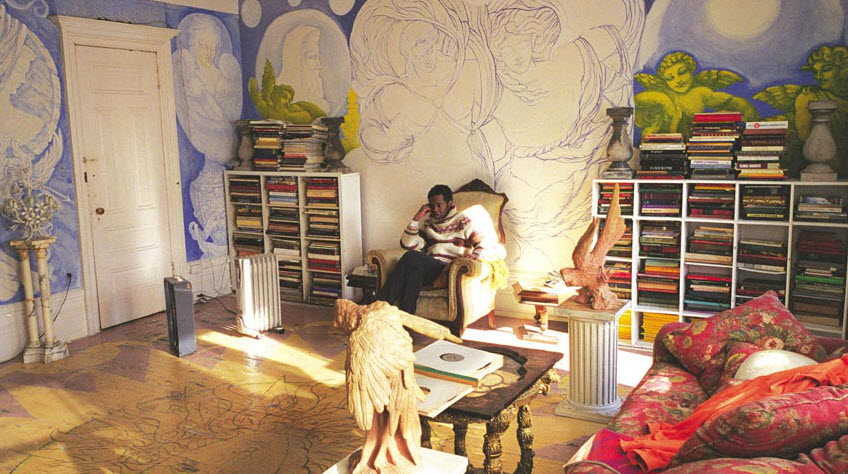
Curtis’ life was all those things—fantastical, unusual, spiritual—and yet on the most literal level, he had also done all the things and seen all the places my brother had said he had. His house in Washington Heights, which is where the photograph of him reproduced here was taken, teemed with books, sculpture, ornate furniture, art of all kinds. The way in which Curtis decorated the walls and floors of his 17-room home with his drawings and paintings seemed his artistic homage to all he had experienced in the world—and he had experienced a lot. It was as if he needed to create something outside himself, to heal his own spirit if not his body, something visual to show that all his past callings and journeys and memories, and his art in and of itself, were, in fact, the core of the fabric of his life and his being, as much his life as all the present-day rounds of dialysis he had to undergo, as the smokers’ room and Bingo Night at Rivington, as the Chinese takeout meal I delivered to him in a flat styrofoam container, with different depressed compartments in the tray for the rice, the main dish, the sauces, the egg roll.

Curtis Wheeler, an African-American artist battling AIDS, in his house in Washington Heights, c. early 2003. This image is a film still from director Jacob Okada’s documentary short film Curtis (2003). Image appears courtesy of Jacob Okada.

The film Curtis was completed in 2003, and the final 33+-minute cut was finished the same day Curtis died. Fortunately, my brother had shown Curtis a close-to-final cut of the film before he passed away. The film aired multiples times on PBS, and it went on to the 2004 Sundance Film Festival and received an Honorable Mention in Short Filmmaking there. For those interested in additional background about the making of the film, an interview my brother did with Asian American Film appears here.

Curtis wasn’t the first person I knew with HIV or the first I knew who died from it. Nor was he the last. But both meeting him and later, in 2003, watching my brother’s finished short film about him brought some of the stigma and loneliness of HIV and AIDS home for me in new ways. Because while the film Curtis is about AIDS, to be sure, above all else, it reflects Curtis Wheeler as a complicated, insightful, multifaceted human being. Not an anonymous HIV statistic. Or a stereotype of whatever kind—black, male, gay.

Everyone who lives with HIV has a unique story. Everyone who dies from AIDS-related causes has a unique story. These people aren’t numbers. They don’t fit neatly into one-dimensional stereotypes that the rest of us can use to distance ourselves from the disease, its reach, and its brutality. Part of Curtis’ legacy is that he got to share some of his individual story and his self, and all the corresponding vulnerabilities, before he died, and it got documented, which will extend the sharing of that story in the years to come. He was lucky in that regard, the same way that he was lucky to have discovered and explored an inner well inside himself where he could find solace and healing though creating art, and he knew it. He also recognized that many others like him who are dealing with HIV and AIDS don’t have any of that.

Having known Curtis, however briefly, and riding for him reminds me of all those things—of the therapeutic power of creative expression, of how distinctive each human set of experiences is, and at the same time, of how equally important it is to acknowledge the elements of humanity we all share.

I’m grateful to Curtis for those things. I also wish he was still here.

On Fear of Failure

Today would have been Julia Child’s 100th birthday, so a lot of videos and photos of her are floating around the Trending Internet Ether.

One of the video clips I’ve seen today is this vote of reassurance from Miss Julia, which could just as easily apply to any new or difficult endeavor, whether it be making a soufflé or a beurre blanc, attempting to complete a novel, driving a stick-shift with your mother hollering at you from the shotgun passenger seat, or, um, raising $5K to fight AIDS/HIV and training to ride 300 miles in three days on a bicycle:

All we can do is practice, fail, practice some more, get better at failing, practice. Again. And again. It’s a useful perspective.

La cuisinière chez Martinet, depicting a woman wearing an outfit made of cooking implements. Courtesy of Library of Congress Prints and Photographs Division.

For many years, I think I truly believed that the most important sign of achievement—in any arena—was the fact of that thing coming easily. The problem with this line of rather haughty thinking is that very little learning or education is actually involved; it more or less confines one only to pursuits in which natural or innate skill, talent, aptitude—whatever you want to call the stuff with which you were born—make base-level success almost effortless. In fact, the logical extension of this faulty belief is that if you have to work at it, whatever “it” is, you suck, you’ll never be good enough, and you should hang it up right now.

Being good at something as a novice is very satisfying, of course, a balm to the ego if nothing else, but without practice and discipline, and yes, failure, dreaded dreaded failure, that preliminary talent doesn’t get any of us very far, nor does it push us to stretch ourselves. Making Talent, that most elusive and mysterious of elixirs, a prerequisite for our future choices and callings is also a pretty effective way to stop oneself from trying anything new.

Courtesy of Library of Congress Prints and Photographs Division.

How dull and predictable we’d all be in such a world. The creativity and innovation that comes from testing out unknown waters, and flailing and floundering and failing miserably, wouldn’t exist.

When I find myself in some mental tailspin about failing, or not being where I’d like to be, as I so often do—not only about cycling and athletic goals, but about almost everything I care about—some part of me remembers that failure and the related disappointments are supposed to come with the territory. It’s called education. Bon appétit.

Reasons to Ride to Fight HIV—Reason 2 of ??: I Live in NYC

AIDS and HIV have no borders. There are no maps that say, “Beyond this point, there be HIV.”

Image

The Carta Marina, an early 16th century map of the Nordic countries. Like many early maps, it featured depictions of dragons, sea monsters, and serpents as a warning, to indicate, as the saying goes, “Beyond this point, there be dragons.”

Nevertheless, some geographical regions get hit harder by HIV than others, for all the usual reasons—economics, population size and concentration, demographic factors (ethnicity, gender, age, sexual orientation, etc.), health care access, education, and the like.

New York City, my birthplace and my current home, was one of two places where the majority of the first AIDS cases occurred; the other was San Francisco.

Image

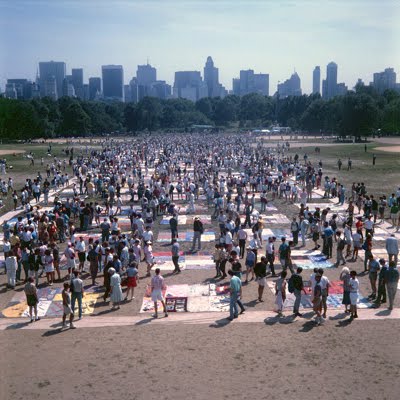
The AIDS Quilt in Central Park in 1988.

Over 30 years later, New York City remains the epicenter of HIV/AIDS in the United States:

  • More than 107,000 New Yorkers are living with HIV, and thousands more are unaware they’re infected.
  • HIV is the third leading cause of death for New York City residents aged 35 to 54.
  • The case rate for AIDS in New York City is almost triple the U.S. average.
  • HIV transmission through heterosexual sex is outpacing transmission through intravenous drug use by more than four to one.
  • Nearly 80% of new diagnoses are among blacks and Hispanics.

Image

Even within New York City, the playing field for who is directly affected by HIV is far from level. According to an April 2012 health study released by the University of Wisconsin Population Health Institute, based on 2010 Census data, the majority of individuals diagnosed with HIV in New York City were in the South Bronx, Central Brooklyn, and in the Clinton/Hell’s Kitchen, Chelsea, and Harlem neighborhoods of Manhattan. (The New York City metropolitan area map reproduced here relies on the NYC United Hospital Fund (UHF) neighborhood boundaries.)

The good news is that the above data can be used to allocate resources and efforts to the people and places where they are most needed. Case in point: The same week the health study was published, Housing Works, the beneficiary of this year’s Braking the Cycle ride, relaunched a newly renovated  facility, the East New York Community Health Center. As a result, the Center will now be able to provide comprehensive care to Central Brooklyn communities irrespective of their HIV status. The renovation was made possible by a Human Resource & Service Administration (HRSA) grant awarded to Housing Works to provide comprehensive primary care services to the general community, and targeting the homeless community in particular; the expansion of the facility will effectively double the number of primary-care patients seen per year.

New York City is so vast and so densely populated, it can seem like an anonymous place, a place where it’s hard for an individual to have an impact. The Housing Works effort in East New York reminds me of why I do this ride. It reminds me that even in New York City, every small contribution by every individual to make the lives of our neighbors better matters.  Most of all, it reminds me of the many reasons I’m so glad to live here and be a born-and-bred New Yorker.

Sources: “A Vision of a Grim Past and a Hopeful Future,” New York Times, April 8, 2012Housing Works East NY Center ribbon cutting; Housing Works East NY Center re-opening

So Many Reasons to Ride: Reason 1 of ??

This image is part of a five-year campaign for AIDS awareness by the White House, U.S. Department of Health and Human Services, and the CDC. It wasn’t made in the 1980s, or the 1990s, or even the early 2000s. The campaign with this particular statistic was launched in April 2009.

In recent days, I’ve been thinking that in addition to using this blog for posts on my process and progress—training and fundraising—it may be a good place to muse about answers to the question of why I do this Big Thing almost every year. Some of the reasons I participate in an endurance ride that raises money for HIV/AIDS services appear in brief form in the fundraising letters and emails I sent out asking people to support me doing the Braking the Cycle ride. But in truth, within the limited confines of a fundraising letter, it’s impossible to really explore and list the many reasons I find myself returning to this process, this cause, this physical challenge. I may not even fully be able to fully articulate all of them here, but it seems as good a place as any to try.

These posts about my reasons to ride and support this cause aren’t going to be pre-planned, which is to say that they will appear as they occur to me, and not in any particular order of emphasis or importance. Here is the first:

Reason 1: Last year marked the 30th “anniversary” of AIDS/HIV. This is not an anniversary I want to continue to mark. June 1981 was when the first formal report of the disease that came to be known as AIDS was issued. The first New York Times piece about AIDS was written by Lawrence K. Altman in early July 1981; the article title was “RARE CANCER SEEN IN 41 HOMOSEXUALS.” (Last May, Altman also wrote a thoughtful, interesting follow-up on where we are with the disease 30 years later.) At the time of Altman’s first article, the mystery disease that was killing mostly gay men was informally called “the gay cancer” by some. The science community and the press didn’t have a real name for it—acquired immune deficiency syndrome—for another year. It took three years before the HIV virus was identified as the infectious agent that led to AIDS. And until the advancements in antiretroviral drug treatments in the mid- and late 1990s, an HIV+ diagnosis was, by and large, considered to be a painful death sentence.

It’s now late July 2012. AIDS/HIV is 31 years old. As of the end of 2010, worldwide, nearly 30 million individuals have died from AIDS-related causes; of those, 1.8 million died in 2010. A related figure that’s both the good and the bad news: Another 34 million people around the globe are now living with HIV/AIDS (a figure that’s up from 8 million in 1990). Nearly 1.2 million of those 34 million people live in the U.S., and of those, 1 in 5 (that’s nearly 240,000) are unaware of their HIV+ status.

The image I included here features a statistic that sounds like it should date back to decades ago: that every 9.5 minutes, another person in the U.S. becomes infected HIV. It doesn’t; it’s from three years ago.

I ride because I want to see the day when I post the following on my blog or in my journal or in an email: This year marks the 30th anniversary of the end of AIDS/HIV.

On Taking the Day Off

It’s late in the season, the nagging voice in the back of my head tells me. Yes yes. Only two and a half months left to train for my ride in late September. The heatwave has broken temporarily.

Saturday, July 21, wasn’t too hot. It wasn’t too cold. It was all very Goldilocks.

And yet. After a long, intense week that had me awake until after 1am every night, and usually between 2 and 4am for most of them, my body rebelled. I woke up yesterday at 5:30am, in plenty of time to get on the road to Nyack and put in a good 70 cycling miles or so. No good reason or excuse not to ride.

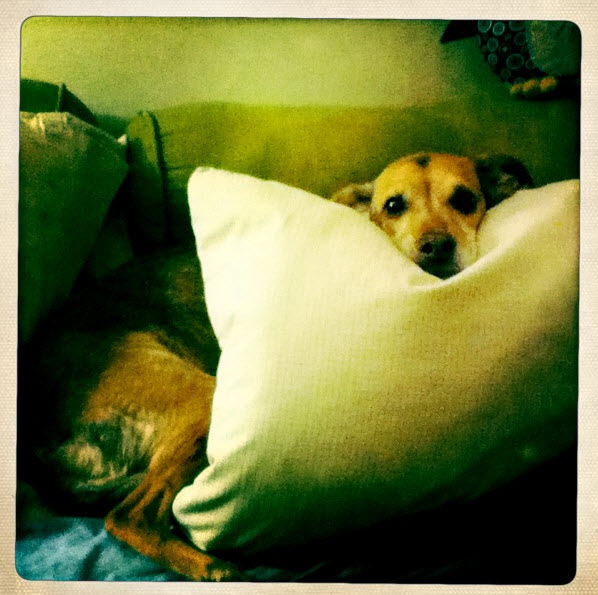
Our dog Sadie rearranged her chin on my foot. I couldn’t move.

Sadie, keeping the bed pillow warm for me.

“I’ll sleep another hour,” I told myself. I texted my training partner in crime, Terry, to say I’d be heading out late and that he should leave without me if he needed to. I was out again in less than a minute, that dreamless sleep of the half-dead. I fell asleep with the phone in my hand, so when Terry vibrated back at 6:30, it woke me.

“I am bailing, too, how funny! Enjoy the day,” he wrote. “I’m not bailing yet,” I thought to myself. “It’s still early.” And I promptly fell asleep again.

My friend Kerri, who is training for a half-marathon (I know; I can’t imagine doing it, either), often runs on the same West Side path along the Hudson that I take to bike out of Manhattan. She sent a text at 8am to say she was starting late, so she probably wouldn’t see me on the road today. Kerri was on her way out the door, but in my Brooklyn bed, Jen was snoring her light cat purr, and Sadie got up, stretched, and spun in three circles before flopping back down into the crook of my knee. In my head, I was mentally dressing myself, slurping down coffee and a smoothie, and rushing out the door to zip zip zip the eight miles to catch Kerri.

“I’m in a blue tank,” Kerri wrote. “Bet you bike faster than I run!”

“I am in my jammies,” I wrote back. And I rolled over and zonked out again.
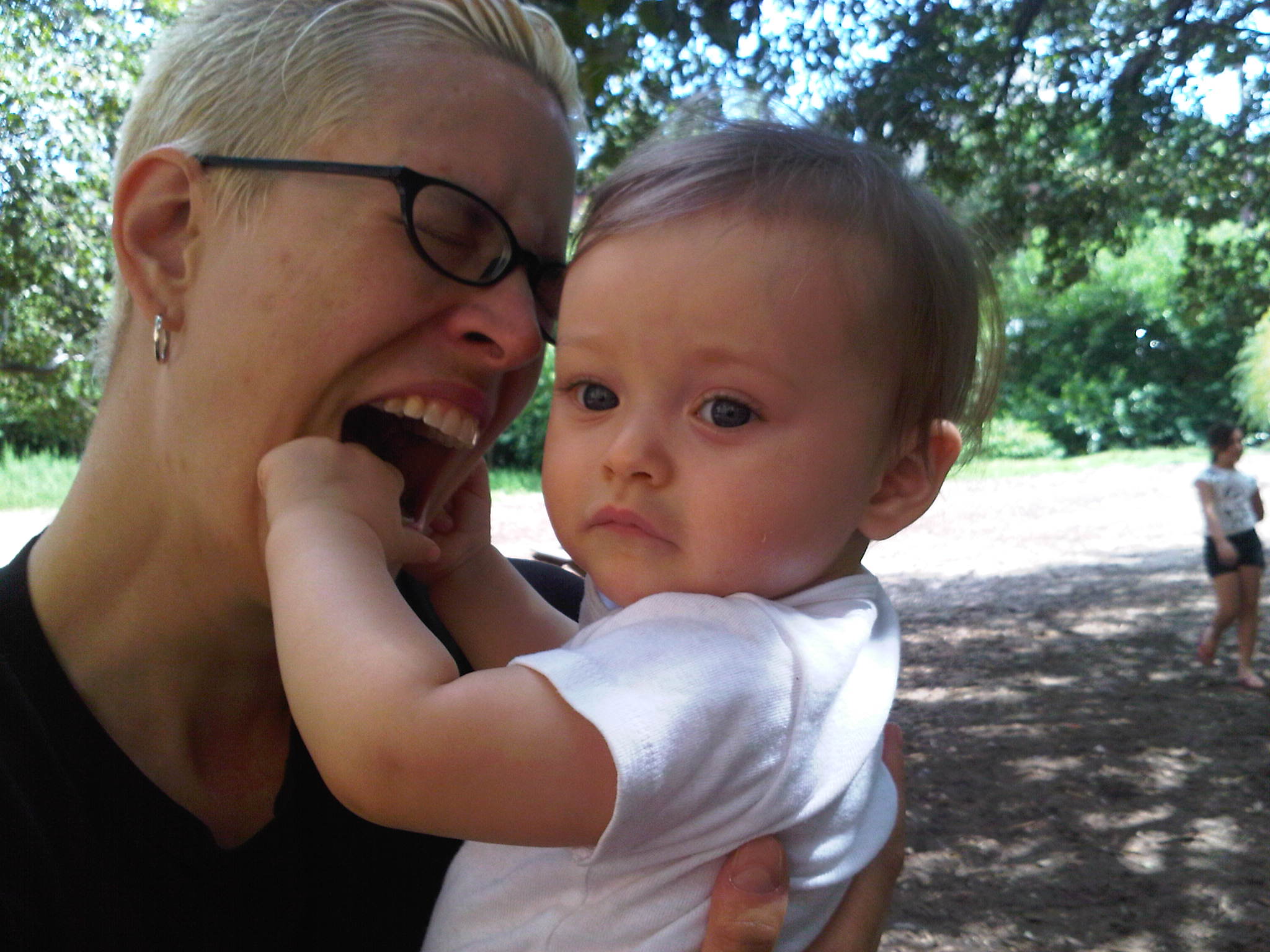
I didn’t go riding today. These things happen. Jen and I talked over coffee and crumpets, the latter part of a food birthday gift package from Jen’s brother and sister-in-law. It’s the first time in weeks that I’ve has something other than a fruit smoothie for breakfast on Saturday. It is also the first time in ages that I’ve had a real, leisurely weekend morning with my spouse.

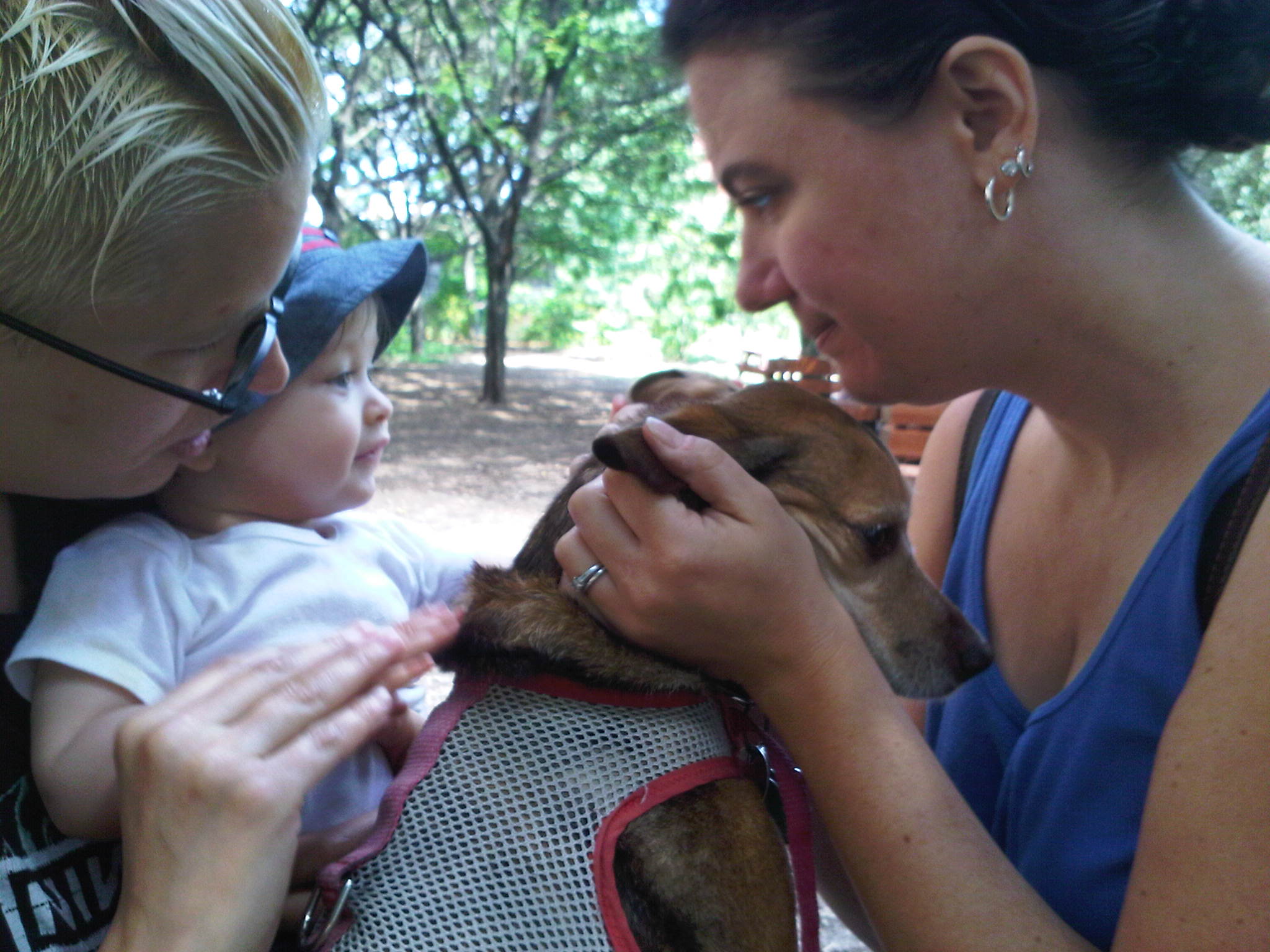
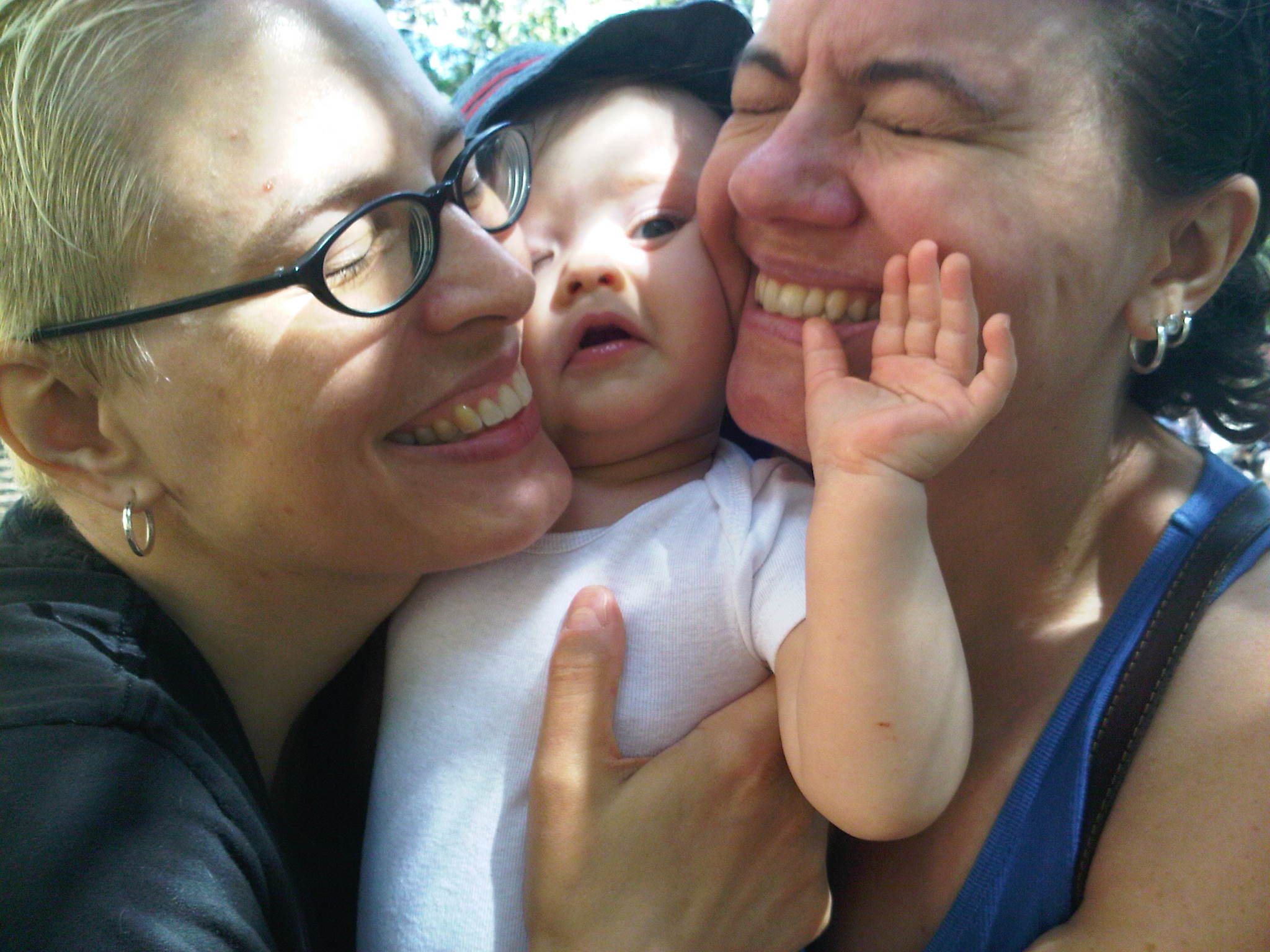
Later in the day, we took a long walk to Brooklyn Heights to the dog run, and I checked in with my friend who lives nearby to see if she wanted to meet us there with her nine-month-old baby. No hills yesterday except the Hillside Dog Run.

My usual inclination when I don’t feel like riding is to push myself. I go anyway. Discipline was so hard for me to learn, some part of me feels like I have to practice it all the time lest I lapse into my old, feast-or-famine ways. But I guess adapting and listening to what your body and spirit need is as much part of training and discipline as anything. For my usual 70-mile training tide, I went today, Sunday. I hadn’t planned to ride this Sunday for sure. But I did. My body didn’t know it was Sunday. The hills didn’t care either.

Maybe some weekends, discipline is knowing and accepting your limits and adapting. If you can’t today, you adapt and do tomorrow what you didn’t or couldn’t do yesterday.

On Saturday, this is what I did instead of training, which is, some days, it seems, just what a body needs.

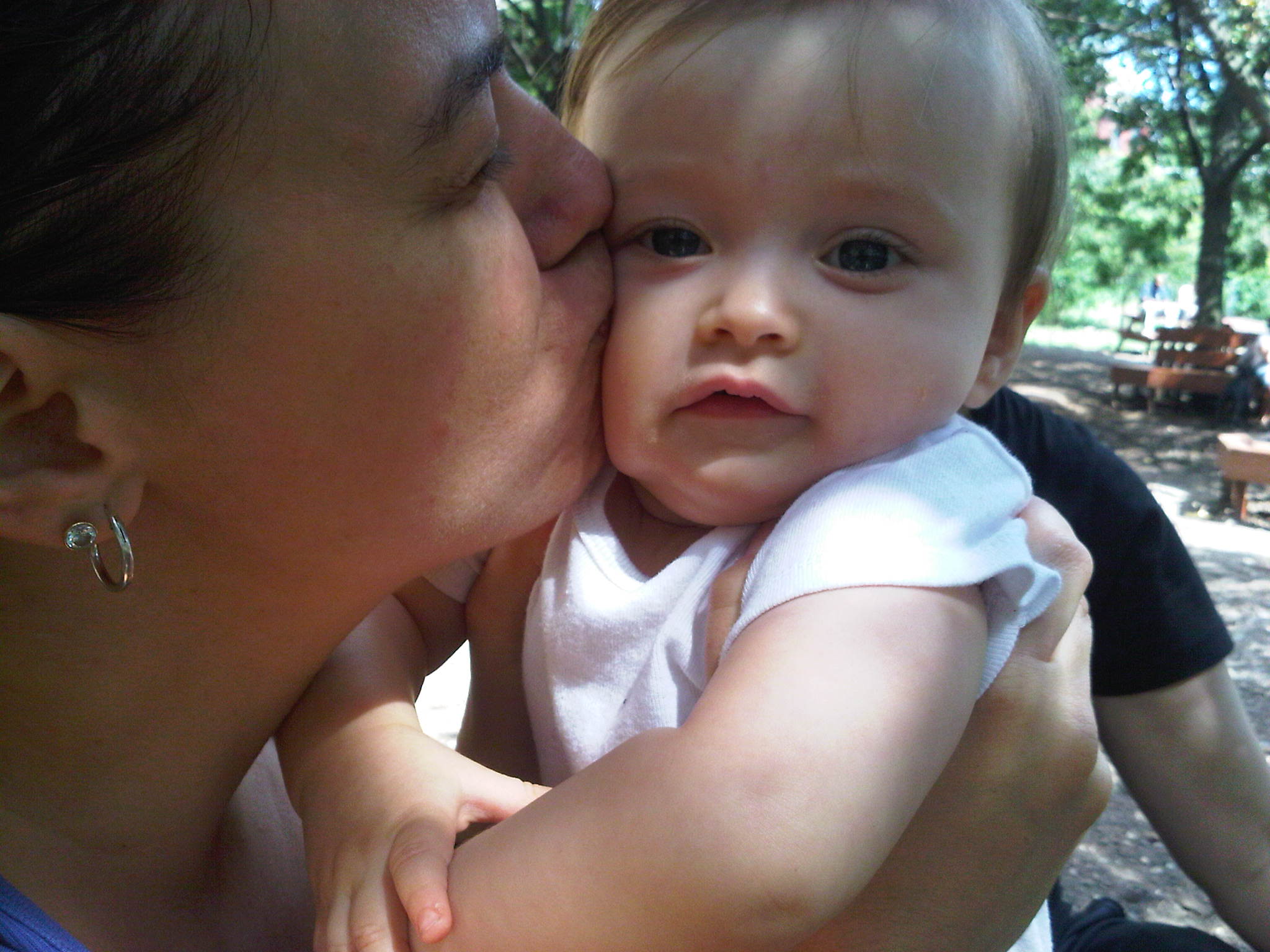
Me, unable to resist the baby cuteness.

Jen, serving as the practice patient for a future dental technician.

“Fur, especially on the ears, is very, very soft.”

Baby sandwich!

Postscript: The Hills and Narrative Flow

I re-read my previous post this morning. I found myself feeling vaguely unsatisfied by it.

I am not new to relying on words.  Words are my medium. They are my bread and butter. They are also the primary way that I create art, and they are my comfort zone. Sometimes, I even feel as though I’m better in word form than in person.

That said, I’m also more accustomed to using words for story-telling purposes. Even when it’s informational material, I know how to shape it to give it a linear logic and form. Good stories have clear beginnings, middles, and ends.

Blogging is relatively new to me. I happily participate in collaborative music blogs with friends, but those rely on music and images, not words—and arguably, by virtue of the collective mixes we make together, those work toward achieving a narrative shape, too.

But I’ve been resistant to blogging for other purposes, probably because I’m such a control freak, willing to have a complicated, meandering artistic or editorial process on the way from Point A to Point B, but less comfortable with the idea of sharing it with others lest they see my inevitable, numerous screw-ups and false starts along the way.

What does all this have to do with cycling and training rides? Nothing and everything. I am coming to think blogging is a lot like training. I may be working toward a definite goal, with corresponding time constraints, but the experience of writing it, and reading it, is episodic. In the moment, goals and progress can feel murky. Training rides are like that, too. They’re an ongoing journey, not a destination. The Blue Streak and I may end up at home each time, but even after I am sitting on the couch—drinking iced watermelon juice and thinking of how soft I’ve gotten in my old age because I am loving loving loving the air conditioning this summer after my weekend rides—there’s another piece of the training to work at harder or longer. Adding weekly mileage one week. More hills the next. Speed the next.
That’s the thing about this endurance-ride training journey. There’s always always always another hill.

To be continued…

The episodic cycling training narrative structure: Lather. Rinse. Repeat.

The Hills Have Hills

I’ve never seen The Hills Have Eyes. But last Saturday, I wished the hills did have eyes, because my friend Terry and I kicked some hilly, cycling ass. It’s a particular boost to the psyche because the last climbing segment we did wasn’t planned.

Poster for The Hills Have Eyes (1977), directed by Wes Craven

It has been a strange cycling season so far. More erratic and grueling than any I have experienced before.

I’ve never been a chipper, chatty girl in the morning. I’m silent and fuzzy-headed and sluggish. Getting up and out on the road early—decidely not what my body and mind are naturally inclined to do. It’s been harder this year to rise early. And more necessary than ever. On our most frequent weekend ride up to Nyack and back—about a 70-mile run round trip from my place in Brooklyn—any time after about 11am on a sunny day is brutally hot, and the roads don’t have much shade. So my friends and I have been trying to meet up earlier to beat the heat. Just the business of getting my ass up and out of bed at 5:30 or 6 each Saturday has felt like its own special hurdle. It’s been a grind.

It’s been so scorching, even leaving early doesn’t let us avoid the heat entirely. The 105-degree heat a few weeks ago knocked me out; I even cut my ride short, stopping in Piermont instead of Nyack. I felt exhausted. Slow. Heavy.

And then all week before this past Saturday’s ride, I was plagued each morning with a tightness in my chest and an irritating, sporadic cough that never quite subsided all day. I thought it was some low-grade version of the cold/flu nastiness floating around my office at first. By Wednesday, I was still feeling crappy, and someone suggested to me that it might be mild asthma. Which I have never had, but it runs in my family and scares the crap out of me. Decades of my grandmother’s wheezing and choking come to mind with the mere mention of the word.

So I was approaching last Saturday’s ride with some apprehension. When I woke up though, after I shook off the initial lethargy and rode out, to my surprise, I felt okay. Better than I have in weeks. My chest—almost normal again. I met up with Terry at the Palisades Park entrance, and we were at The Runcible Spoon in Nyack by 10. You know it’s been a steamy summer when the temp on River Road in Jersey is pushing 90, and you feel like it’s positively cool and breezy compared to every other day during the past two weeks.

We both felt so good at Mile 34, often the halfway marker, I floated the idea of pushing it. Rockland Lake State Park is only another three miles or so away. But at least half of it is all uphill, which is why it’s not always part of the regular weekend run. The last mile down to the lake is a glorious downhill reward, but that also means you have to climb back up that same stretch going back. Because the thought of that nasty hill back right after making the climb to the lake makes me cringe, I usually like to do a loop around the lake before turning around.

All this to say: What looks like a tiny five- to six-mile supplement, which would take maybe 15 to 20 minutes if it were flat, ends up being 40 minutes of alternating cycling heaven and cycling hell.

At various points en route, I was bumping up against how excruciatingly slow I felt, crawling up each hill. It feels endless. Like a bad idea someone else must have duped you into. It wasn’t until I was back in the Palisades heading south,  feeling that giddiness that comes when I know I’m only 14 miles from home, nearly all of them pretty pancake flat that I remembered: when I got up that morning, I didn’t know if I’d even make it the first 15 miles to New Jersey. I reminded myself of that on and off the rest of the way home.

I had had delusions of cycling grandeur for Sunday. I haven’t done back-to-back weekend rides yet this season, and it’s already late July. Eeek. Two years ago, by this point in the season, I had done several back-to-backs and a century ride. The spontaneous Rockland trip was a good idea, and it was wise to take advantage of the slight let-up in the weather. It also was the reason I slept like a fairy-tale character Sunday morning and didn’t ride at all. I sat on my ass, lazed, and went to the movies, where I sat on my ass some more, surrounded by icy central air.

Endurance through more days commuting by bike to work,  and, hopefully, some back-to-backs: next week.