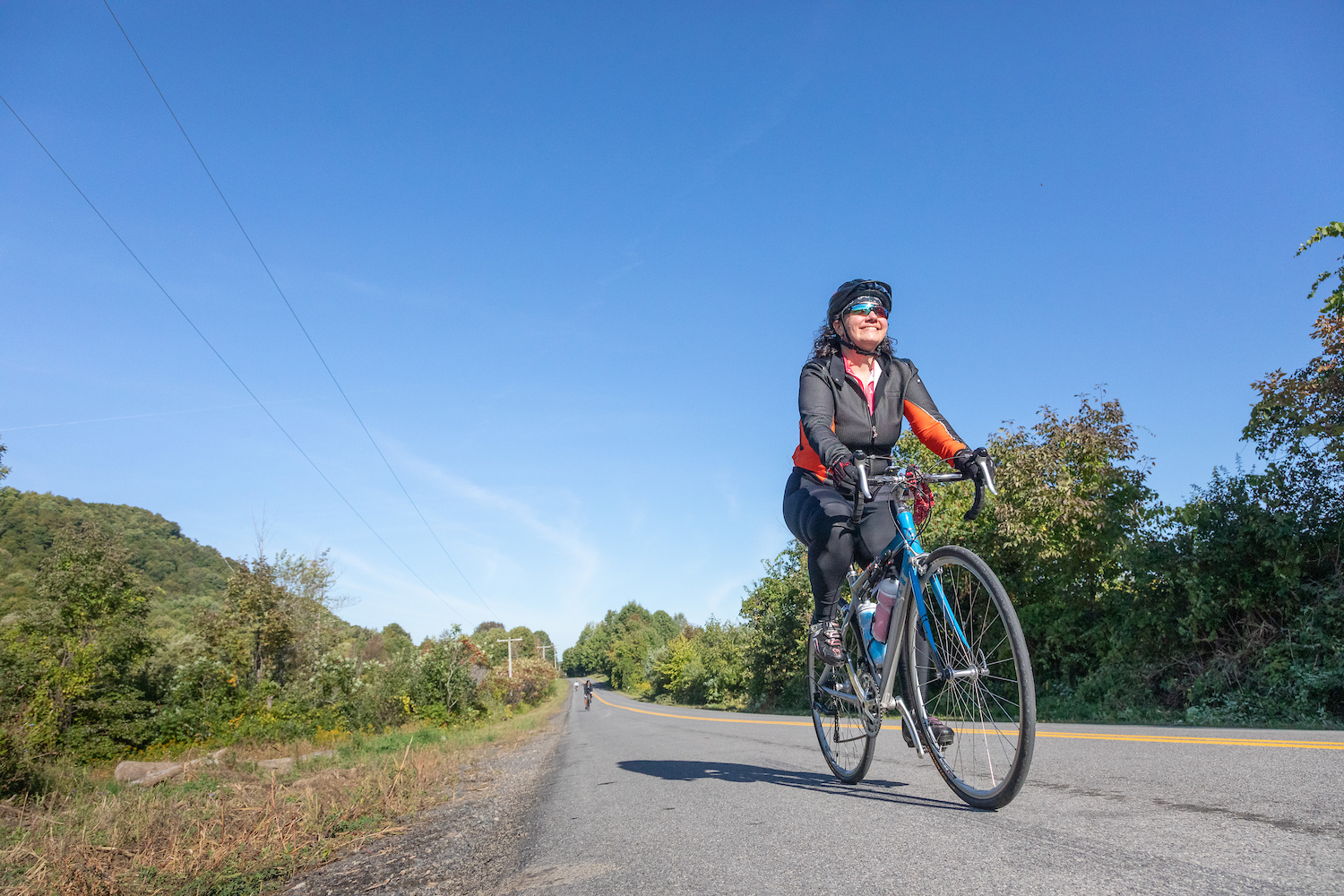
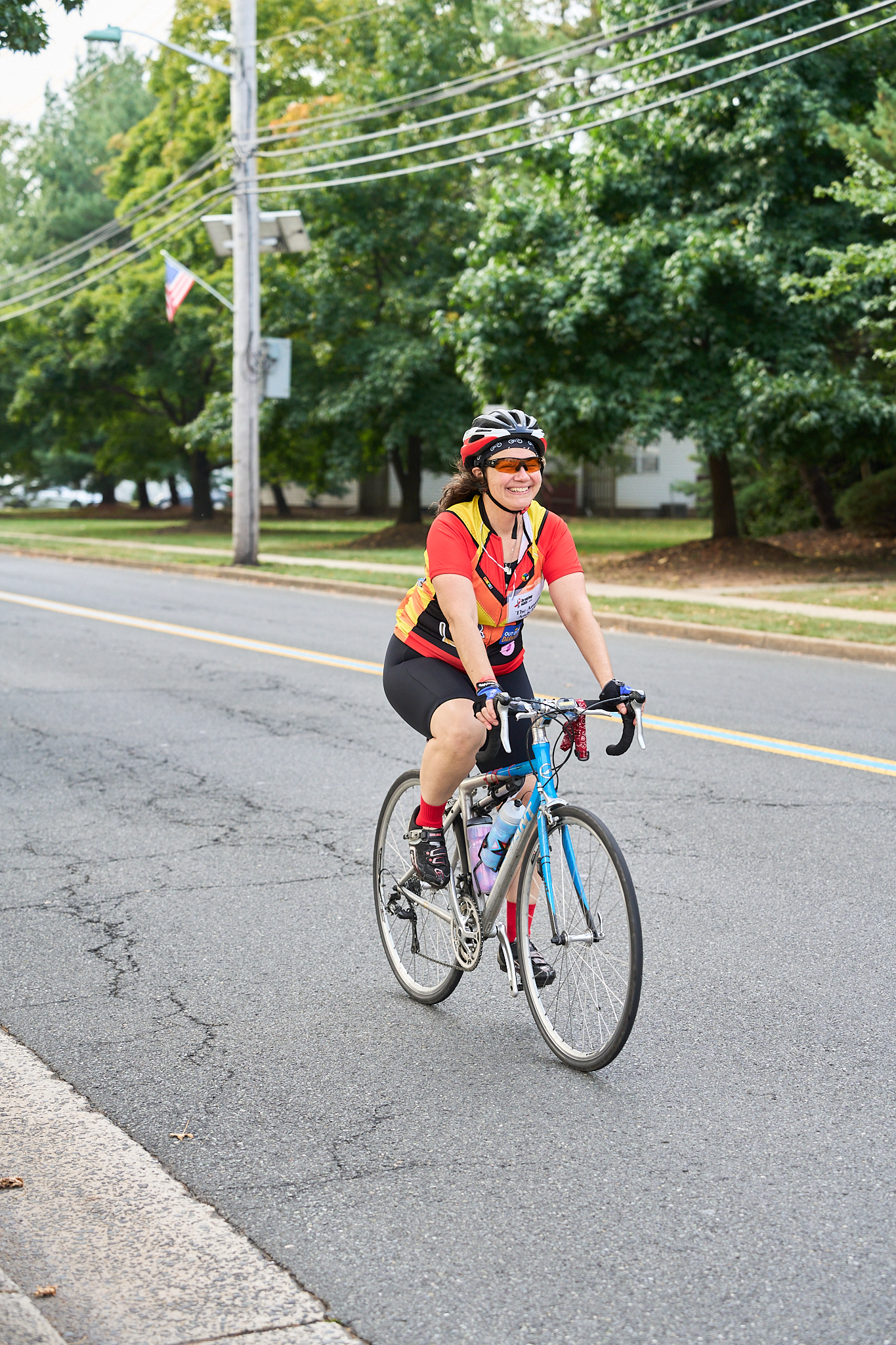
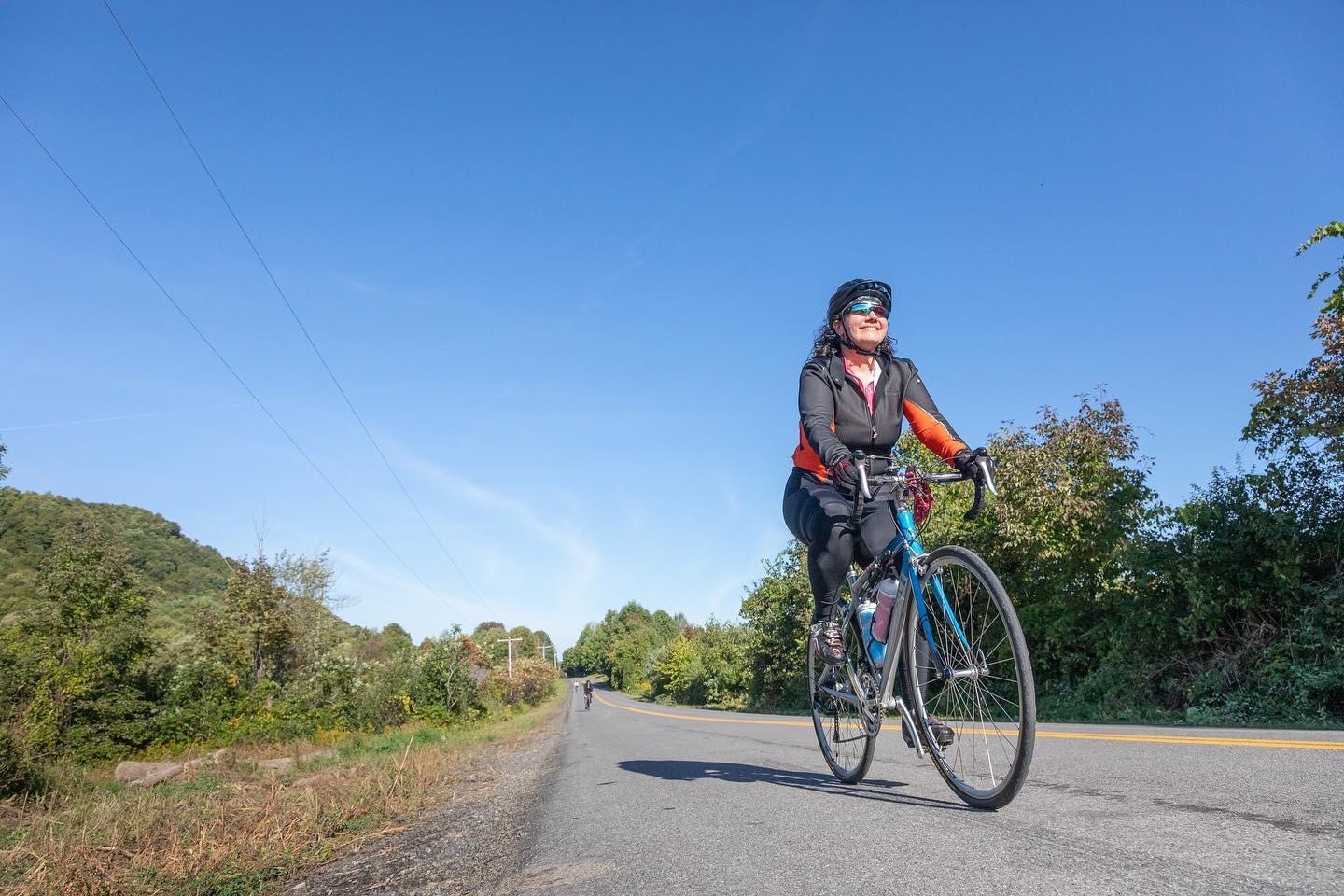
Photo courtesy of Alan Barnett Photography.
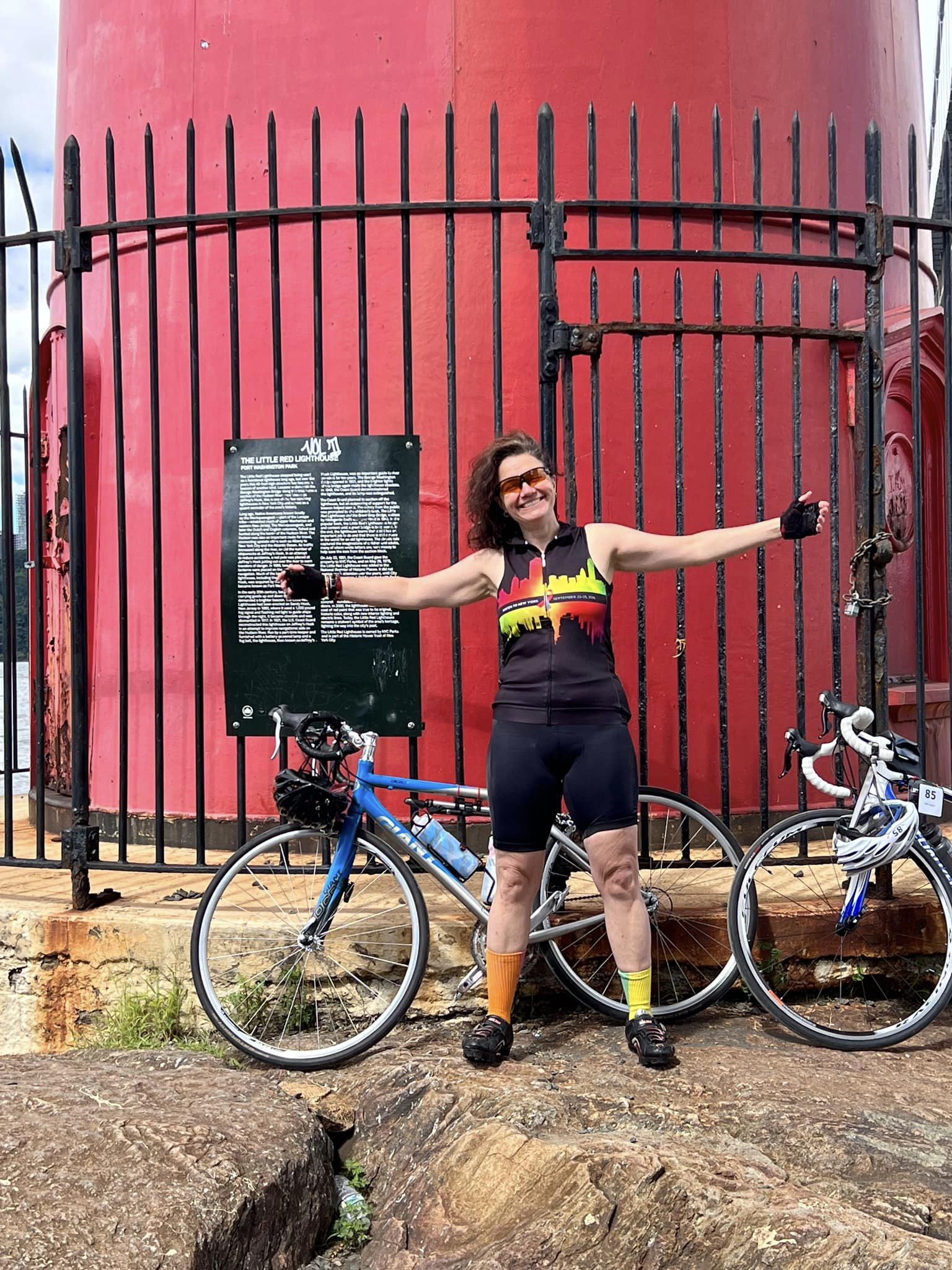
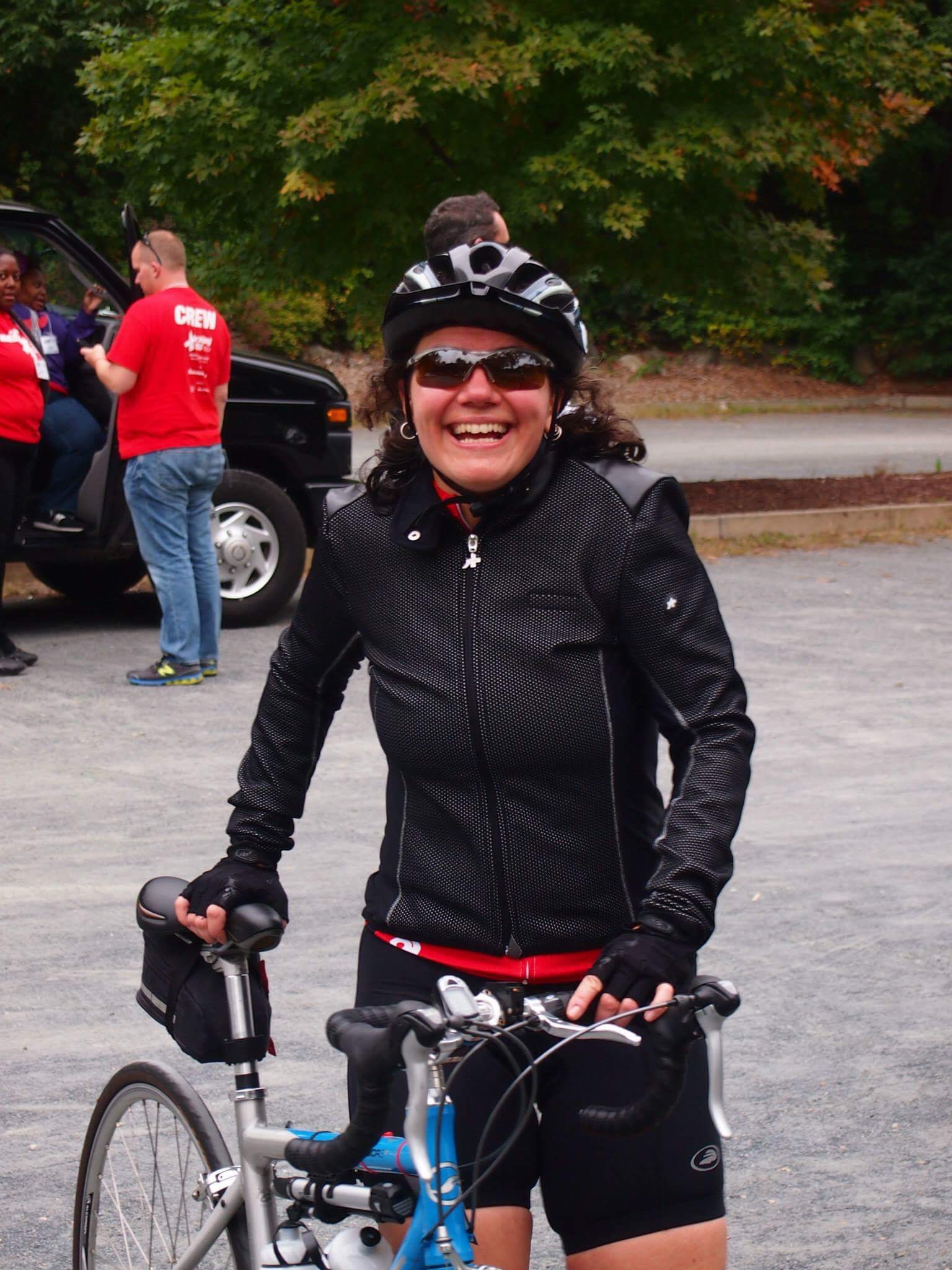
Recaps of endurance event fundraisers for important causes are usually triumphant, celebratory, and short. They’re supposed to sound and feel the way the image above looks—determined, strong, confident, assured. I promise this recap will find its way to some of those spaces, which were and are part of my BRAKING AIDS® Ride experience this year. It just won’t start that way, and the emotional journey to getting there, like the ride itself, was and is nuanced and complex, with twists, turns, hills. Not a straight flat path. But joys worth hearing about are ahead for you, Reader, even amidst some shadow detours. You’ll have to trust me and keep reading.
BRAKING AIDS® Ride is, of course, about raising funds and awareness for an important social-justice cause. If you received a link to this post, it’s because you donated to support my ride and help Housing Works continue to push for programs and policies that will end AIDS as an epidemic once and for all, starting with New York State by the end of 2020.

As of September 15, BRAKING AIDS® Ride 2019 had raised over $242,000. Since then, as additional donations and matching gifts came in, that net total has increased to over $285,000. Photo courtesy of Asher Mones.
On those milestone fundraising achievements, I won’t bury the lead:
• Because of all of you and thousands of other generous donors like you, BRAKING AIDS® Ride 2019 raised over $285,000 net for Housing Works.
• Because of all of you, I not only exceeded my ambitious $20,000 goal, I raised the most money I have ever raised in any year doing this—more than $25,800 from over 200 donors. That’s 129%+ of my $20K goal. (Writers can do arithmetic, too!)
I’m also pleased and bemused to report that because of all of you, I have a fabulous new winter hat, knitted by my friend and BRAKING AIDS® crew member Meghan Sheldon-Brungard. I confess I wasn’t paying attention when this hat prize was being announced during dinner on Day 2 of the ride. (At that very moment, I was ravenous and focused on inhaling as much pasta as possible.) My recollection is that in addition to giving a shoutout to top individual and team fundraisers, a moment of acknowledgement was being made for the rider who had the most donors. Imagine my shock, my cheeks puffed up with pasta like a damn chipmunk, when Rider Coach and friend extraordinaire Blake Strasser called my name. My melon head is already much happier wearing this soft, rainbow hat in the freezing tundra outside. So thank you.

Not everyone is meant to be a hat model. Gorgeous rainbow wool hat courtesy of Meghan Sheldon-Brungard and all 200+ of my generous ride donors. Photo courtesy of Jennifer L. Anderson.
A list of everyone who donated appears at the end of this post. Of the over 200 donors, to my astonishment after doing this ride for many years, more than 50 of them (25%) were from first-time contributors. As I said in the postcard you’ll each be receiving in the mail, thank you thank you thank you. I couldn’t have done it without you. Every single one of you.
That said, any rider or crew member will tell you that the actual riding part of the event over three days in September is as much for us—what it brings each of us and what we bring out in each other together—as it is for the cause. Some of this blog post will be about what we as a collective, including all the donors and supporters, accomplished for the cause, which is life-saving for so many, but much of what follows will be about the inner journey BRAKING AIDS® Ride 2019 was for me personally.
BRAKING AIDS® Ride 2019, Day 1, sometime in the morning when it was cold enough to be wearing all my layers. Photo courtesy of Alan Barnett Photography.
The photo above is in fact of me from this year’s ride. The moment captured in it is as real and genuine as any other I had during those four days. But it’s no more than that. A moment. As such, it’s only one tiny piece of a mosaic of thousands of moments that came and went in countless colors, shapes, and textures all weekend long.
The photo won’t tell you this: I came into this year’s BRAKING AIDS® Ride—my eleventh year participating—depleted on almost every level. 2019 has been a challenging year. That’s the ever-optimistic American euphemism for saying it’s been a shitty year. I’m American, to be sure; I’m also a blunt, native New Yorker who hails from people who don’t mince words about calling it like they see it, an Eastern European Jewish immigrant family—first generation born here on my mom’s side. So I will say it in both ways at once: 2019 has been a challenging, shitty year, full of dramatic change, some wonderful, some as horrific and painful as anything I’ve ever gone through. For me, it has been a year of moving forward into an unrelenting fog of uncertainty. Which is sometimes necessary, exciting, even beautiful, but also scares the shit out of me.
That’s the thing about fog, which, the more that I think about it, is a visual manifestation of states of uncertainty. In fog, you’re not necessarily lost, but you almost never know where you are.

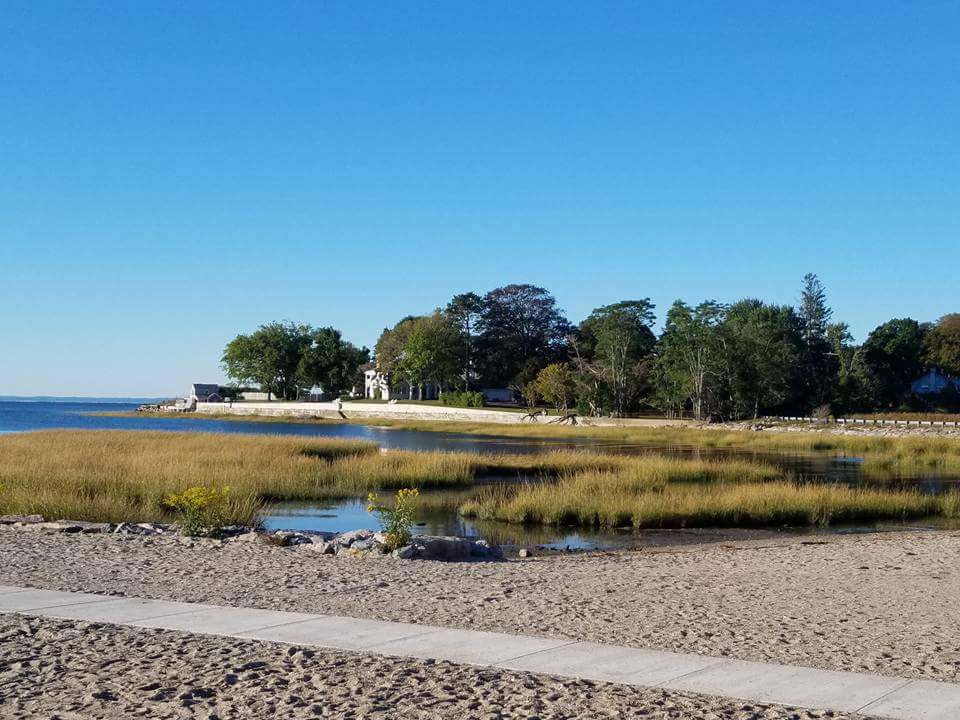
BRAKING AIDS® Ride 2019, Day 1, Glimmer Glass Lake, Cooperstown, NY. Photo courtesy of Mikola De Roo.
When I arrived in Cooperstown on Thursday, September 12, I was already exhausted.
Four friends of mine died during the first five months of 2019. Two were older men, mentors of mine both—one, Lee. K. Abbott, was a former fiction writing teacher who was my thesis advisor when I was finishing my MFA in creative writing at the University of Michigan, the other, Andy Velez, was a longtime LGBT and HIV/AIDS activist and ACT UP New York member. The other two were my peers, one a handful of years older than I am, one four or five years younger—Bill Bish, who I met through dear mutual friends some 20 years ago, died back in March, a suicide that I still have trouble thinking and talking about, and Dawn Grimmett, who was on the BRAKING AIDS® Ride medical crew and whose spirit embodied so much of the inclusion, love, and wry humor that the ride is all about, died unexpectedly in April after complications from pneumonia. In addition to the people in whose memories and in whose honor I always ride, I dedicated my efforts this year to the memories of Andy and Dawn because of the amazing impact they each had on my life and on the lives of so many living with and affected by HIV/AIDS.
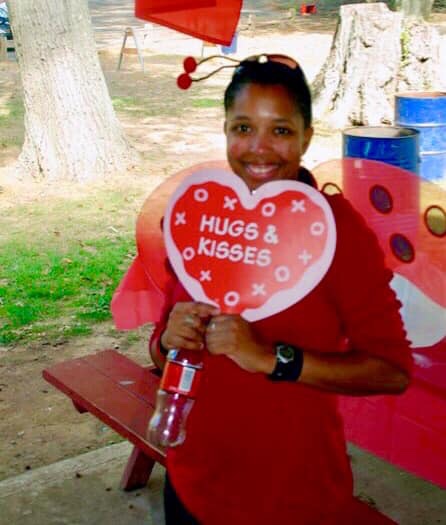
Dawn Grimmett (1975–2019)

Andy Velez (1939–2019). Photo courtesy of ACT UP New York.
Other major challenges arose as 2019 unfolded. The new job I started in late 2018 and had high hopes for didn’t work out. I parted ways with the job and the organization before 2019 was half over and found myself heading into summer demoralized and faced with another daunting job search.
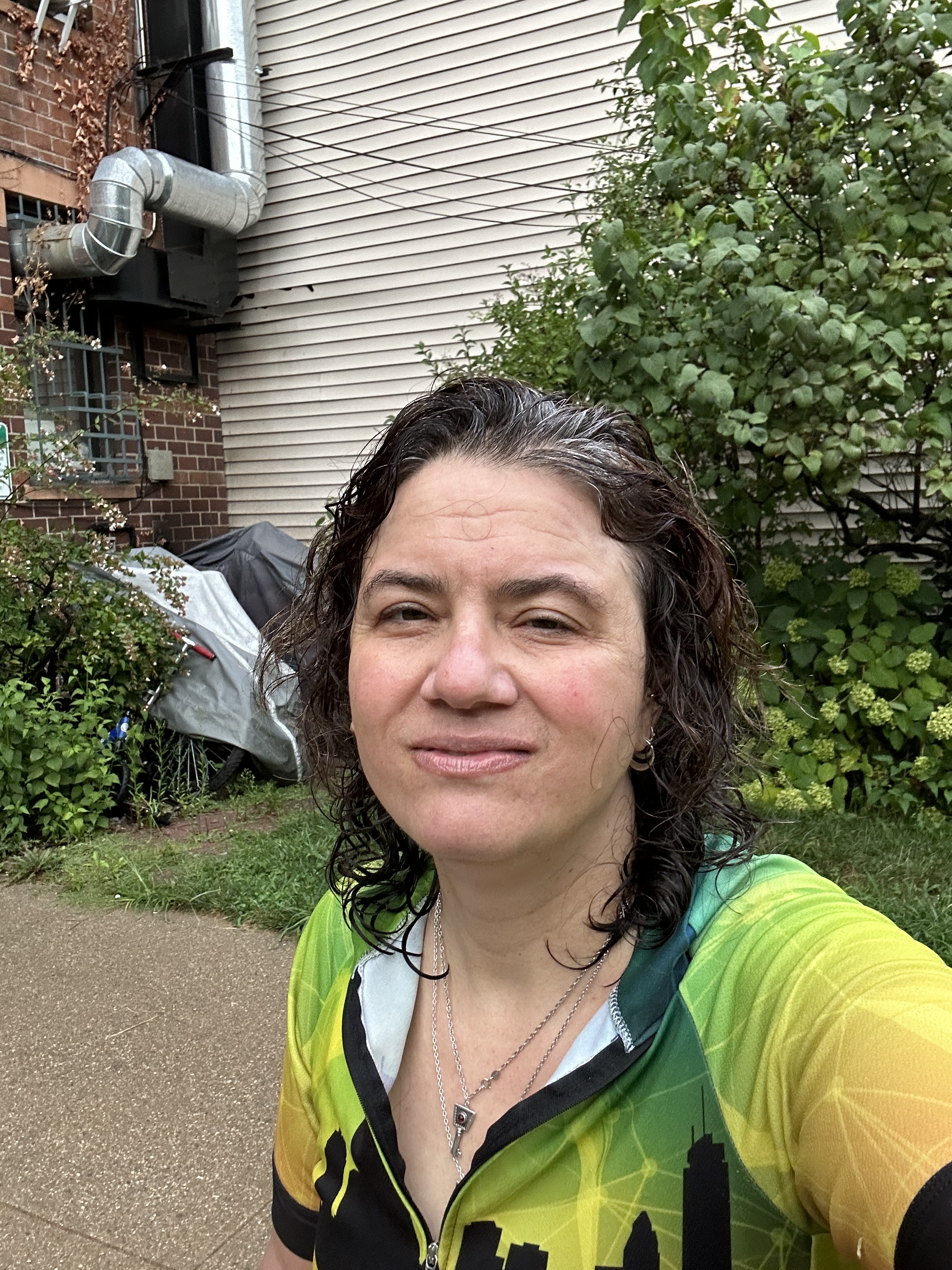
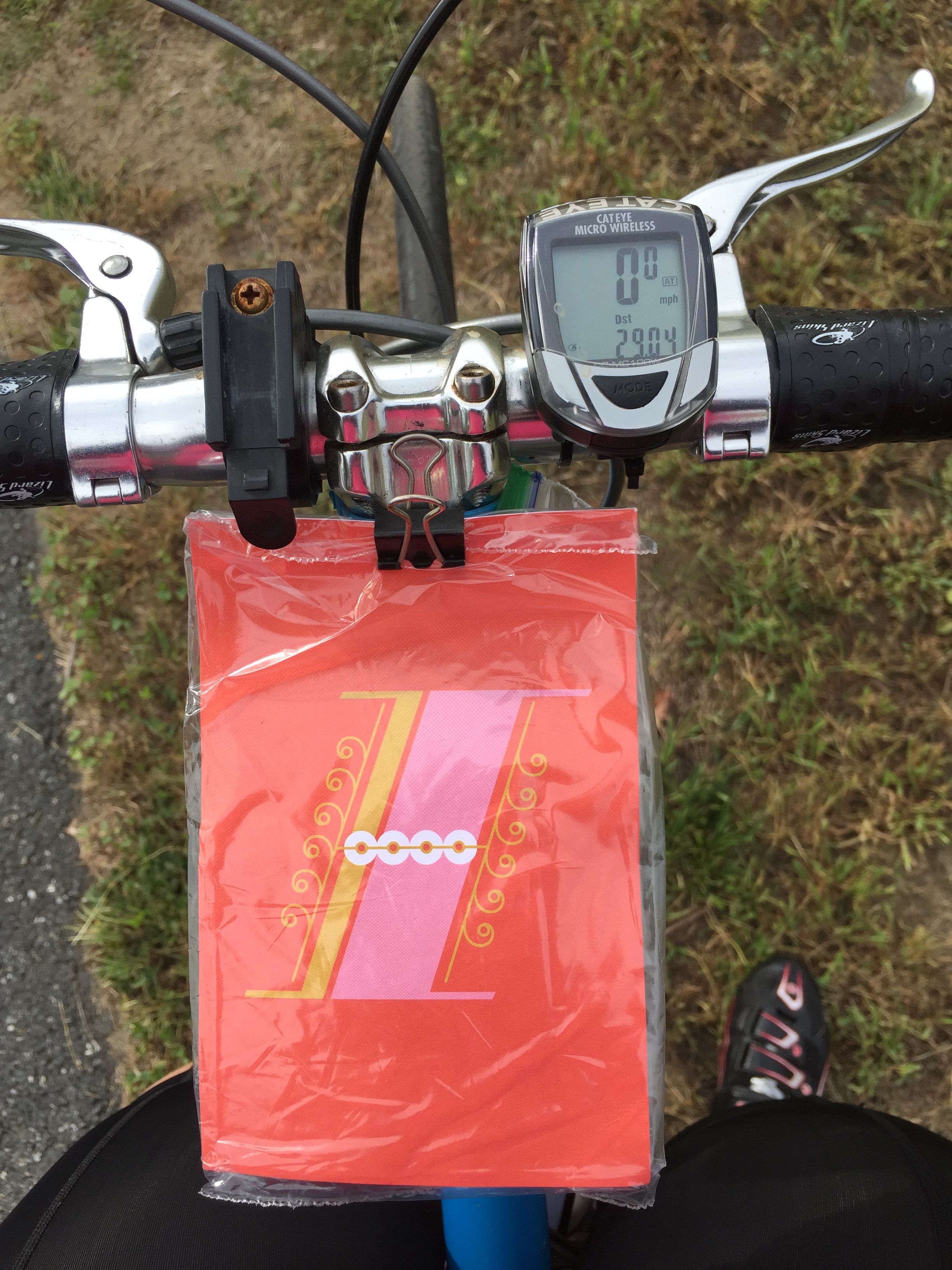
I should have had plenty of time to train in July and August. In my head, I urged myself to ride almost every day. But the stressors and losses of the first half of the year—and perhaps even those of the past five or so years, which I am not sure I ever let myself fully feel for fear that I wouldn’t be able to function and go on—had finally caught up with me. I felt weighed down physically and psychically, and that heaviness, coming from in and around me, kept me from getting out onto the road much. The ankle I sprained badly in 2018 flared up again after a minor, klutzy sidewalk spill in May or June, as did a mild knee injury. I was depressed for some weeks in June and July, sleeping at strange hours, awake when I should have been asleep and asleep when I should have been awake, rarely sleeping well. I knew many of the things I could and should have been doing for myself to feel soothed and comforted. I simply couldn’t seem to get myself to do enough of them to lift my spirits much in those mid-summer weeks. I put in some miles on The Blue Streak, my trusty bicycle, during those crucial summer training months, but those rides were shorter than usual and there were far fewer of them than I should have been doing. The riding also didn’t clear my head to the same degree that it normally does. My head and heart were steeped in other matters. I was focused on my inner life, recalibrating, job searching, writing, reading, trying to get myself back to a headspace that enabled me to get up and choose a new direction to follow.
Per usual, on the outside, I looked fine. Functional. Productive even, whatever that means. I sent out résumés, had interviews, walked our dog, became as domestic a partner as I ever have doing all the food shopping and most of the cooking. I spent quality time with my wife Jen, and at the same time, retreated from many of my friends because I didn’t want anyone’s pity nor did I want to talk much about or relive the dark stuff I was feeling tucked away in shadow corners of my heart.
I was fine. Because I’m always fine.
And I wasn’t fine. I was hurting.

This is what it looks like when I’m fine but not fine, and the armor is off. Illustration courtesy of Greg Lauren.
The point of those admissions is not to elicit sympathy. It’s to say that being in that foggy state most of the summer made showing up for BRAKING AIDS® Ride 2019 tough. Tough may be the wrong word. I was scared. It scared me to show up feeling so shaky, vulnerable, sad, wounded, stripped down, and exposed.
Showing up for anything when I’m struggling is hard, and it has been a year marked by numerous struggles and what felt like failures or at least stalled efforts that I had yet to restart. Still, I didn’t ever seriously consider not showing up for the ride. I love the people in the ride community, and the weekend we spend together each September, while always different, is healing for my spirit; some part of me knows that going is the right thing for me to do for myself no matter where I am. However, if anyone had asked me, I entered BRAKING AIDS® weekend 2019 cautious and wary of myself, my guard up and armor on, tense with trepidation and a deep sense of uncertainty. Uncertainty about most parts of the rest of my life, who and what brings me the most meaning and joy, whether any of my desires, even if I can identify them, are still possible. Uncertainty even about the ride itself—what the road would bring me this year that would have any value, and what I was capable of offering to others that would have any value to them. I worried I might be unable to let my armor down enough to take what others were offering, and I felt guilty and disheartened that I was walking in to a space full of people I love with so little to give. Part of me felt like I was wearing all that vulnerability and depletion on my face and body. Because I was.
I also wasn’t happy going in knowing I wouldn’t be able to ride every mile. My body was far from 100%, and I hadn’t trained enough, plain and simple. I also knew the only way I’d be able to let myself enjoy the ride fully was by leaving my ego behind for the weekend as much as possible. It was about being willing to be curious rather than judgmental or worried about what I would and wouldn’t be able to do or achieve physically—listening to my body more closely than usual, to know when I could and should push myself and stretch and when doing so would be reckless, foolish, and a recipe for injury. I knew that, but I also knew that’s easier said than done.
What’s interesting about reflecting back on the ride weekend now, all these months later, after the magical afterglow of spending four emotional, intense, and rewarding days doing something meaningful and important with amazing people has faded, is what has stayed most with me. (Spoiler alert: What remains etched in my memory, and what matters most, is less about the cycling than one might imagine.)
These are my snapshots from BRAKING AIDS® Ride 2019:
DAY ZERO:
Orientation in Cooperstown
The day we arrived in Cooperstown for orientation (which we call Day Zero) was and is all about hugs. My wife Jen is on the ride’s volunteer crew, and the crew travels up separately early on Thursday morning. Each year, I ride upstate with her in one of the crew vans rather than taking the rider bus, which means that I don’t get to see most of the other riders until they arrive in the late afternoon. The ride family for me is divided into two big groups: some folks who I get to see socially during the rest of the year—sometimes at ride events, sometimes on my own—and those who I only tend to see during those four magical days out of the year, usually because of how far away folks live and everyone’s busy lives and schedules. The ride starts to feel like the ride to me when I get to hug the people who usually fall into the latter category. If I named everyone whose embrace filled me with joy and affection, I’d end up listing most of the people I know from the ride community. This year, however, a handful of those Day Zero reunions in particular were the jolt of love that my system sorely needed:

Me with Chris Vaughan, one of my favorite people. Photo courtesy of Chris Vaughan.
Chris Vaughan. Chris recognizes that I’m a skeptic and misanthrope and loves me anyway. Go figure. He’s also among the few who sees I’m a walking paradox, containing Walt Whitman’s contradictory multitudes: The realist skeptic is also a tenacious believer, with a deep desire to have faith that change for the better is possible if we all keep showing up together. Some people see one or the other of those sides of me, but not both. The balance and nuanced tensions between those selves are more me than either element is on its own. Chris has always understood that about me. Perhaps best of all, Chris appreciates my filthy language and bawdy humor, even when almost no one else does.
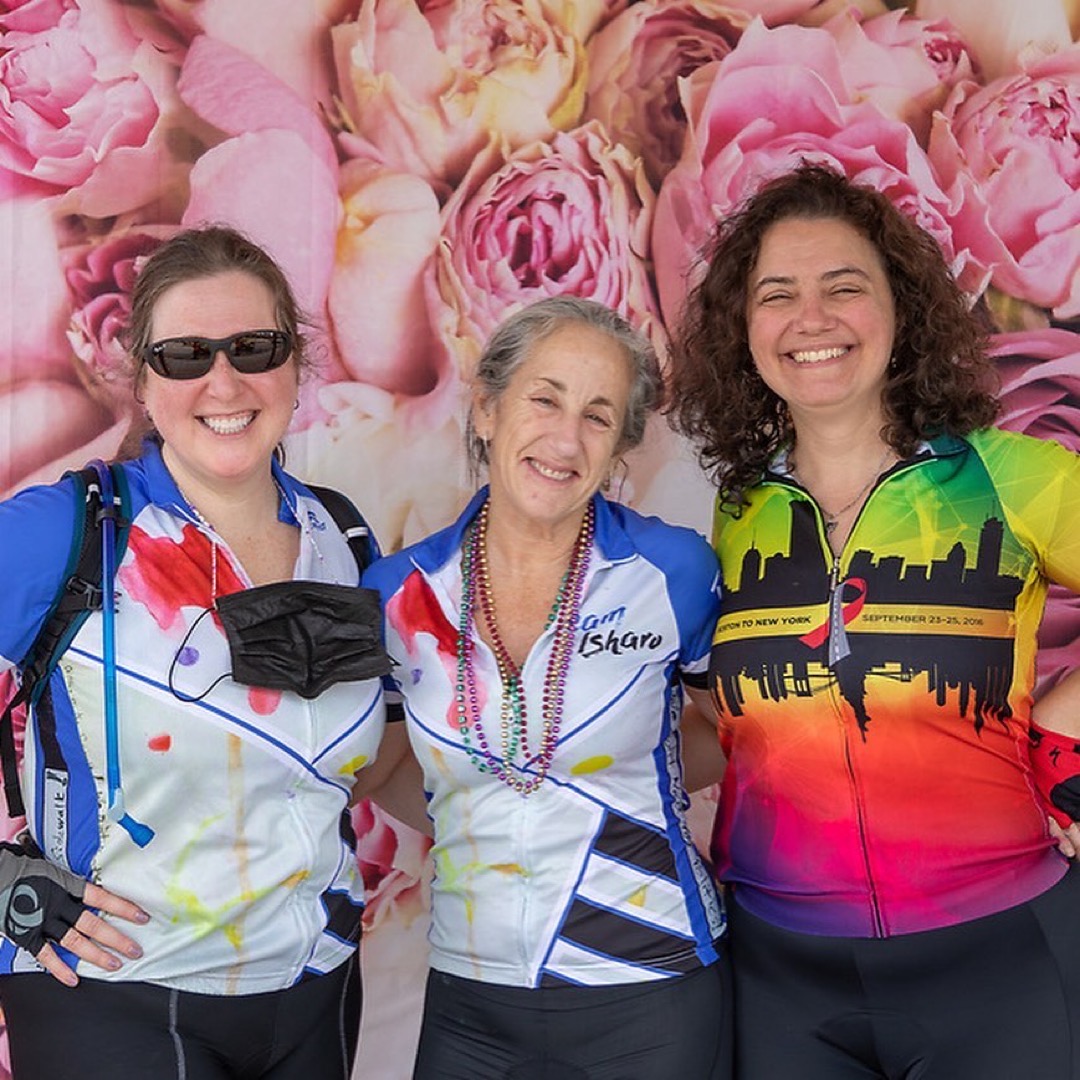
Beth Shapiro and Andrea Slone Biblow. These fierce, beautiful, strong women are part of Team Isharo, a team of riders and crew that’s grown out of Beth’s incredible extended family. Which is to say Team Isharo is made up of Beth’s family members by blood, by marriage, and by choice—Beth’s two kids, two of Andrea’s three children and her partner, several cousins, and a longtime close friend—and the family grows a little every year. They ride and crew in memory of Ira Shapiro, Beth Shapiro’s older brother, who died of AIDS over 30 years ago. More on Beth and Andrea later in this post. These two amazing women were among the biggest reasons I was able to get through the ride as well as I did this year (and last year, too, for that matter).
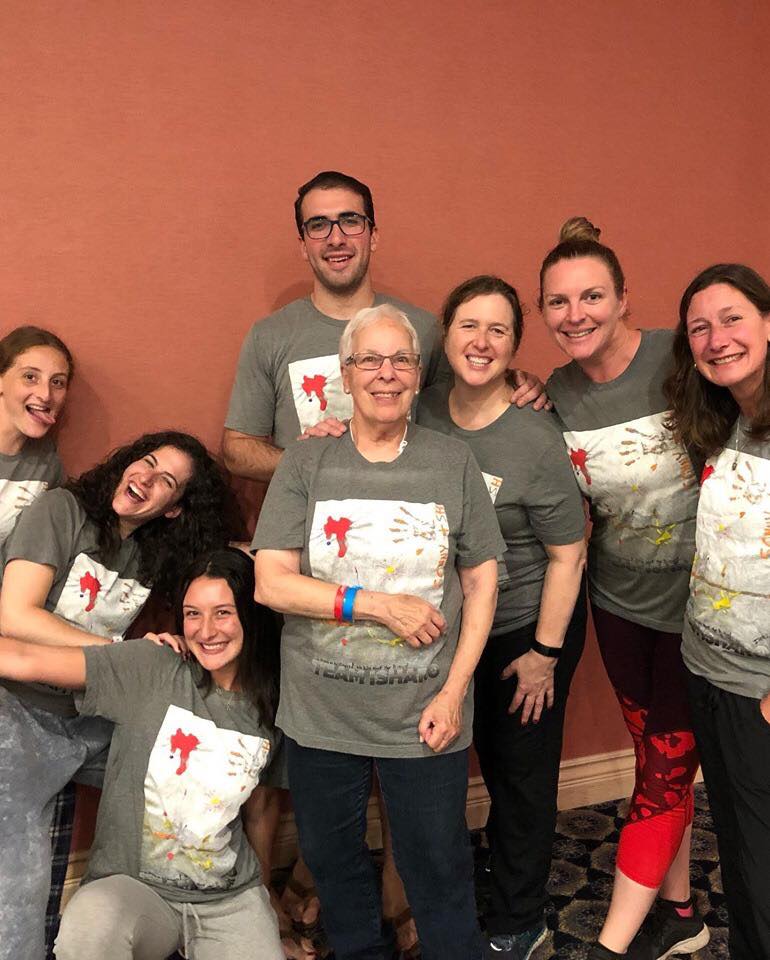
Team Isharo, a family of open-hearted warriors. From left: Lucy Biblow (Andrea’s younger daughter and at 17, the youngest member of our ride family); Sydney Shapiro (Beth’s daughter); Emily Biblow (Andrea’s older daughter); Jordan Shapiro (Beth’s son): Norrie Kurtz (Beth’s cousin); Beth Shapiro; Kate Farrington (cousin at heart, who joined the team via Norrie); and Andrea Slone Biblow (Beth’s cousin and friend). Missing from this year’s team photo are Steven Golub (Andrea’s partner) and Amy Danziger Tenenbaum (Beth’s friend, who we were all so sad wasn’t able to join us this year). Photo courtesy of Norrie Kurtz.
Linda Zipko. Part of our medical crew, Linda is kindness itself. She’s funny as hell, with no bullshit about her. The only thing wrong with Linda is that she lives in New Jersey, which is why we haven’t yet been able to hang out during the rest of the year, despite vowing to do so for years now.
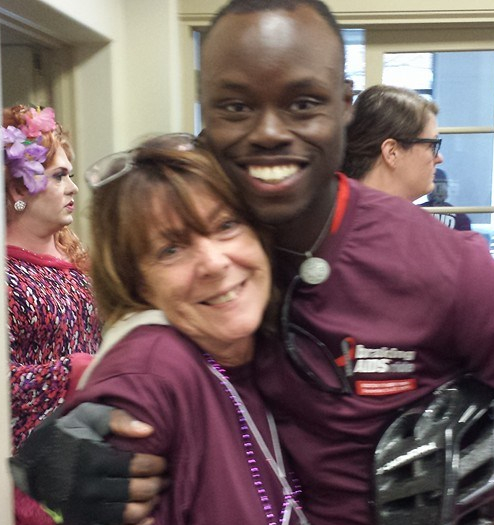
Linda Zipko, with Jamil Eric Wilkins. Photo courtesy of Linda Zipko.
Brian Carroll. Brian and I knew each other before last year, but in 2018, we were riding at a similar pace and cadence, so we spent a lot of last year’s ride together, at first by default and then intentionally, because we were enjoying each other’s company on the road. Brian’s kind, grounded presence kept me going more times than I can count last year. I hadn’t realized how much I was looking forward to seeing him again, and in fact, that some part of me assumed we’d ride together again this year, until I saw him arrive in Cooperstown, our eyes met, and we leaned in to give each other a big, affectionate squeeze.
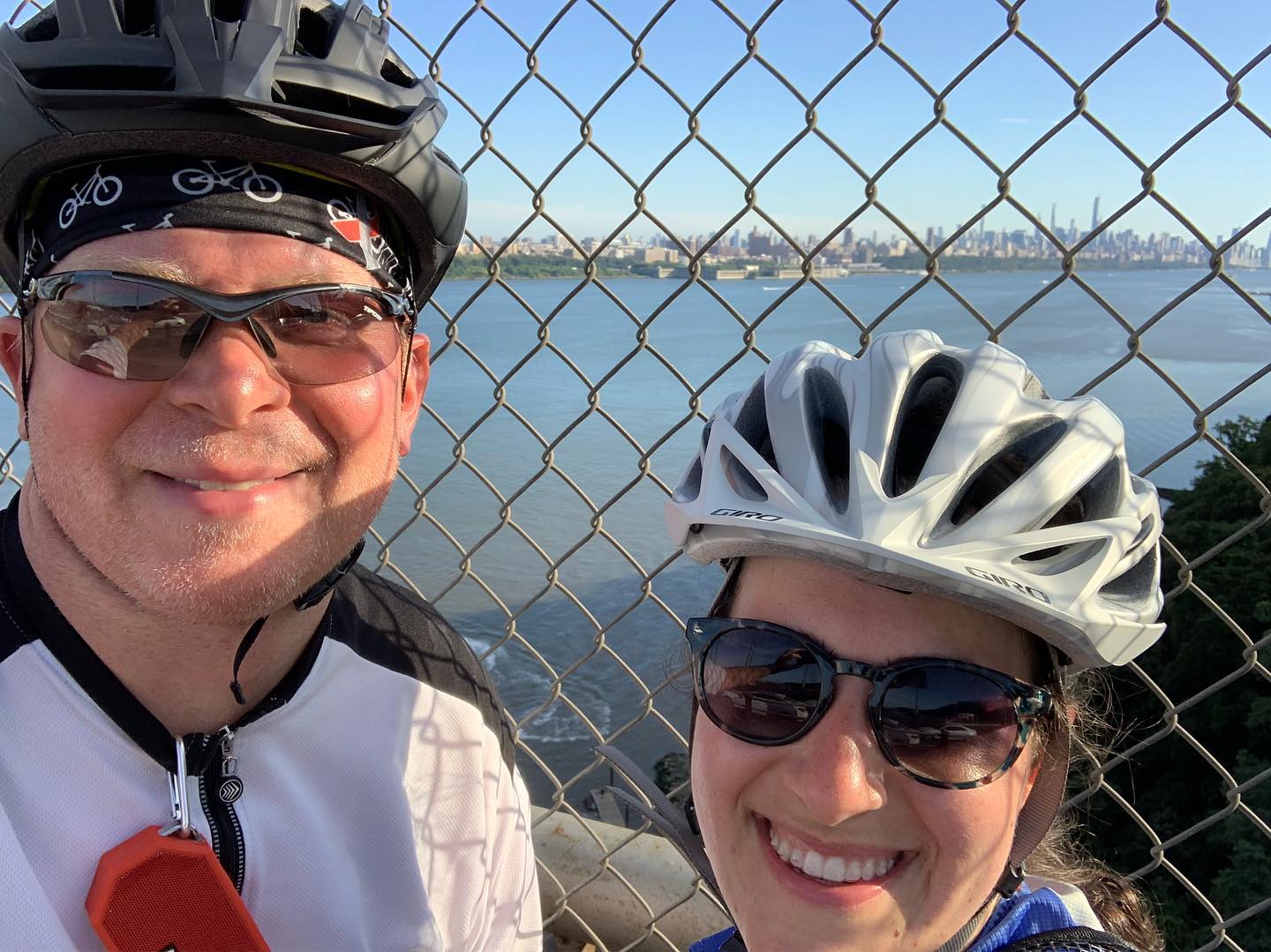
Brian Carroll with Sydney Shapiro, BRAKING AIDS® Ride 2019, Day 3, at the George Washington Bridge. Photo courtesy of Brian Carroll.
The embraces I had with each of these folks upon seeing them on Thursday afternoon for the first time in a long time—a year for everyone except Chris, who I got to visit with in DC last February—were soul hugs, the full body kind you don’t ever want to step out of because of how healing and joyful it feels.
Seeing and hugging these five people again reminded me that my fears and anxieties were feelings, nothing more, nothing less. Not truths. Not facts. Feelings. Feelings that would recede and pass. Chris, Beth, Andrea, Linda, and Brian, with little more than a smile and a brief, affectionate touch, all reminded me that whoever and wherever I was when I showed up for the rest of the weekend that followed and whatever happened, I was going to be surrounded by the main quality that is at the heart of this ride, and why I keep selfishly returning every year to replenish my spirit: love. Love of all kinds without condition or judgment. Love in the face of tremendous pain—loss and suffering and rage and disappointment and grief and anxiety and fear and depression and trauma. And for many of the folks in this community who have carried that pain, until they came to be part of the BRAKING AIDS® Ride family, they had been bearing that load—living with it and struggling with it—alone, for decades in some cases.
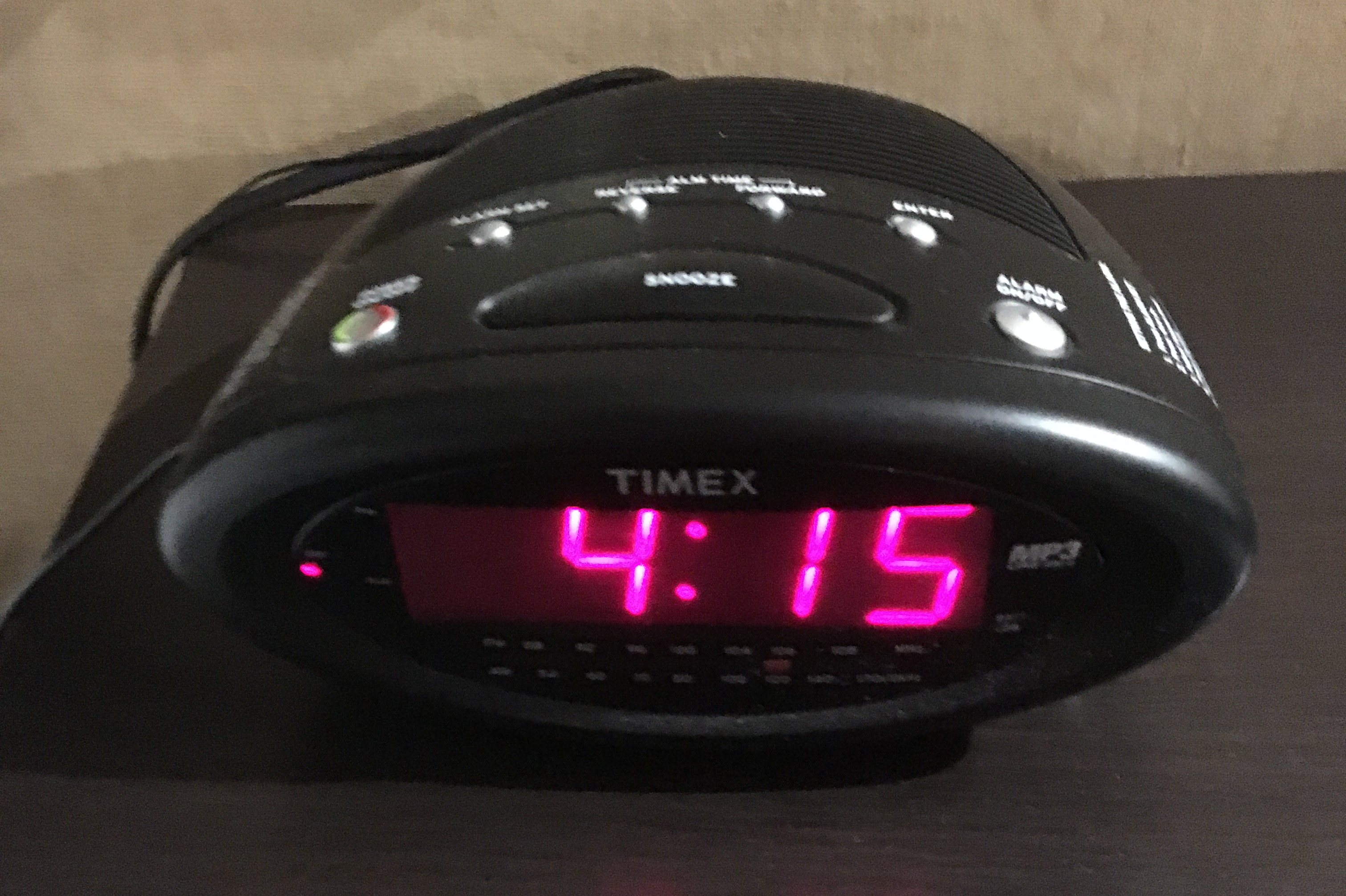
BRAKING AIDS® Ride 2019 alarm clock. Yes, it’s set for between 4:00am and 4:15am. Photo courtesy of Mikola De Roo.
DAY ONE:
Cooperstown to Albany.
Or, Lost in Schenectady.
Or, “This is a pretty long detour!!!”
Day 1 began and ended with two bookends, both, as it happens, about unpredictability, humor, and good will. The first one occurred before I even made it to the shuttle to take us to breakfast and the opening ceremony.
I should preface this story by noting that I’m not a morning person. I’m slow-witted, draggy, and typically grumpy and in need of coffee at 4:15am, or 5:00am, or even 6:00am. In those wee hours, I’m a useless idiot who shouldn’t talk to anyone beyond saying “good morning” until I’ve been awake at least a few hours. That means that typically, ride mornings for me are about achieving two goals: 1) me having been vigilant enough the night before about organizing and prepping my gear for the next day’s ride that I don’t have to think too hard or search too long for anything in the morning, and 2) me not sleeping through the alarm when it goes off at 4:00am, which I’m always terrified of doing.
I thought I had done my due diligence. I checked the weather forecast and laid out all my gear before falling asleep, and I was out of bed at 4:15am. But on Friday morning, sometime between 4:30am and 5:00am, Jen and I discovered our hotel room door was stuck. The deadbolt wouldn’t budge. Jen picked up the phone to call the concierge in the lobby, and the line was dead. She then called Eric Epstein, the head of Global Impact (the company that produces the ride event), who she assists on the ride itself, on her cellphone to let him know we needed help, and Eric spoke with the concierge to get someone upstairs to try to pry the door open. During the intervening 15 minutes, we tried the adjoining door to the next room, hopeful we might exit that way if need be, but it was two doors, one on our side that we could unbolt and one behind it that could only be unlocked by the people next door. We spent a few minutes debating how likely it was that those people were also BRAKING AIDS® folks, and whether it was worth risking waking up total strangers at that hour. I mulled over other absurd options, including going back to bed. At one point, I even peered out our room window to contemplate whether exiting the building that way was feasible, however crazy it might be given that we were up a flight or two—though I admit I had no plan for how we would get our two suitcases out that way.
The time it took the hotel to get someone upstairs was just long enough for me to consider that if they couldn’t get the door open and had to call a locksmith, a fair portion of my first ride day might be all shot to hell right there. After all the weighty worries I’d been carrying around for months, and after Jen and I had run through all our options for trying to get the door open and all we had left to do was wait for help, I found to my surprise that I wasn’t frustrated. I was amused, relieved even. A stupid hotel door deadbolt might be the obstacle that would keep me stuck in Cooperstown indefinitely, unable to ride? It struck me as funny. Hilarious even. Because it was.
So much of life is not in our control. If I was going to have any chance of enjoying most or even any of what might happen amidst all that Unknown Stuff, I was going to need to roll with it, do the best that I could, and surrender willingly if sometimes begrudgingly, to whatever surfaced that wasn’t in my power to change. It was exactly the kick in the ass my self-centered anxieties needed to put things in perspective for the ride.
After the hotel staff cavalry arrived, it was touch-and-go for another 10 minutes, but we did get sprung from the room by a vigilant hotel concierge. I made it to breakfast a little late, and the rest of the morning was blissfully undramatic.

BRAKING AIDS® Ride 2019, Day 1, Me at Glimmer Glass Lake, Cooperstown, NY. Photo courtesy of Mikola De Roo.
Day 1 was freezing and foggy but beautiful and perfect for riding, especially as the day warmed up. Beth and Andrea, with whom I’ve been riding more and more the past few years, were both crewing that day (and then riding for Days 2 and 3), so I spent a fair amount of the first day riding alone. The scenery was beautiful, rolling hills, farm land, cows and horses, barns, rows of crops ready to be harvested. Mist off horizons. I felt more grounded in my body than I expected to, slower than I usually would be but stronger than I expected. After the silliness of the morning, the mere fact of being able to ride was peaceful and centering. I felt grateful, more calm and comfortable in my own skin than I had in months, and I didn’t have any expectations about my pace or mileage. I went with what my body told me and listened to it, slowing or resting when I needed to.

BRAKING AIDS® Ride 2019, Day 1, Glimmer Glass Lake, Cooperstown, NY. Photo courtesy of Mikola De Roo.
In the afternoon, when I had gotten through about 80 to 85 of that day’s 100+ miles without a hitch, I had a surprised-by-joy moment. I looked at the remaining route info, which was flat terrain for another 15 to 20 miles, and realized with pleasure, Huh, I might actually ride every mile today. That’s a lovely surprise.
Well, sort of. That brings me to Bookend 2. The rest stop oasis at roughly Mile 80 or 85 was, at it happens, being overseen by Beth, Andrea, and Andrea’s awesome 17-year-old daughter Lucy. I hung out with them happily for about 15 minutes, resting, snacking, and rehydrating. Then I went to pee, and I was ready to plow through the next 20 or so miles into Albany to the hotel, where I could take a much-needed shower. Both the oasis and the surrounding signage were a little unusual in their set-up because the rest stop was in a sort of campground hut off the main road, and the next 10 to 12 miles of the route was on an extended bike trail through woods, rather than a road open to car traffic. I said goodbye to my friends, peeled out of the oasis entrance, made a right, waving at the three other riders and crew members standing near the oasis entrance/exit (including Christian, our Ride Crew Coordinator, who knows the route inside and out), and headed down the bike trail.
I was getting tired, but the trail was flat and forgiving, and the foliage and weather were beautiful, so I was in good spirits. We’ve had a few trail segments on the ride before. Because these stretches tend to contain no possible choice points for riders to make a right or wrong turn, or any directional decisions at all, and because they tend to be wooded with few viable places to hang the ride signs, which are usually posted every mile or two, there’s less signage. I didn’t think anything of it when I hadn’t seen a BRAKING AIDS® sign in a while. Because the trail wasn’t open to car traffic, I also knew I wouldn’t see any BRAKING AIDS® crew vehicles passing me along the road. Finally, it was the last leg of a long first day. I wasn’t concerned that I didn’t pass any other riders on the trail. The strongest, fastest riders were already in or near Albany; many other riders had put in their cycling miles for the day and were being transported to the Albany hotel by Safety and Gear support vehicles. In the last 15 to 20 miles of a 100-mile ride day, I’ve often ridden long stretches alone without seeing another rider.
Can you see where this is going, dear Reader? Good for you. I didn’t. Until the bike trail sort of ended, some 12 miles or so from where I’d left Beth, Andrea, and Lucy’s oasis, dumping me out onto a small intersection of a town, with strange, unclear road signs indicating that if I made several turns through town, I’d pick up the bike trail again, I had no inkling anything was amiss. I followed those weird signs about the trail for a few blocks, stopped under a highway overpass to stare bleary-eyed at the route cues sheets that I had managed to hang onto all day, and couldn’t figure out what I’d done. Then I called Dispatch to tell them I was lost and off-route. Dispatch sounded a little confused or flummoxed by where I was, which made us all laugh. They were having web connection trouble pulling up maps to locate me and then direct me, but after chatting for a few minutes, we managed to piece together the way to set me right and get back on route. I thanked them, took their directions, and off I went. I rode another few miles until my phone rang. It was Andrea, who had packed up the oasis along with Beth and Lucy in their transport van; they were ready to drive to the Albany hotel, when they got a call from Dispatch. After getting off the phone with me, Dispatch must have realized based on where I was that I had somehow managed to backtrack 10 to 12 miles on the route. I was in fact farther from Albany than I had been when I left the last oasis.
“We’re coming to pick you up,” said Andrea. “Where are you now?”
Several GPS searches later, it became apparent that I was in Schenectady. Again. Near a funeral home. And a college campus.
“We’ll be there in 10 minutes.”

The text I received from Andrea Biblow around 5:00pm while waiting for her, Beth Shapiro, and Lucy Biblow to pick me up on a street corner in the wilds of Schenectady, a town I managed to visit twice on BRAKING AIDS® Ride 2019, Day 1. Photo courtesy of Mikola De Roo.
I stood on a Schenectady street corner, a dork in a pink jersey with flying goats on it, waiting for my friends to haul my ass and my bike back in the right direction.
My detour was due to a single mistake: That right turn I made out of the oasis onto the bike trail? That should have been a left turn. If a sign was there saying so, I didn’t see it. I was on the right path, going in the opposite direction. I try not to make too much of the symbolism. These things happen sometimes.
When Beth, Andrea, and Lucy arrived, they were teasing and kind, relieved to see that I wasn’t pissed or frustrated by not being able to ride the last leg on my own steam. It’s true I could have done the mileage, but it was late and getting dark and with my nutty detour, I had more or less put in a full day via my own special route. Safety first. The day brings what the day brings.
When Beth commented that I was in good spirits under the circumstances, I shrugged and grinned.
“My day started with us being trapped in the hotel room. So this is on brand.”
In point of fact, I’m hard-pressed to articulate why, but the whole way back to Albany, surrounded by these women, who are compassionate, loving, smart, thoughtful, and funny as hell, I couldn’t stop smiling and laughing. Not when we spent 10 minutes trying to figure out how to store my bicycle in a van that was set up for carrying snacks, drinks for hydration, tables, and oasis-themed costumes and decorations, not bike transport. Not when Andrea and Lucy ended up sitting on boxes or coolers or what have you, because the van only had two real seats. Not when Andrea and Lucy were bickering about the right way to navigate GPS directions while Beth waited for them to tell her which way to turn so we didn’t end up in Schenectady again.
That photo of me on my road bike that looks like an advertisement for the perfect ride on the perfect road bike? I had that happy-place feeling again in that oasis transport van, despite being tired, gritty, hungry, in need of a shower. The fog of existential frustration I had carried into Cooperstown with me had lifted, at least for a while. I was grateful my friends had come for me. I was happy as could be to see their amused, loving, beautiful faces. Dispatch had apparently debated about the best way to pick me up—a calculus that weighed van types with who on the crew was closest to where I was. Whatever the factors, my friends insisted on getting me. I felt loved and cared for and protected and safe and cherished.
Most riders think the end of a perfect day on the road looks like rolling up to the hotel entrance and being cheered at by all the other riders and crew for finishing the day. Sometimes it does look like that.
Other times, it looks like friendship and generosity and humor and love. It look like this:

Schenectady. Again. The best rescue team a tired, lost rider could ask for. Clockwise from left: the exhausted, sweaty one in the pink jersey is me; Andrea Slone Biblow; Beth Shapiro; and Lucy Biblow. Photo courtesy of Andrea Slone Biblow.
DAY TWO & DAY THREE:
Albany to Ellenville—>Ellenville to NYC.
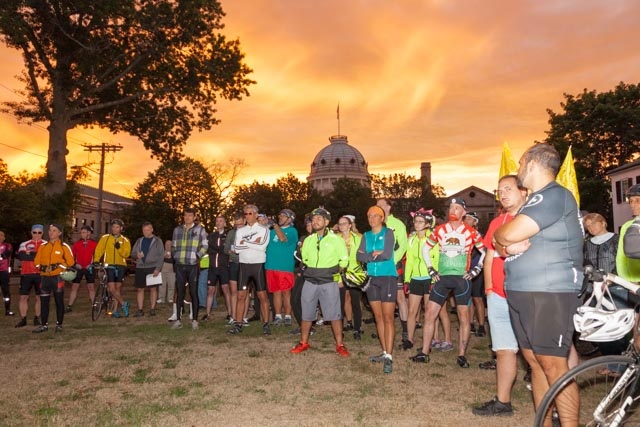
After a powerful opening moment as a group at the Capitol, Day 2 was an immersion into damp mist and fog that was quiet and beautiful and haunting all at once. The early dawn light shifted between blue and grey and slate and yellow-green from an overcast sky as we cruised down empty streets wet with rain. It made everyone even quieter than they usually are at that early hour.
My most visceral memory of Saturday morning was turning into a park where an oasis awaited us. I coasted down a hill obscured by mist only to be met by a deer that emerged from the woods and came to a stop in the middle of the road in front of us. Only one other rider was with me, Steven Epstein, Eric Epstein’s brother, who I saw on the road a lot that day. We both slowed down to a near-halt, and the deer stared at us. Within a few seconds, another dozen or so deer that must have been trailing behind the first one came forward and paused behind the herd leader. They watched us carefully, pausing as though bestowing a silent blessing of some kind, and then they trotted across the road and into the trees.
The morning stayed that way. Quiet. Contemplative. Fogged. I found myself lost in thought at some moments and at peace and just being in others.

BRAKING AIDS® Ride, Day 2, outside of Albany, around 6:30am. I’m trailing Steven Epstein into the mist and fog. Aside from the photo of me with Beth, Andrea, and Lucy after they rescued me from further poor navigation—a photo in which I look exhausted and puffy because I was but my friends look radiant, so I don’t care and love the photo anyway—this might be my other favorite photo of me from this year’s ride. Photo courtesy of John Anderson.
I rode with Beth and Andrea a fair amount through the rest of the day, and we all ate lunch together with Jen at the Woodstock oasis. In the afternoon, after we got to the Ashokan Reservoir, Beth and Andrea were ready to take a break from riding and headed into a van. I decided to ride on. My thought as a couple of rain drops began to pock my jacket was that a little rain never hurt anyone. I was right that it didn’t hurt. I was wrong about the amount of rain. It wasn’t a little, it was a lot. Sheets of rain came down for the better part of the next few hours. At a certain point it became laughable, frenetically joyous to ride through rather than irritating. For a while. Toward the end of the day, when my muscles and mind were becoming weary, the layer of wet became another weight I couldn’t wait to shed. When I finally arrived at the old Catskills hotel in Ellenville, a fellow rider greeted me with a towel, and my riding clothes were so soaked, I left puddles in my wake everywhere I stood for more than a minute.

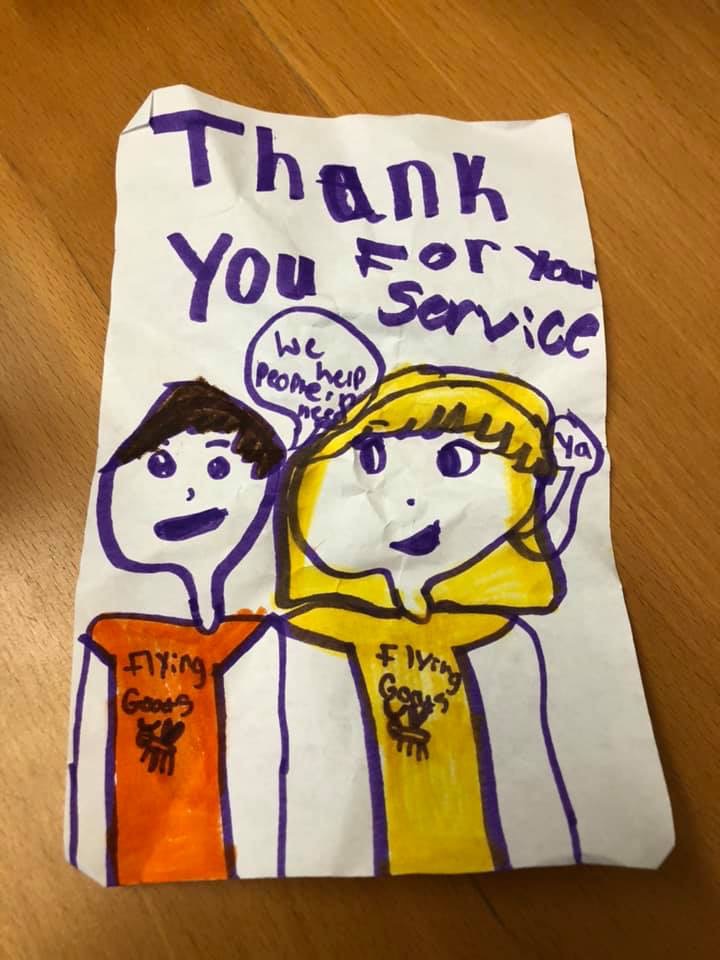
When BRAKING AIDS® Ride can’t go to the First Congregation Church of Griswold, apparently, the church can come to us. Photos courtesy of Mikola De Roo.
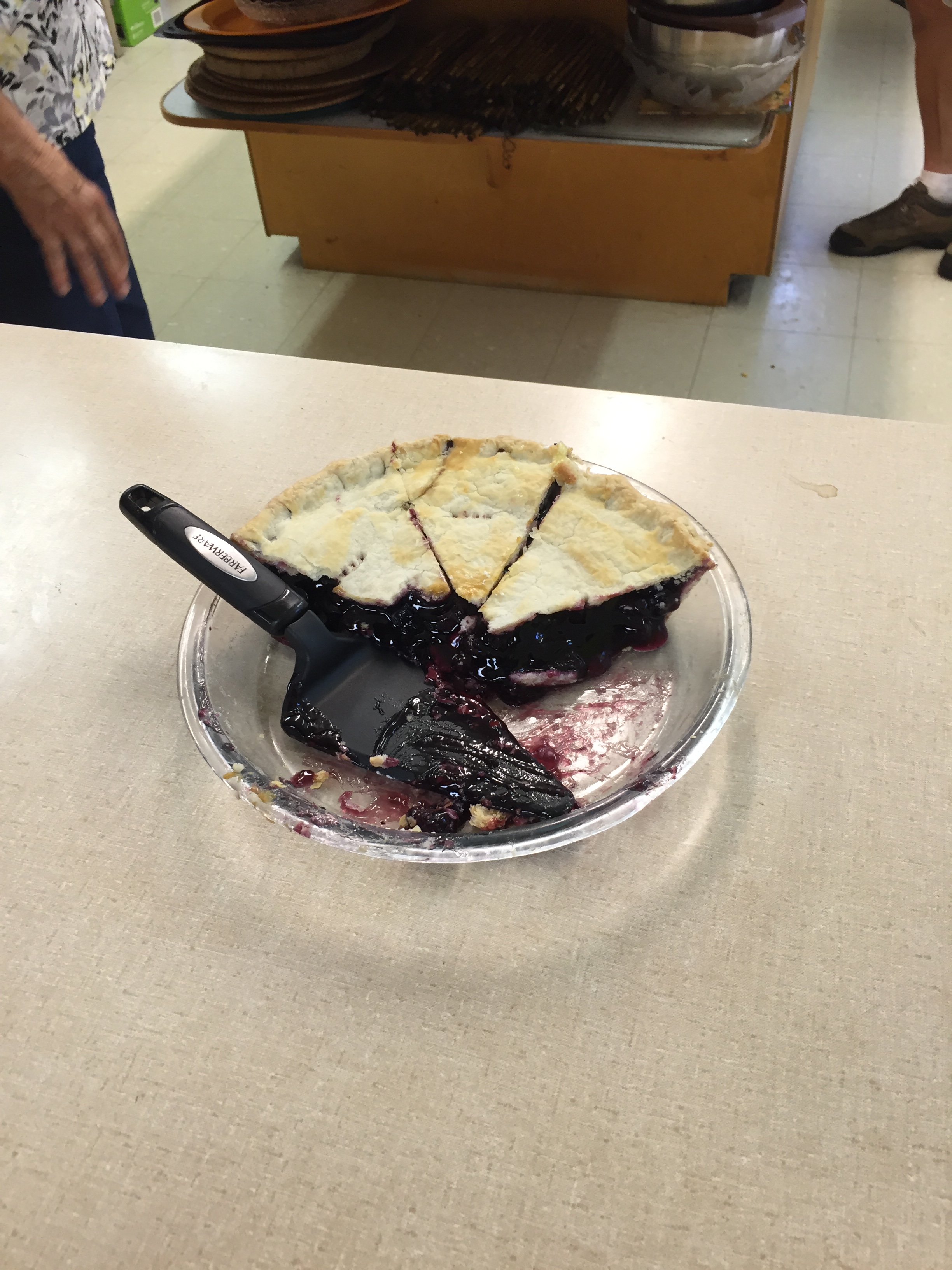
Day 3 heading into NYC was the opposite of the previous day. The sun was out, but it was an unrelenting sort of sun. Hot and tiring. We were content but achy and ready to be done with riding. I was certainly done with hills. A highlight of the day: Lunch and homemade pie from the First Congregation Church of Griswold, CT, which I have written about before. For years, when the ride route went from Boston to NYC, the church was an oasis toward the end of Day 1, and volunteer congregants and staff came out to cheer us on and serve us homemade pie and soup, as well as give us hugs and cards of encouragement from kids in the congregation. They also pass the donation plate at the church before the ride and contribute a group donation on behalf of their congregation every year. They walk the walk of compassion, love, acceptance, and inclusion, and they make me wish all religious institutions, irrespective of belief system, could move in the world that way. When the ride changed in 2018 from Boston to NYC to its current Cooperstown-to-NYC route, one of the first pointed questions posed to Eric was, “Wait, what about the Griswold church folks?” The astonishing part is the answer: They’ve kept coming. Apparently when Eric called them to give them the news that our ride would no longer take us through Connecticut or anywhere near Griswold, they didn’t bat any eye. The past two years, they’ve driven all the way from Connecticut, with homemade pie and soup and other yummies in tow, to some small park near the northern NY–NJ border to serve us lunch and cheer us on, the same way they have every single year. Look at a map. They’re spending more hours on the road getting there and back than they are with us.
That’s what I mean when I say this ride is restorative and transformative and about far more than cycling, raising money, or even raising awareness. It’s an experience that year after year—even when it’s emotionally intense, which it almost always is, and even when it’s painful, which it sometimes is—is a model for what the world should be like rather than than the way the world usually is. That’s because of the people, not only who shows up, but how they show up.
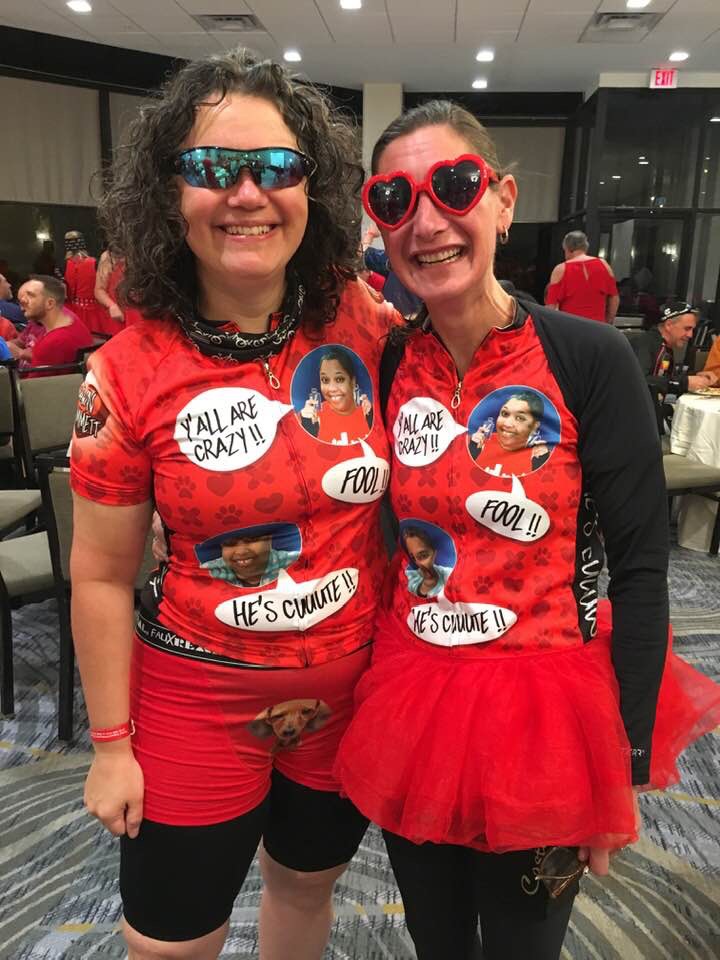
BRAKING AIDS® Ride 2019, DAY 2, Albany to Ellenville, me, at breakfast, on Red Dress Day, with the kind and beautiful Andrea Slone Biblow, whose company and friendship have been one of the biggest highlights of my rides the past few years. Photo courtesy of Beth Shapiro.

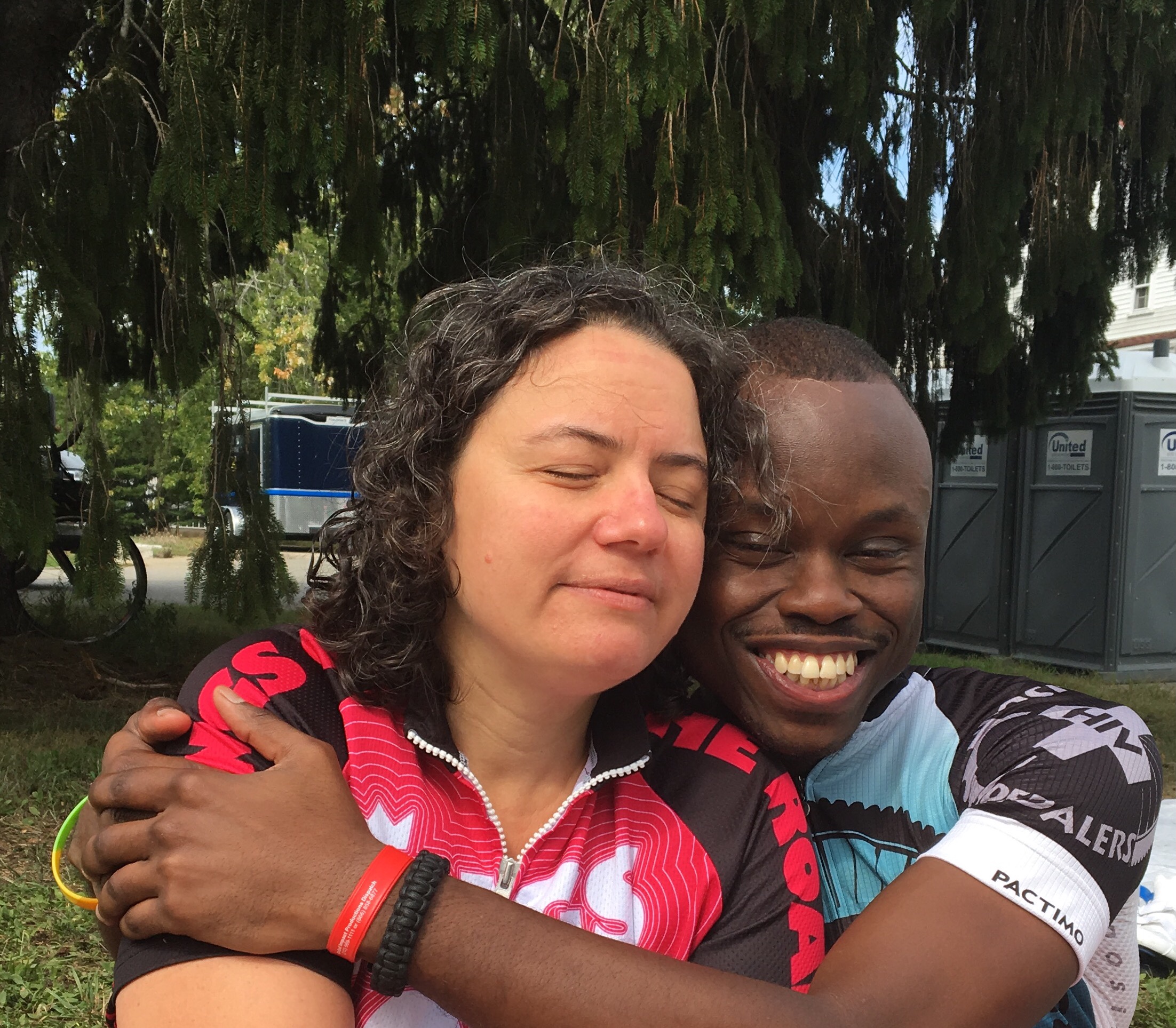
BRAKING AIDS® Ride 2019, DAY 3, Closing Ceremonies at Grant’s Tomb in Manhattan. From left: Crew member and Positive Pedalers Board President Çhärlėš Łöūgée, me, and Team Isharo member and friend Amy Danziger Tenenbaum, who was missed on the ride this year but who came to closing ceremonies to cheer us in. Photo courtesy of Tom Okada.
No one embodies those qualities more than Beth, Andrea, and Amy Tenenbaum, all of whom I met the first year I began doing this ride back in 2008, and who I’ve had the pleasure and privilege to come to know much better the past two or three years. I rode with Andrea a lot last year, and this year, I rode with her and Beth for a lot of Saturday and Sunday. Amy’s absence this year was palpable, and I hope she has been able to fully take in how much we all missed her.
This year, it was especially moving to ride the final leg of the route with Beth and Andrea into New York City and to closing ceremonies, which is the first time that’s happened. Riding over the George Washington Bridge with them, I couldn’t stop smiling.
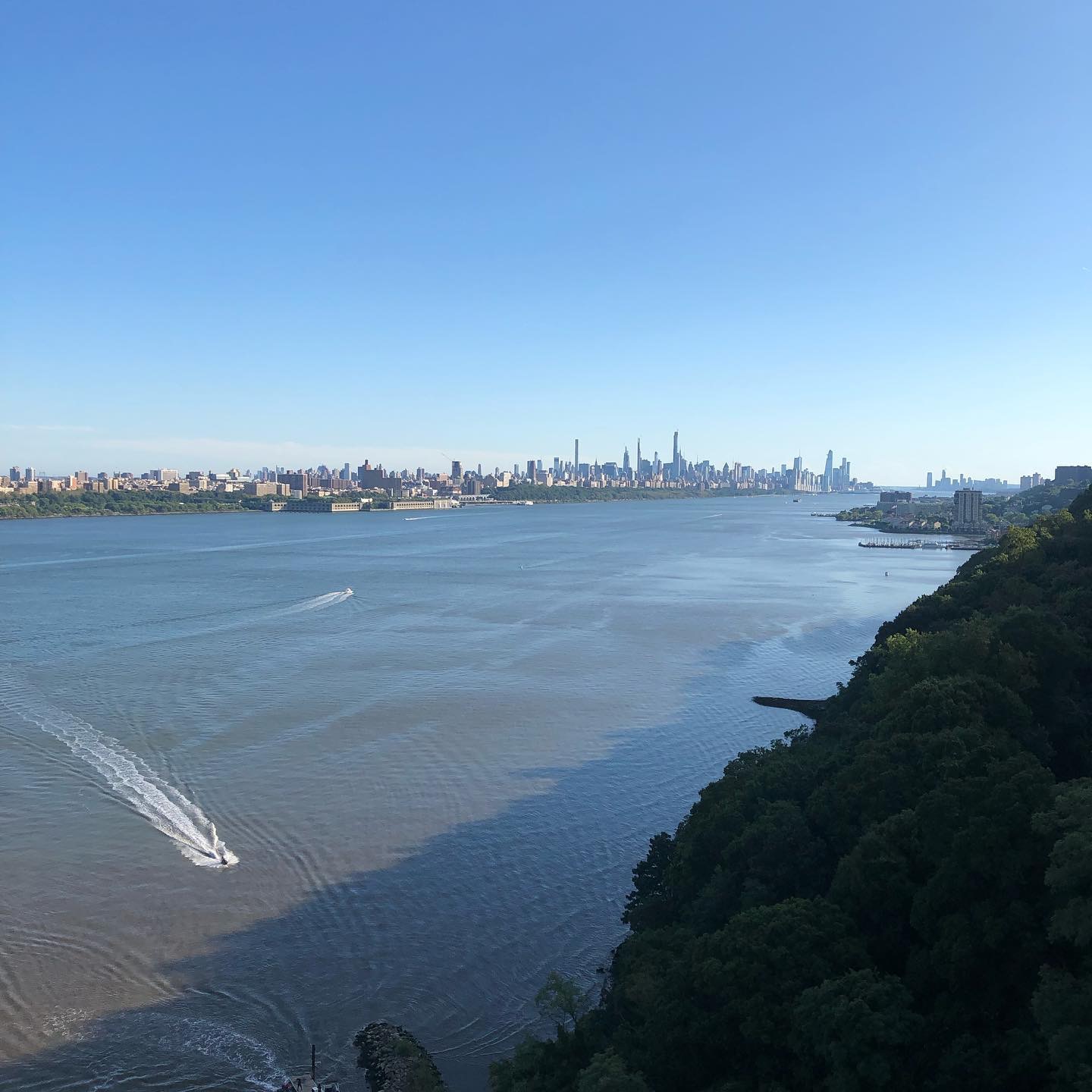
BRAKING AIDS® Ride 2019, Day 3 home stretch: The view of Manhattan from the New Jersey side of the George Washington Bridge. Photo courtesy of Mikola De Roo.
When I try to think of what Beth, Andrea, and I talked about over the course of the weekend, what we laughed about aside from my silly Day 1 detour (though we absolutely laughed a ton—see photo below), when we were serious or sad or complaining and what we shared, nothing specific comes to mind.
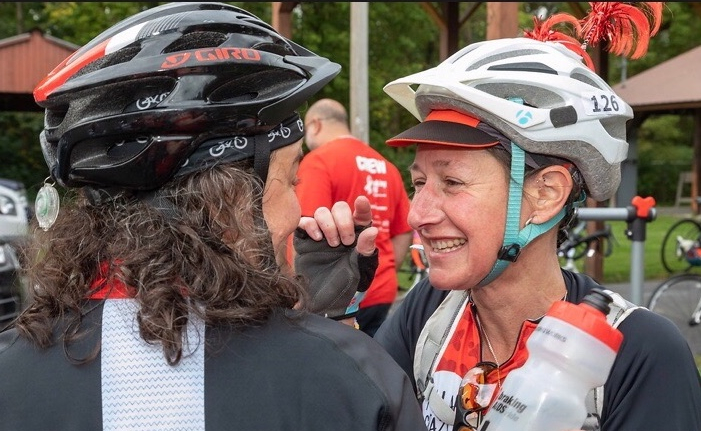
Me and Andrea Biblow sharing one of many laughs. The source of this one? Trust me—you don’t want to know. Photo courtesy of Alan Barnett Photography.
Truth be told, I find it hard to describe the texture and quality of being with these incredible woman. Perhaps it’s because their open-hearted, accepting presences put me at ease. I feel immediately comfortable and comforted. That’s notable. That doesn’t happen to me often with other people—and when it does, it takes longer for that ease and trust to develop. I’m private. It takes me a while to let my shoulders drop, to get to comfortable. Beth and Andrea bring that ease and trust out in me. They are—kind. Compassionate. Welcoming. As Chris Vaughan said to me recently, they both have remarkably open and loving hearts, and they greet the world with this invitation to others: Tell me how I can help.
On the ride in particular, that care, patience, and devotion to those they love is as visible on them as the cycling gear they wear when they ride and the themed oasis costumes they don when they crew. It’s especially apparent in the affection and ease with which they interact with each other; with Amy, who’s usually the third in this trio of powerful, amazing women when it’s complete as it should be; and with the other members of Team Isharo—children, cousins, spouses and significant others, friends. It’s moving to witness those moments between them and be surrounded by that wave of attentiveness and steadfastness to one another even when it’s only moving between them as a family. The ride gives a big group of us the gift of seeing and experiencing the beauty of a family intimacy that would otherwise be private.
At the core of that intimacy is the spirit of Ira Shapiro, Beth’s older brother, who died way too young in 1987 after a short brutal battle with AIDS, less a month after his diagnosis. Beth has said that her biggest fear was that she would forget Ira. Instead, she has managed to not only honor his memory by fighting to end the disease that killed him—this year was her 17th ride, and Amy has been doing the rides alongside her from the very beginning—but she has ensured his legacy by telling her story, his story, and by sharing memories of him with many people who never had the privilege to meet or know him. Starting with her own children, Sydney and Jordan, who now also do the ride, but also extending through the rest of Team Isharo, and indeed the full BRAKING AIDS® family. And Andrea—rarely have I encountered someone who is as giving, fervent, loving, and fiercely loyal to those she loves and who takes such joy in doing so. On more than one occasion, watching her, Beth, and Amy support each other as dear friends, sometimes even in the most mundane ways, has moved me to tears.
That’s the sort of vulnerability and intimacy that develops on this ride, and the intense power of it. When I did my first BRAKING AIDS® Ride in 2008, I knew no one else who was participating, and I was riding in memory of two family friends, Curtis and Dennis. Now, 11 years later, and after 5 years of working at Housing Works with so many others who have lost people to AIDS, live with HIV, or both, I carry a list of names with me while I ride every year, some who have died and some who are living with HIV. The list keeps growing, and not only because of new deaths, although those keep happening, too, unfortunately. That list grows because Beth shared Ira with me and so many others, because Chris told me about his partner David, because Amy Hemphill told me about her brother Mason, because Fred told me about his ex-partner Ken, because Eileen told us about her brother David, because Clay told me about Craig, because Craig Pinckney-Lowe shared his memories of Joseph and Uncle Billy and Uncle Bobby, because Will told us about his father, Charl about Steven, Valerie about her first husband Papo, Reed about his mother. If I listed all the names of beloved people who bind this ride family together, both those we’ve lost as well as the many inspiring, brave friends I have who live with HIV, the list would be longer than the list of donors at the end of this post.
So what does that all add up to?
I have been thinking a lot the last few years about what philosopher Jonathan Lear called radical hope. Lear wrote, “What makes this hope radical is that it is directed toward a future goodness that transcends the current ability to understand what it is.”
What strikes me as strange and intriguing about this type of hope is that it doesn’t depend on having a delusional denial of the current, usually less-than-stellar realities and challenges and sufferings. In fact, radical hope seems to require a tacit, realistic acknowledgment of that forbidding, present-day landscape and the lousy odds of it changing any time soon, and then merges that recognition with an insistence on actions geared toward a better future anyway.
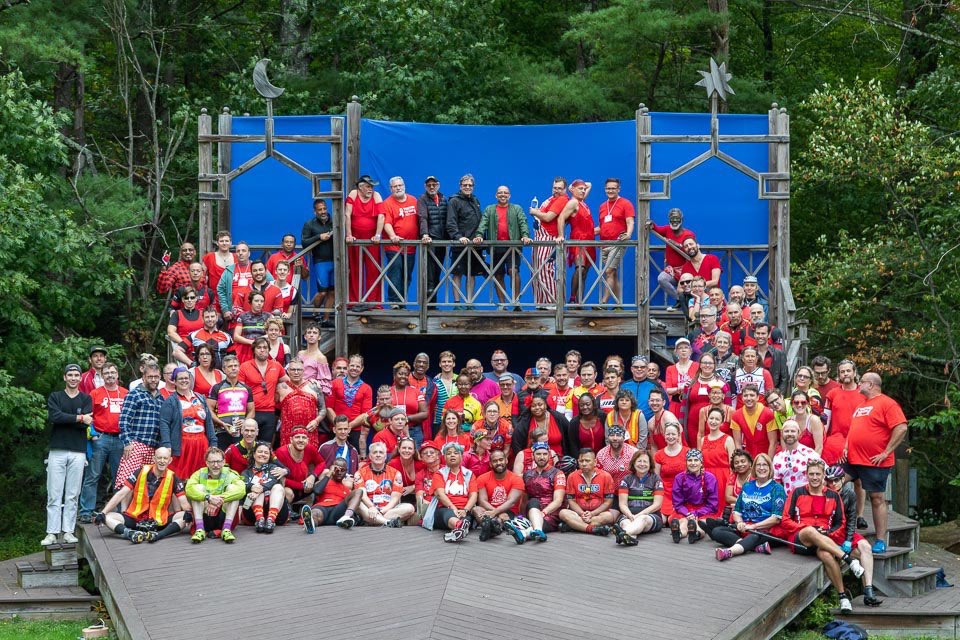
BRAKING AIDS® Ride 2019, DAY 2. The whole BRAKING AIDS® family gathers for a group shot on Red Dress Day.
The volatile and divisive times we’re living in make it both harder and easier to remain grounded in the utility of radical hope as a way to live. On a disheartening day, it feels sacrificial for minimal progress—but then, what is the alternative? On an inspiring day, it feels joyous—and my ideas about what inspiring days look like are evolving. Of course I enjoy victories, especially over hard-won battles like ending the AIDS epidemic, which we are now well on our way to doing in New York State by 2020 (next year!). But the victories that matter most are hard fights that take time—sometimes a lifetime, sometimes many lifetimes—and the world can be an unfair, ferocious, vicious, and unsparing place. Some of us will be around for some of those triumphs, and we will dance and celebrate together. Some of us won’t. Who will be in which category is, as far as I can tell, arbitrary, and as subject to the world’s inequities, ferocities, viciousness, and mercilessness as anything else. I’m not yet 50, and in the month following the ride, two of my oldest and closest friends found out they have cancer, neither HIV-related. I don’t need to look hard or far to have a visceral sense of how fleeting, how mutable our time to be alive can be.
Radical hope is what we have in the meantime, until the arc bends toward justice and those victories finally rise to the surface and until we have to pass the torch to younger people to continue the fights that need fighting, because there is always another injustice to fight. Radical hope is the people I love on this ride and the people on this ride who love me. Radical hope is that most of them have been riding since the days when AIDS was a death sentence and any thought of ending it was a farfetched fantasy.
Radical hope is Chris looking down at the photo of David on his bike on Day 1, and remembering how astonished he was earlier that morning when I had used David’s last name, David who I never met. Radical hope is Beth seeing Chris begin to cry with the realization that I know of David and Ira and so many others through this ride, and Beth coming over to Chris wanting to know what was going on—not what was “wrong,” allowing and understanding that tears are as much a part of the human experience as laughter. Radical hope is Chris telling Beth what was stirring his heart and the two of them holding each other in grief and joy. Radical hope is understanding, accepting, and even embracing that grief and joy and any number of other complex emotions live intertwined with each other. Radical hope is Chris and Beth and Andrea and Amy and my beloved Ride family celebrating these helixes of emotional DNA in everything they do and in every way they are.
Some images are worth repeating. Photo courtesy of John Anderson.
In the fourth part of her masterful, six-part poem “October,” poet Louise Glück asserts, “You will not be spared, nor will what you love be spared.” (The entirety of Part IV of Glück’s “October” appears below, but it is worth reading the full poem, which is available both as a standalone chapbook published in 2004 and in the 2006 collection Averno.) Radical hope is regarding and understanding that unsparingness and the inevitable deaths and sufferings that accompany it, and showing up to help others anyway, “still passionately clinging to what you love,” as Glück puts it. Radical hope is what Glück describes as a willingness to embrace the light of autumn, the beauty of its losses, and the happy-sad melding of joy and grief, and to “approach the end still believing in something.” Radical hope is us choosing again and again to ride into that veiled fog together and to cherish what we find in ourselves and each other along the way.
Section IV from “October,” By Louise Glück
IV.
The light has changed;
middle C is tuned darker now.
And the songs of morning sound over-rehearsed.
This is the light of autumn, not the light of spring.
The light of autumn: you will not be spared.
The songs have changed; the unspeakable
has entered them.
This is the light of autumn, not the light that says
I am reborn.
Not the spring dawn: I strained, I suffered, I was delivered.
This is the present, an allegory of waste.
So much has changed. And still, you are fortunate:
the ideal burns in you like a fever.
Or not like a fever, like a second heart.
The songs have changed, but really they are still quite beautiful.
They have been concentrated in a smaller space, the space of the mind.
They are dark, now, with desolation and anguish.
And yet the notes recur. They hover oddly
in anticipation of silence.
The ear gets used to them.
The eye gets used to disappearances.
You will not be spared, nor will what you love be spared.
A wind has come and gone, taking apart the mind;
it has left in its wake a strange lucidity.
How privileged you are, to be still passionately
clinging to what you love;
the forfeit of hope has not destroyed you.
Maestoso, doloroso:
This is the light of autumn; it has turned on us.
Surely it is a privilege to approach the end
still believing in something.
THANK YOU AGAIN TO ALL MY AMAZING 2019 BRAKING AIDS® RIDE DONORS:
* new donors in 2019
Anonymous (14 donors, *****5 new) • Jessica Abel & Matt Madden • Mike Abram * • Chris Anderson & Mel Stupka • James Anderson & Suzy Turner • Midori Peiris Anderson * • Renée Anderson • David Anthony • Janis & Dave Auster • Marco Avila * • Sean Ball • Jason Baluyut & Michelle Misner • Elizabeth Barrett * • Jenna Barry • Emily Bass * • Leah Bassoff • Nat Beagley * • Heidi Bender • Jon Bierman • Deirdre Birmingham • Maxine Borowitz * • Nancy Boudreau * • Mark Brady & Bonita Leung * • Arnold N. Bressler * • Robert Brooks • Carrie Buss • Catherine Campbell • Barb Cardell * • Stephanie & Bill Carpenter • Jess Carroll & Sharon Glick • Lynne Carstarphen • David Cascia • Beth Castrodale • Betty Chen • Andrew Coamey • Paula Collins * • Barron Collodi * • Susan Conceicao • Nancy Crochiere • Chad Crume • Richard D’Amico & Mike Meyerowitz • Suzanna De Baca • Adele Della Torre & Spencer Okada • Zoe DeRoo • Ellen DeVegh • Nicole Dewey & Bill Seely • Pawan Dhingra * • Carol Diuguid • Sharon Doctor • Peg Donahue * • Cassidy Edstrom * • Mariamne Eliopoulos • Polly Englot * • Rachel Epstein * • Vivian Firger * • Janis Firstenberg * • Sheldon Firstenberg * • Timothy Fitzpatrick • Kory Floyd & Brian Seastone • Dianne Footlick • Marcel & Anne Frenkel * • Emmanuel Gaeta * • David & Svenja Gifford-Leggewie • Kristin Goodwin • Judy & Jay Greenfield • Brent Griffith • Cheryl Grimm • David Groff • Amanda Guinzburg • Michelle Hamm * • Karen Henry • Janice Hillman • Madelyn Hoffman * • Frima Fox Hofrichter • Noel Hohnstine • Frank Hopp • Thomas Hyry • Andrew Janke • Andrea Johnson • Marsha Johnson * • Shelley Karliner & Barbara Howard * • Elizabeth Keyes * • Michael Kharfen * • Liz King • Alison Kliegman • Tad Kulkowski • Carolyn Lengel • Matthew Lesieur * • John Lewis * • Becky Lien • Jen Lowe * • Rachel & Jon Lowy • Frances Lucy • Matt Martin • Luke McDonough • David Meier • Kristin Mellstrom * • Alan Miles • Megan Minier* • Heather Mirman • Sadie Mitnick * • Richard Monreal • Lily Moore * • Bennett & Lorraina Morrison • David Murphy • Elizabeth Murphy • Eva & Tom Okada • Jacob Okada & Carylanna Taylor • Kate Padgen * • Gregg Passin • Ann Pedtke * • Nancy Perry • Megan & Sarah Perry-Spears * • Lauren Phillips * • Peter Phillips * • Lisa Pinto • Eileen Pollack • Josie Raney • Candace Rivela • Rhona Robbin • Rebecca Rozen * • Carla Samodulski • Terri Schiesl • Emily Schmalzer • Sigrid Schmalzer • Roger Schwartz • Alicia Scotti • Sandra Serebin • Sam Shaber • Katja Shaye * • Ginny Shubert • Brigid Siegel • Adam Singer * • Kirit Singh * • Erik Skarstad * • Jane Smith • Janet Byrne Smith • Kimberleigh Smith • Fred Speers & Chase Skipper • Alexandra St. Charles * • Danielle Stein • Paul Stenis * • Krishna Stone • Matthew Taylor * • Amy Tenenbaum • Naomi Tolson • Matthew Trokenheim & Jen Simon • Marissa Walsh • Pam Warshavsky * • Clay Williams • Sherry Wolfe • Yu Wong • Therese & Lin Wu • Alison Yager

BRAKING AIDS® Ride 2019. “This is the light of autumn.”—from “October,” by Louise Glück. Photo courtesy of Mikola De Roo.

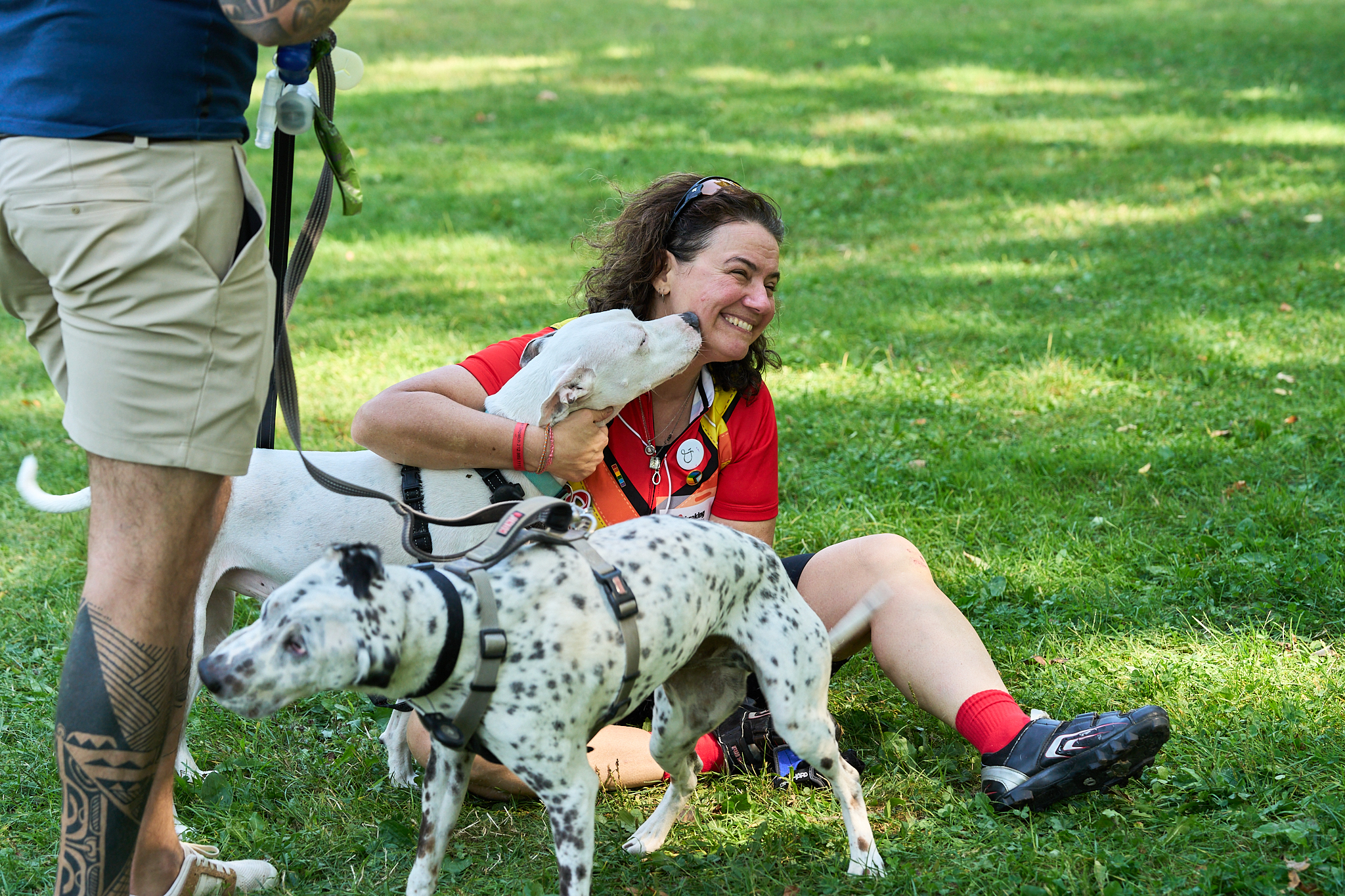
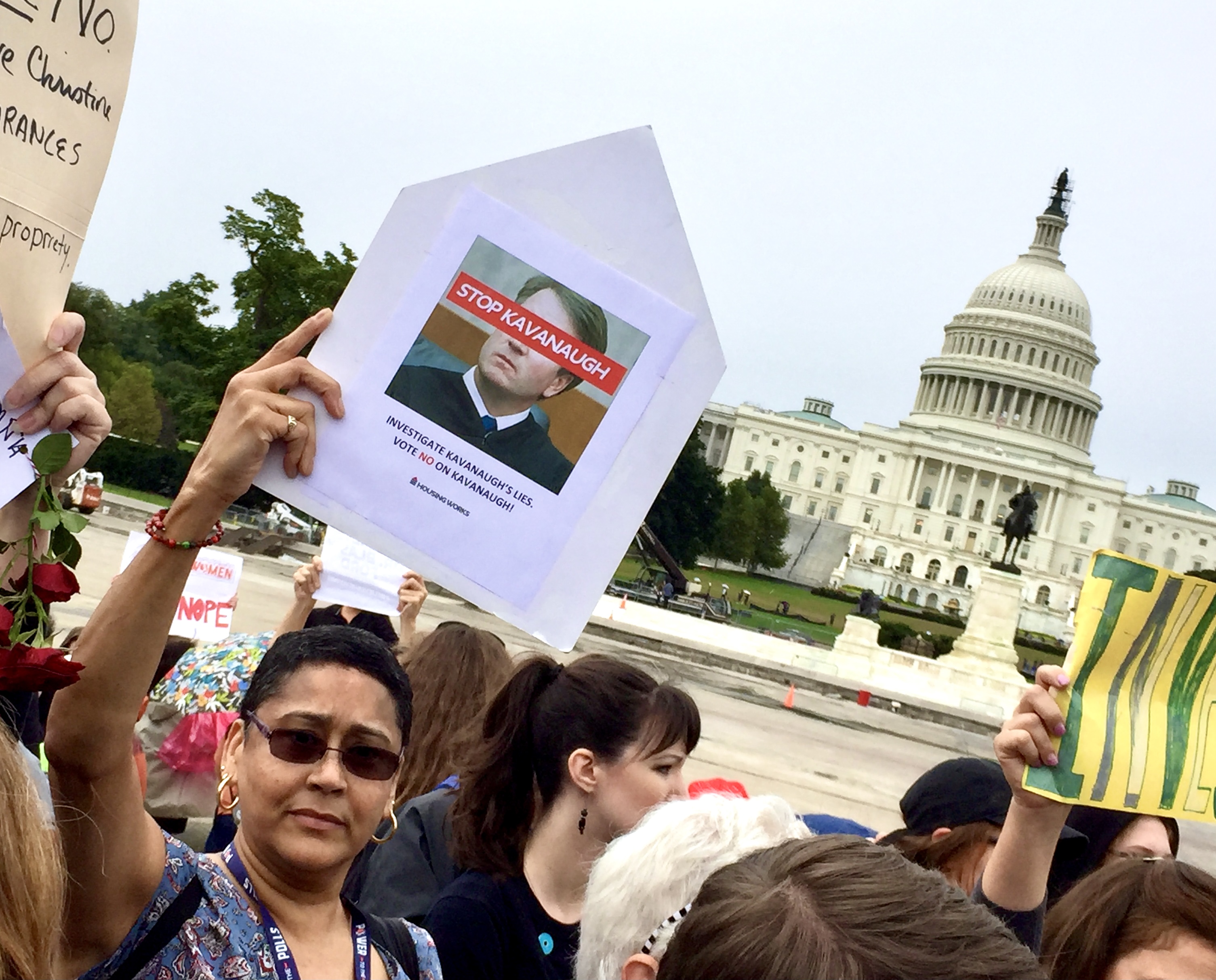


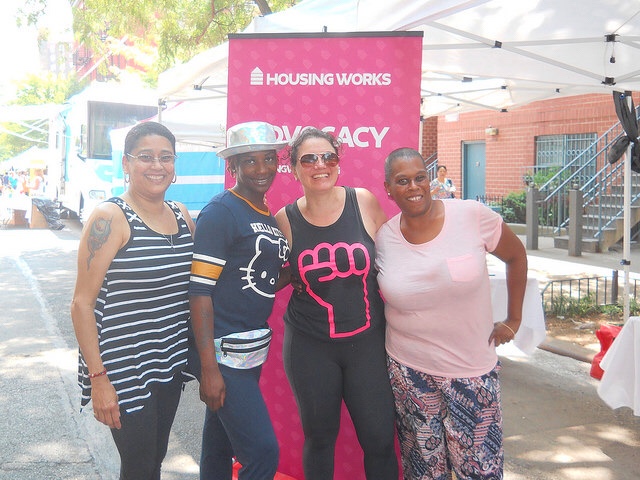 Me, with some of my amazing Housing Works Advocacy colleagues and friends, who inspire me every day (L to R): Valerie Reyes-Jimenez, Legacee Medina, me, Felicia Carroll.








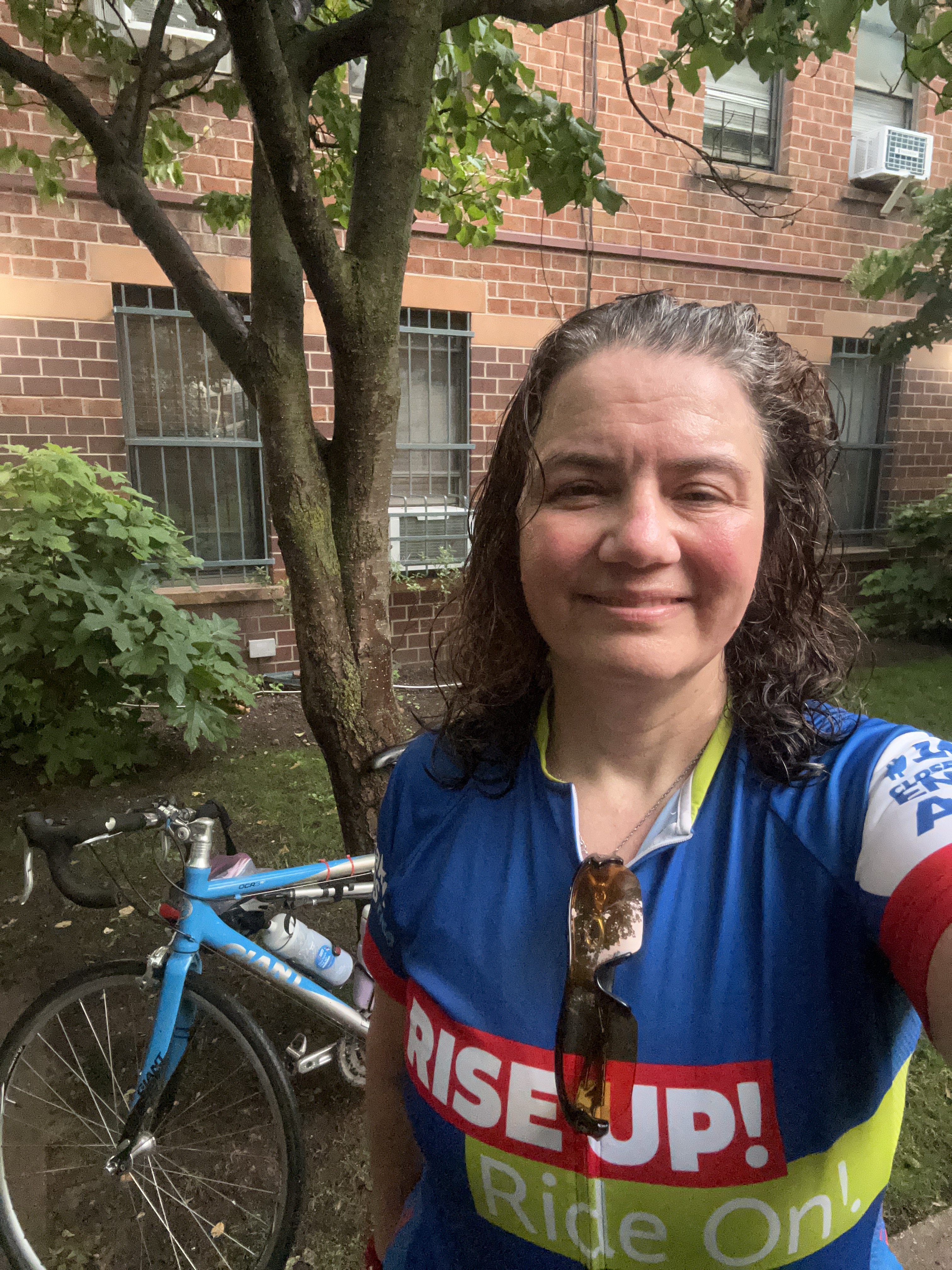
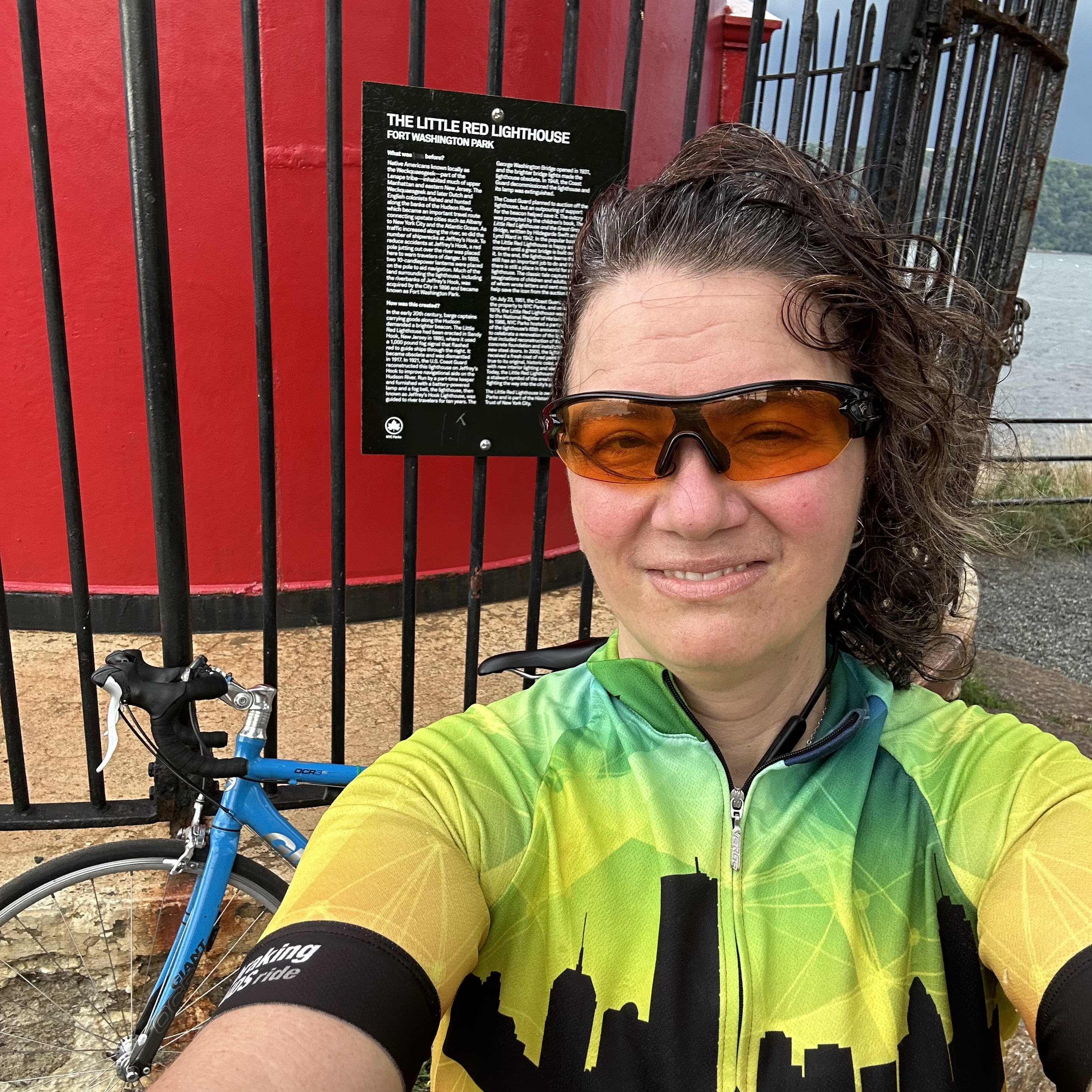
 The Blue Streak