
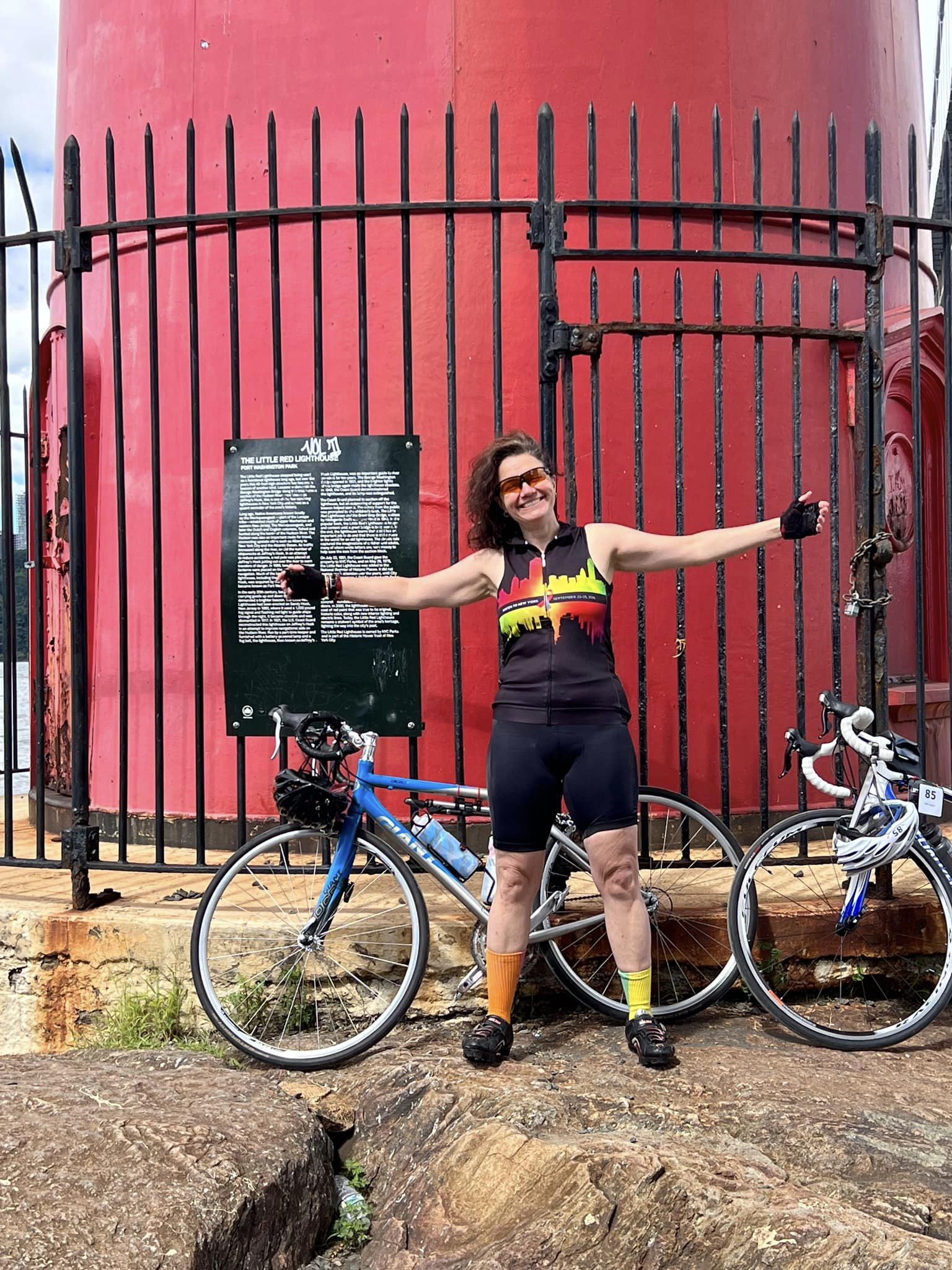
I shared the video below last Saturday on social media—one of my favorite stories from when I worked at Housing Works, the BRAKING AIDS® ride beneficiary, and I’m only just getting around to posting it here now. My hope is that it lends some new insight into what’s special about Housing Works as an organization, as well as some inspiration for these lifelong journeys in pursuit of greater social justice, particularly when those roads feel long and rough.
As of this writing, thanks to 120 supporters and counting, I’ve raised 45% of my fundraising goal and am still aiming to reach my audacious $50,000 target in support of Housing Works and the fight to end AIDS and homelessness.
PLEASE DONATE TODAY, and LATHER, RINSE, REPEAT!
An important correction and follow-up about language (mine, in this case) :
Well into the video above I try to say something about a statistic—69 individuals with HIV transmitted via injection drug use (IDU)—and underscore that the small size of that group could fit into a Housing Works conference room. In my haste to make that point about data and HIV progress, I end up referring to the statistic—69 IDU-transmitted infections—rather than the human beings, in effect verbally conflating the two. That kind of shorthand happens all the time, and I want to call attention to it here as a mistake on my part. My apologies. I should have said “69 people living with HIV who acquired it through injection drug use,” or something along those lines.
If this language distinction seems like hair splitting, it isn’t: In point of fact we all ought to avoid that same kind of mistake when talking about people living with HIV or any other infectious disease for that matter. The language we use matters. It’s reductive and dehumanizing to frame people only in terms of a disease they live with. People are not mere vectors for disease and illness. People are multifaceted human beings with many rich aspects to their identities, and the language we use when we talk about people living with HIV should reflect that. I misspoke here and endeavor to do better. I decided to post the video with the mistake anyway rather than re-recording it because it was a chance to use my own error as a teaching moment. We all misspeak at times, saying thoughtless or insensitive things that can potentially hurt people or fuel stigma even if that isn’t our intention. The terms we use for racial and ethnic groups change over time; we discover we have been mispronouncing the non-English name of a close friend for years without knowing it; people we have known for decades change their names, pronouns, or both, and at times we may slip and use the words we’re more familiar with; some of us have trouble adjusting to “they/them” being used in multiple contexts, sometimes as a singular, gender-neutral pronoun, sometimes as a plural, gender-neutral pronoun. And on and on. Language is organic and evolving, and sometimes we struggle to evolve with it in our own speech patterns, and we make mistakes along the way. Life and progress calls upon us to rethink and relearn our own first language. The only way people get better about these language nuances is through practice, which is why it’s important to acknowledge when we’ve made a mistake and set an intention to do better next time. I made a mistake here and no doubt I will again—and that’s okay. Like everyone, I’m practicing. As I do, I get better, and the more likely that I’ll say it right next time.
 The Blue Streak