
BRAKING AIDS® Ride 2022 took place yesterday, and I was reminded again of all the reasons it’s always one of my favorite weekends of the year. I had the privilege of being asked to give some brief remarks at the opening ceremony kicking off the ride . My dear ride husband and fellow rider Clay Williams recorded and shared it via Facebook live (thank you, Clay), so I’m able to share it here. Below the video is a written transcript of the full speech.
Good morning,
The first person I knew who had AIDS was my mom’s childhood friend Dennis. Dennis, like my mom, came from an immigrant family, and was like an uncle to me. When he and my mom got together, the air thrummed with laughter and loud yakking in Romanian.
Those gatherings were infrequent because Dennis’ job as a journalist had him jumping from one global political hotspot to the next. But then he’d breeze into town and spark a jam session of multiple languages, dancing, eating, drinking. His laugh was a high-pitched cackle, one that would turn your head to see who had made that sound.
He confided to my mom that he was bisexual, but she believed he was gay. Regardless, his sexuality was a secret. And then, in early 1987 Dennis got sick and he stopped globetrotting. He died in December, and his NY Times obituary led with a common lie: “Dennis A. Volman, a reporter for The Christian Science Monitor, died of cancer Monday at the Mount Sinai Medical Center. He was 37 years old and lived in Washington.”
Dennis died a horrific death of physical agony from AIDS. If he had a partner, he took that secret with him. Only Dennis knew how much his soul suffered from shame and fear. I can only imagine it made a difficult dying process far lonelier.
This next bit I’ve never shared publicly. In 2012, I launched a blog about the ride, and I wrote an entry about Dennis. The blog’s main audience is my network, so imagine my surprise in 2013 to get emails from two strangers. One was a former girlfriend of Dennis’ who found the blog through a google search; she shared the post with the other stranger, an old friend of Dennis’s mom. They each emailed me to debate the historical record: Dennis had died of pneumonia while battling cancer. And why did I think Dennis was gay? The family friend was especially insistent it couldn’t have been homosexuality or AIDS. She cited his affairs with women, his poor health in childhood, his chronic pain from a back injury. From these women, I learned that Dennis had kept his illness secret, too. Only his nearest and dearest heard he was sick with “cancer” shortly before he died.
Our email exchanges ended quickly in a stalemate, but they unnerved me enough to ask my mom how she knew Dennis had AIDS. Apparently, she saw he had KS lesions when she visited him in the hospital.
I don’t judge Dennis for keeping secrets. Homophobia and AIDS stigma were prevalent enough that those choices may have protected him, whatever emotional price he paid. But by 2013, he’d been dead for over 25 years. His parents were dead. He had no children. No siblings. How had stigma, fear, and homophobia re-emerged, overshadowing sense and reason, when those lies protected no one anymore?
So why share this fucking heartbreaker of a story?
Because the shadow side of people’s humanity isn’t the only story. That is never the only story. Seeds of social justice were being planted even then. While Dennis was dying in March 1987, the first meeting of ACT UP was held in the West Village. Three years later, Housing Works was founded out of ACT UP’s housing committee. Both organizations demanded action from a government that ignored AIDS for years. These fiery activists didn’t wait for a grand utopian future; they acted with courage in a seemingly hopeless present, defying the cruelty and ignorance around them. They used civil disobedience to demand better drugs today, not tomorrow. They won those fights and saved countless lives.
Today the fight goes beyond medication; it’s a social justice battle—fighting the racism, homophobia, transphobia, and misogyny that fuel the AIDS epidemic in spite of our medical progress. For over 30 years, Housing Works has fought for social justice, anchored by this belief: that whether we are dying or healthy or somewhere in between, all human beings are deserving of housing, food, healthcare, and basic dignity and respect. Whether it’s AIDS, homelessness, the opioid crisis, COVID-19, or the next challenge, I trust Housing Works to lead with compassion, doing what needs to be done.
All of you are full of those same passions. The same courage, kindness, fierceness. The same miraculous blend of love, laughter, grief, and audacity. I see it every time Beth mentions Ira; when Clay passes me on a hill, again; when I see Cheyenne’s dazzling smile; when Amelia or Amy shouts something lewd at me on the road; when Linda envelopes me in a hug; when Wendy makes a bacon joke; when I see Jim stopping on the road to tell someone why we’re riding and when they say, “I don’t know anyone with HIV or AIDS,” he says, “yes, you do. I live with HIV.” What I see all around me is love—and I see it in every one of you.
These stories, our stories, are worth writing, sharing, expanding, and retelling. We come together on this ride to commemorate our dead and honor our best selves by showing up for those in need, and for one another. This ride is citizenry of the highest order. We have been writing that narrative together as a ride family for years, and the time I spend here with all of you every year heals my own soul on its darkest days. So let’s go write the next chapter.
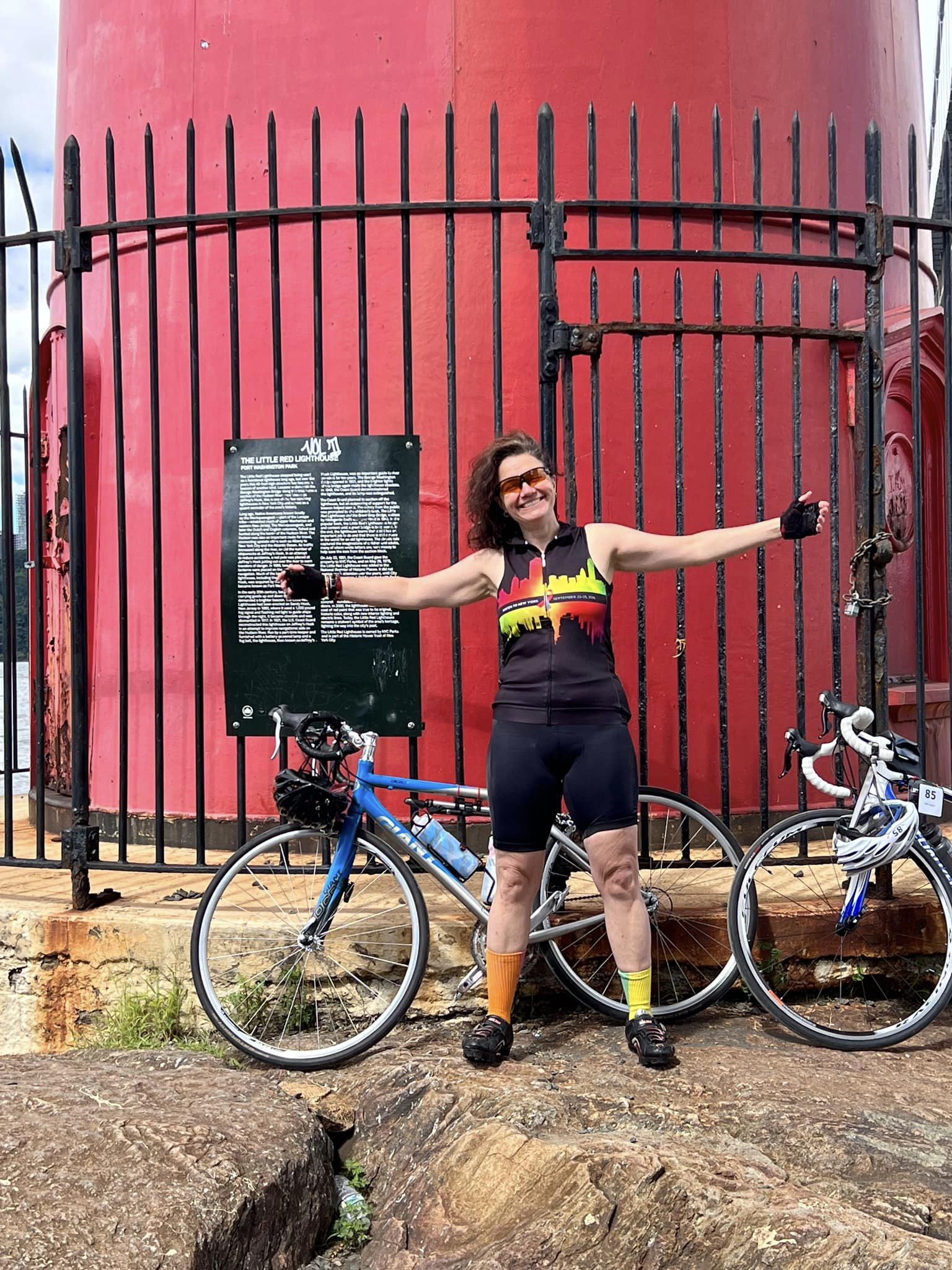
 The Blue Streak