About Housing Works’ Emergency Covid-19 Homeless Shelters
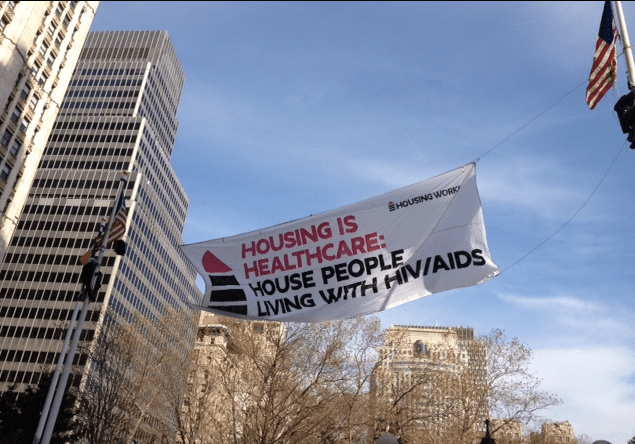
True to its “housing is health care” roots, Housing Works’ first priority at the onset of the Covid-19 crisis and lockdown in New York was to address the most critical housing and shelter gaps created by this new pandemic. The policy at NYC’s congregant shelters has been to screen people for Covid-19, to send those with symptoms or who tested positive to a hospital ER, and then prohibit their return until fully recovered—a protocol that effectively turns homeless people with Covid-19 out onto the streets, where there is no way to maintain the adequate physical separation and hygienic safety measures necessitated by the coronavirus pandemic.
Aware of the particular challenges that homelessness would pose as Covid-19 spread throughout the city, Housing Works wasted no time back in March and immediately partnered with Latino Commission on AIDS, the National Black Leadership Commission on AIDS, Treatment Action Group, and Callen-Lorde Community Health Center to form the Covid-19 Community Work Group. Housing Works then approached the NYC Department of Social Services to propose managing Covid-19 emergency shelters out of unused city hotels.
As a result of those timely pivots, since April, Housing Works has been operating two shelters for homeless people who have or are suspected to have Covid-19, the first housing 150 people and the second housing another 100. Amidst a city shortage of protective gear and medical supplies, Housing Works also turned to a former board member to locate face masks, gloves, and other supplies to protect the people they serve as well as Housing Works staff.
At the Housing Works Covid-19 shelters, onsite staffers conduct wellness checks, case managers are on hand to help secure public assistance or Medicaid, crisis intervention specialists deliver behavioral health services using telemedicine, and Callen-Lorde staff provide medical services to residents. As of mid-June, the shelters had served over 300 people so far.
Housing Works is also working to find upgraded housing and better care and living situations for the people served, rather than just returning them to congregant shelters. For example, some people who were living with HIV or who had suffered domestic violence or sexual assault in the shelters have been able to transition into Housing Works apartments.
Select press coverage of Housing Works’ Covid-19 emergency work:
This isn’t going to be my usual, annual AIDS Ride fundraiser. A lot has changed since last September. For five months and counting, we’ve been in the midst of a raging global pandemic of a potentially lethal and highly contagious virus, the likes of which none of us has known during our lifetimes, and we’re experiencing the economic and community upheaval that goes with that. We’re also seeing a huge wave of nationwide and global demands for long overdue racial and social justice. To say that our world is facing ongoing volatility and uncertainty is putting it mildly.
2020: Not Your Typical AIDS Ride Year
In my 12 years of doing this ride, I’ve often written about the importance of showing up over the long term for the important causes and ideals we believe in. With so many challenges amidst so much chaos, it’s been hard to know what showing up means and requires in our present circumstances. Here’s what it means to me right now: Together, we can still take some actions that assuage some of those uncertainties and help address some of the existing societal inequities that Covid-19 has illuminated more widely, and I hope you’ll consider helping and supporting me in that endeavor.
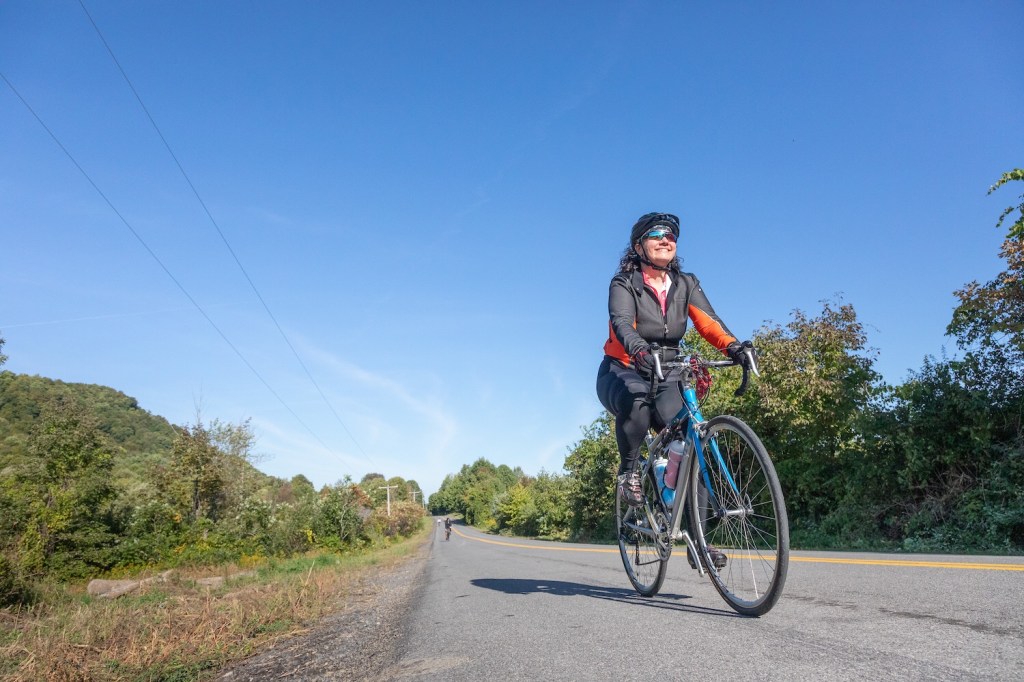
Me, riding with my friend Brian Carroll on Day 1 of last year’s BRAKING AIDS® Ride. Photo by Alan Barnett.
Housing Works & the Covid-19 Crisis
Since 2008, I have participated in BRAKING AIDS® Ride in memory of Dennis and Curtis, two family friends who died of AIDS-related illness in 1987 and 2003, respectively, and for many close friends who live with HIV. In that time, donations from people like you enabled me to raise over $125,000 and counting to support services for those living with HIV as well as its efforts toward ending the AIDS epidemic once and for all.The life-saving HIV services and healing community that Housing Works has provided to the most vulnerable among us are still crucial, but because of the tremendous progress we have made toward ending New York State’s AIDS epidemic, that need is a little less dire than it once was.
What is urgent, as you likely know from the headlines you see every day, is supporting those hit hard by Covid-19, particularly in the most vulnerable communities among us. Many of those communities are the same poor, disenfranchised populations that Housing Works, BRAKING AIDS® Ride’s beneficiary, has been serving since its founding 30 years ago in 1990—those who are homeless or incarcerated, and those struggling with severe physical illness, mental illness, and/or addiction. As with HIV/AIDS, these communities have been particularly vulnerable to Covid-19.
As someone who worked at Housing Works for five years, I know firsthand that when a new crisis arises, no matter how daunting, time and again, the organization rises to the occasion to meet that challenge right away. After the devastating 2010 earthquake in Haiti, Housing Works responded with immediate emergency aid, helping rebuild three health clinics for those displaced by the natural disaster. Throughout 2017 and 2018, Housing Works galvanized an ongoing national movement of concerned citizens to descend on the Capitol to save the Affordable Care Act and oppose the many GOP attempts to repeal it and eviscerate affordable health care for all.
So I wasn’t surprised that as soon as Covid-19 shut down New York this past March, Housing Works sprang into action and became a crucial player in the city’s coronavirus response.In addition to their ongoing work as the largest community-based AIDS service organization in the country—providing housing, healthcare, case management, substance use treatment, legal assistance, and job training—since the beginning of the COVID-19 pandemic, Housing Works has opened two COVID-19 homeless shelters and partnered with a major NYC-based PPE supply operation to distribute PPE to frontline workers.
Those who are interested in more details about Housing Works’ innovative interventions can check out this post.
What’s most important to understand is this:
None of these endeavors was in the budget. But it is essential emergency response work that needs to be done. These remarkable Covid-19 emergency initiatives were launched in a matter of weeks, all while Housing Works has simultaneously faced a massive revenue deficit—estimated at $8 million by the end of June—as a result of the need to shut down its retail locations, which provide so much of their financial support, as well as the April cancellation of its largest annual fundraising event, and the suspension of a number of revenue-generating programs.
How You and I Can Help
The Covid-19 crisis isn’t going anywhere anytime soon, and no doubt Housing Works will continue to provide emergency services for our most vulnerable residents. Housing Works doesn’t hesitate to act and provide solutions when new problems arise, and we shouldn’t either.As of this writing, for safety reasons, the biking portion of this year’s BRAKING AIDS Ride will likely only span one day—a 62-mile, masked and physically distanced group ride beginning and ending in Manhattan. In the week leading up to the ride, I am also committed to doing two 100-mile (century) rides on my own while I’m in Cape Cod. More important, whatever the physical ride does or doesn’t look like, between now and September, I remain committed to raising $20,000 to support Housing Works. The graphic below highlights what your generous donation can help to fund right now.
Please DONATE TODAY. Donations of all sizes are welcome, but a gift of $200 or more will go a long way toward reaching my $20,000 goal. $200 provides two weeks’ worth of gowns for five residence managers; $250 pays for emergency food for 10 Housing Works shelter residents for a week.
Ways to make giving easier, to make your donation go further & to help me reach my $20K goal sooner:
• PLEASE CHECK WITH YOUR HR DEPT. & SEE IF YOUR COMPANY WILL MATCH YOUR DONATION! If so, then check the “YES” bullet in the Company Matching section of the online donation form, and fill out the related information. You may be able to double or even triple your contribution! In 2019, nearly $5K of the $24,000+ I raised came from company matches, so I cannot underscore enough how much this helps.
• Recurring Monthly Gift: On the donation page, once you select a gift amount, click on the “Donate Monthly” option to set up a recurring donation of any amount over your desired period of time.I prefer to donate this way because I can give more with much smaller hit coming from my wallet each month.
• Cover Processing Costs: Each donation incurs a processing fee that’s 4% of your gift. When the overall fundraising goal is $20K, 4% adds up: If everyone who gives covers the processing fee, that’s an additional $800 that goes straight to work at Housing Works.
• Please forward this information to EVERYONE. Spread the word to your friends, family & colleagues! Forward this email letter or share my donation link with your own networks on Facebook, Twitter, Instagram & other social media.
Thank you in advance for your support for this important cause. I couldn’t do any of this without you.
Me, on the morning of Day 1, Braking AIDS® Ride 2020. Photo by Alan Barnett.
Please support me & Housing Works by donating to Braking AIDS® Ride 2020 (Sun., 9/13)—Mika De Roo, Rider # 32. DONATE: BRAKING AIDS® Ride 2020



 The Blue Streak