I have been thinking a lot lately about possibility. How I go about determining what is possible for certain, what seems possible but hard, what is unlikely, and what is impossible.
It isn’t that I don’t ever get ambitious or dream big. It is that I also tend to be a realist. I am the person in the room who has vision but who’s also good at figuring out how to take an idea and create a process that turns the idea into a reality. I assess possible approaches, saying, “well, doing it that way won’t work” or “let’s try this instead.” Some of this may be temperament; some of it may be that I have spent a lot of my life around big-picture talkers. I am talking about people who need realists and makers—people who Do and Manage Concrete Stuff and turn imaginative talk into something more—to get anything done. Some of these big-picture folks have genuine vision with potential brilliance in them and some don’t; regardless, they tend to be people with authority and in some cases big ambitions about Making a Certain Outcome Happen. In my experience, however, many of these people set a high bar for others but offer up little by way of planning, knowledge, or proposed steps about how to get their desired result. They also don’t tend to care much about determining what will or won’t be entailed and which resources are essential and which are nice to have but not crucial. They rely on other people to do that—creative implementers, managers, analysts, builders—to translate abstraction into creative visions, interpret vague demands and desired results, arrange processes and people, outline a plan with concrete steps, manage the whole business, and in the end, make something happen. You can’t make anything happen with your head in the clouds all the time. It takes having at least one foot and better yet two feet on the ground at least some of the time. And at least in my career life, I am right a fair amount of the time about what does and doesn’t work, enough anyway that the realist, maker skills have gotten a lot of play in my workplaces and kept me employed.
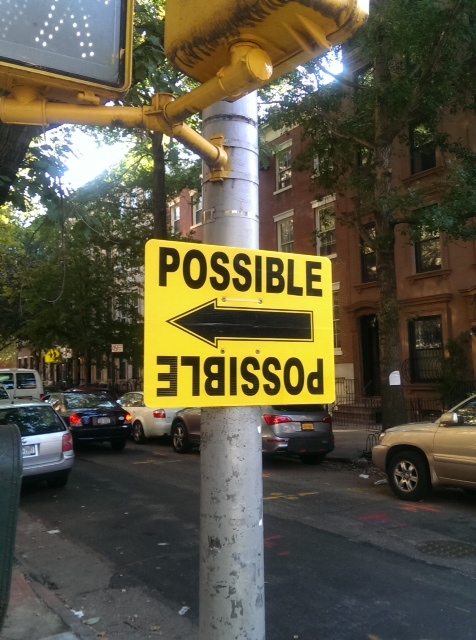
I encountered this mysterious street sign near a construction site on Henry Street in Brooklyn a few weeks ago while walking home. It was as though the universe was trying to tell me something. Turn left?
I have a mentor who has pointed out to me that our strengths and our weaknesses are often the same aspects of self. Whether they are operating as one or the other or both depends on how and when we are using them. The same person has also observed that I have a lot of experience and comfort with articulating to myself why something isn’t possible. I have spent a lot less time letting myself dream and imagine what I want, irrespective of whether it is possible or impossible. That tendency to gravitate toward hyper-realism and always be sussing out the odds has served me in good stead in some ways, but the problem with that frame of mind is that it’s prevented me from imagining in other parts of my life. How one can dream about what might seem impossible but is possible. That in turn has stopped me from imagining something that I desire but seems nuts—unrealistic or unlikely—and trying to do it anyway. It’s stopped me from trying and perhaps failing but maybe getting closer than I had thought. It has stopped me from seeing the value of a free imaginative space if I can’t guarantee a particular outcome. It has stopped me from trying and perhaps failing but in doing so learning something that might make the next attempt more effective. It has certainly stopped me from trying something unlikely and discovering I was wrong—that the effort was hard, maybe harder than even I thought it would be but that the goal was in fact possible. Not impossible as I had believed.
In short, the editor in me outshouts the writer in me. A lot of the time. I tend to talk myself out of a lot of ideas before I have even let myself dream them up much less gotten started on attempting them. Usually, it’s so unconscious and familiar a mental process—an internal argument, a whittling down of options, of paths to travel—that I am not even fully aware that I’ve had a hand, and a pretty significant one, in narrowing what’s possible for me and what I choose to pursue right from the beginning.
The fact that typing that last two paragraphs made me tear up a little underscores not only its veracity but also why it matters: Because it’s me holding myself back and getting in my own way. I am my own biggest obstacle. I don’t have any control over what gets in my way outside of me. But I do have agency over the role I play, the choices I make, the ideas I allow myself to contemplate and the paths I allow myself to carve out and walk.
One of the things I love about being part of BRAKING AIDS® Ride is it is a concrete, physical manifestation of challenging my own certainties about what is possible and what is impossible. It has also forced me to re-evaluate my own beliefs about what is going to prove to be hard or challenging in a given ride season. The first year I signed up for the ride, I didn’t know I could ride 100 miles at a stretch. I had no idea I would be able to slowly crank my ass up a hill that seemed like a mountain. I had never raised what ended up as almost $13,000 for anything. Other people may not have been surprised, but I didn’t know I could be relentless in asking family, friends, colleagues, and even acquaintances and strangers to donate money, even if it is for a worthy cause. I go back to BRAKING AIDS® Ride each year, yes, because I believe in and am passionate about the cause and because I love the spirit of the ride community, but also because the ride and the annual process of training and fundraising leading up to it force me to re-think what I believe my obstacles are every year and to keep showing up. Every year, I think to myself this is the year everyone who knows me will get fed up with hearing about HIV/AIDS and stop giving money. This is my sixth year doing this since 2008 and that fear—that little slice of reality, such as it is—has yet to materialize. Which is a way of saying I underestimate myself and perhaps more important, I underestimate the ongoing kindness, generosity, empathy, compassion, and interest of other people, all the individuals who have supported me with donations but also with love, encouragement, wisdom, humor, you name it. And perhaps I underestimate whatever small impact I have on them, and that their support has on me, too, because I worry about disappointment—expecting more of others and of myself and then being hurt when they or I fall short.
The ride is a space that has let me try to visualize and then do things I didn’t think were possible and, on my good days, to care a little bit less than I do in other parts of my life about failure and disappointment that things don’t turn out how I planned or imagined or dreamed. It’s forced me to redefine what is success and what is failure. It’s challenged me to see that the process of showing up and seeing what happens—and being open to the actuality, whatever it might be, often different than anything I could have imagined or planned or trained for—is more important than any outcome. I keep showing up and along the way, I hope that these life lessons sink in a little more and gets a little more integrated into my self and how I move in the world. My wish is that over time, these lessons also become something that I can live out not only on the ride but in the other parts of my life, too.
Training and fundraising for this event multiple times has also made me see again and again that I struggle with taking the many things I can’t see or hear on faith. I operate a lot of the time with a strong desire to see visible signs that who I am and what I do in the world make a difference, make something better for someone other than myself. Sometimes I think that longing is an insatiable part of me, and it’s difficult for me not to judge myself for that kind of ego, to yearn for that kind of constant reassurance and positive reinforcement so much it feels like a need—a prerequisite for attempting anything at all—rather than a want.
I’ve been doing this ride since 2008, so I can speak first-hand to the amazing collective energy in doing a community physical event. I am also a storyteller, so the power of the symbols and metaphors BRAKING AIDS® Ride offers when it comes to raising money and awareness for an important cause aren’t lost on me. The parallels between doing a daunting physical and financial challenge and living with a chronic disease like HIV are certainly inexact, but they still bring home messages about helping one another, about working and fighting together, about endurance, about pain, about compassion, and about love in a way that few direct-mail solicitations asking for donations can. Seeing HIV+ positive riders, who can choose to self-identify during the ride by riding with an orange flag on their bikes, climb hill after hill over 300 miles inspires me more than any fundraiser gala and gives me a different perspective on what it might be like to have to live with HIV each and every day. Three days on the ride makes HIV more palpable than statistics or a report in The New York Times. I have also been amazed by some of the people we encounter along the road every year, strangers who come out and stand on their lawns with signs to cheer us on.
Still, in spite of all that, I have wondered about whose minds we are really changing and whose hearts we are opening with the ride itself, pedaling our way across New England. At the very least, I know the ride has a transformative effect on everyone within our ride community. It connects a cause, which can easily become too much of an abstract idea, to our own friendships and families, to our goals and fears, and to our humanity. The stigma-free, passionate, and supportive environment of BRAKING AIDS® Ride is a profound enough experience that the ride is worth doing for those reasons alone. There’s also no question that the ride has an effect on the many clients who rely on the Housing Works life-saving services by raising funds that support those crucial programs. But even after years of being part of this experience, it’s sometimes hard to know—to see and recall in concrete ways—who we are reaching outside of the immediate ride and Housing Works community with our moving presence on the road.
Eric Epstein, President of Global Impact, which produces the event, calls BRAKING AIDS® Ride a civil-rights march on wheels. I don’t think he’s wrong, but I confess I have sometimes wondered whether we’re preaching to the already converted or whether our presence changes anyone. Who is hearing us as we cycle, rain or shine, through the suburbs of Boston, in small towns in Rhode Island, in Lyme, in New Haven, in Milford, in Yonkers, in the South Bronx, the signs on our bikes and messages on our bike jerseys publicly reminding folks that AIDS is still around and we still need to work together to fight it and someday, end it?
It isn’t lost on me that this same doubt nags at me in other parts of my life. Who is listening and does it matter? Is anyone out there? When I was a teacher, I wondered it about my students. Whenever I write something that other people read, I wonder if anyone’s reading, and if so, if my words and stories are resonating with anyone at all. Most of the time I haven’t the slightest clue.
But something happened during last year’s ride that gave me pause and made me think again about how we all have an impact on people all the time, in big and small ways. We just don’t always know it. In fact, most of the time, we won’t know it.
Every year on the ride, one day is declared Red Dress Day. Originally called Dress-in-Red Day, the concept came from one of the early AIDS rides many years ago; the idea is to have every rider wear something red so that from a distance, the riders cycling along the road would look like a red ribbon. The BRAKING AIDS® community being the creative, kooky, fun-loving bunch that it is, it’s also the day that many riders don an elaborate costume of one sort or another—everything from a red bike jersey to an Incredibles superhero outfit to a vinyl red bustier to a red tutu to red fishnet stockings to yes, a red cocktail dress.
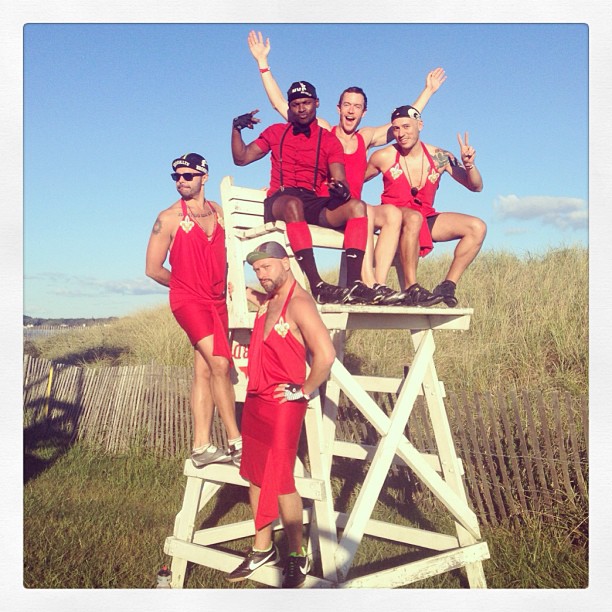
Some riders posing during lunch at the beach, Red Dress Day, BRAKING AIDS® Ride, September 2013.
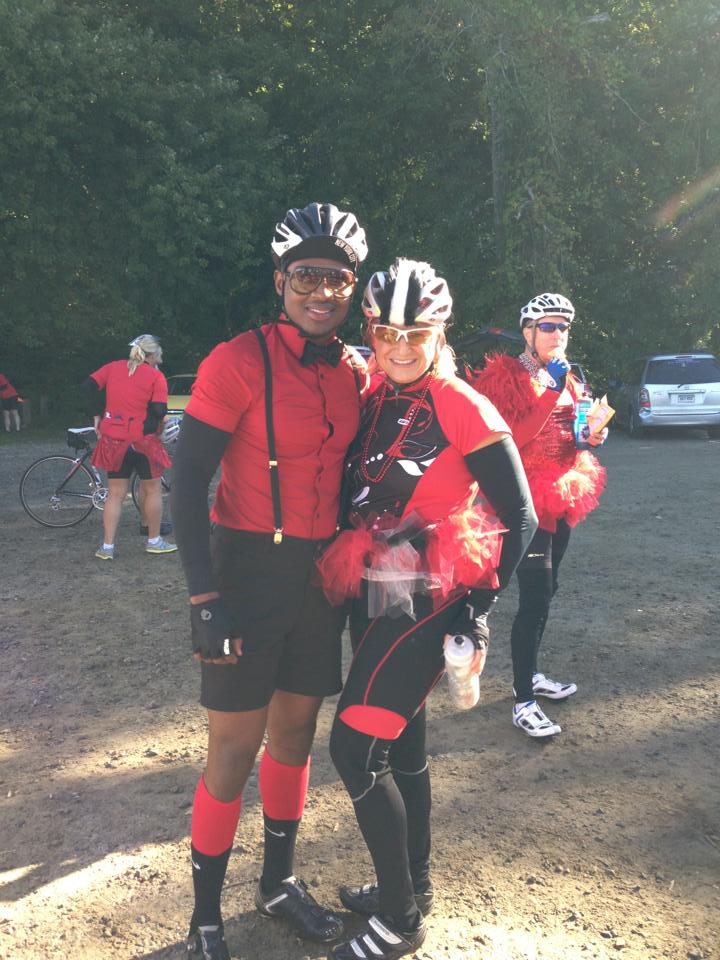
Riders Henry Bolden and Brigid Siegel, hotties dressed for success, Red Dress Day, BRAKING AIDS® Ride, September 2013.
The effect this visual parade has on the spectators who encounter us during the course of Red Dress Day varies. Some people are rude cat-callers, but many are simply curious, and some have even donated money on the spot when they find out why we’re riding. But overall, suffice it to say, Red Dress Day garners attention: It’s hard not to notice over one hundred people cruising through small New England towns, all of them wearing red, many of them in costumes or drag of one sort or another.

Tom Dwyer, hitching a ride with one of our amazing moto-safety crew guys and cruising through new England in style in his self-described “Tragic ‘Ho” outfit, Red Dress Day, BRAKING AIDS® Ride, September 2013.

A small group of riders and crew gathering during lunch at the beach to make a red ribbon, Red Dress Day, BRAKING AIDS® Ride, September 2013.
Another BRAKING AIDS® Ride tradition is that we all eat dinner together each night of the ride. During the course of the meal, various announcements are made by staff and crew, and for a portion of the evening the mic is opened up for anyone—rider or crew member—to share something from that day on the road. The moments people share run the gamut in tone and emotion: Some regale us with the silly or lewd comments they overheard people say. Others tell us what moved them or inspired them that day. On more than one occasion, brave souls have used that space to come out about their HIV status, sometimes for the first time to anyone.
Last year, crew member Linda Zipko got up at dinner one night and told us the following story: When she and a bunch of other BRAKING AIDS® Ride folks arrived at our host hotel en masse earlier that day, it turned out to be the same place we had stayed at the previous year. While she was in the lobby, one of the people who worked there walked up to her, perhaps recognizing her from the year before and said something like, “See? I heard you guys were coming back this year, so I wore a red shirt to work today.” Linda was warmed by the gesture and the two of them ended up hugging, two virtual strangers, right there in the hotel lobby. Normally a hug of that sort doesn’t last more than a second or two. But the hotel staff member held on, and it became clear to Linda something beyond a kind gesture of solidarity was happening. Tears began streaming down the face of the staff person, who clung to Linda, couldn’t quite release her, and who whispered in her ear that a close family member—father?—had been diagnosed with HIV during the previous year. I don’t recall what else the person said to Linda; I believe the words “thank you” were repeated a lot.
A number of other BRAKING AIDS® crew and riders were in the lobby at the time. They said later they could sense something big was transpiring as they witnessed the hug and the exchange; they just didn’t know what. Someone had the forethought to snap a photo of the moment as it took place, even without knowing what it was or what it meant.

Crew member Linda Zipko hugging a new friend, who wore a red shirt for Red Dress Day, BRAKING AIDS® Ride, September 2013.
I wasn’t in the hotel lobby that afternoon. I was probably somewhere out on the road, trying to get my bike, the Blue Streak, which was having mechanical shifter troubles, through another 25 miles. I didn’t witness any of what Linda experienced first-hand, and yet I have found myself returning to this story again and again during the past year.
The story is touching, to be sure, but it doesn’t give me solid, neat answers. I don’t know what happened to that stranger in the hotel lobby afterward. Perhaps the moment with Linda unfolded, it was powerful and moving, and then like a thundershower, it was over. I can’t say what that person felt or whether the moment resonated and had ripple effects later. I don’t know whether this person has told any of what was shared with Linda to anyone else, before or since. Likewise, I don’t know whether the person told anyone about wearing the red shirt, before or after doing it. I only know that showing up in a red shirt that day last September meant that this singular person had been waiting, for months, possibly all year, to have some kind of brief connection with us, with our ride community, a bunch of strangers, for a few minutes—to say in some small way “HIV affects my life, too,” and in doing so, perhaps to feel a little less alone in the world with whatever challenges might come with that.
It also means that our presence as a ride community had an impact on someone, long before that person chose to say something to one of us about it. I wondered later about that, about that choice to say something to Linda. The person could have worn the shirt as a private gesture and said nothing at all, and might even have had the same feeling of connection, just without any of us knowing it. What if the person hadn’t recognized someone from the ride or felt too vulnerable and didn’t have the nerve to say something in the moment? What if Linda had been tired that night and not up to sharing the story with the rest of us? We would still have had an impact, possibly a big one, on a stranger. The difference is we wouldn’t know it.
That refrain hums in my head sometimes now like a strange, minor-key mantra. We don’t always know, we don’t always know.
We affect one another. All the time. We can’t always know how or when.
We don’t always know, we don’t always know.
That might sound pessimistic to some, but it isn’t. I try not to dwell too long on whether I’ll recognize those moments when signs of connection and impact and meaning rise to the surface, if and when they happen, or if I’ll be lucky enough to be present for them—literally and emotionally—when they do make themselves visible. I think of how many teachers and mentors and surrogate-parent figures and friends I’ve had over the years, of how much they have shaped who I am today. I think of the BRAKING AIDS® Riders and crew who have moved me, some who became close friends, and others who I haven’t seen recently. I think of how sometimes it has been the smallest moment that struck a chord or changed something in me—a gesture, a smile, a word of reassurance, a moment of tough love when I needed it, a split second where the eyes met in recognition. Then I observe to myself how rarely I ever shared the fact of that impact with those people, often because I wasn’t aware of it myself until much later.
We all matter. We don’t always know.
We don’t always know.
I keep returning to that moment with Linda and the hotel staff person. Then I think to myself that for every moment like that, one we get to witness and hear and talk about—to see some tangible proof that who we are and what we do matters—a dozen other moments like that may be happening to other people, changes inside the shell of their selves that are happening because of us, because of something we said or did, that we aren’t aware of and may never know of. Something that changes their perspective or their trajectory forever, however slightly.
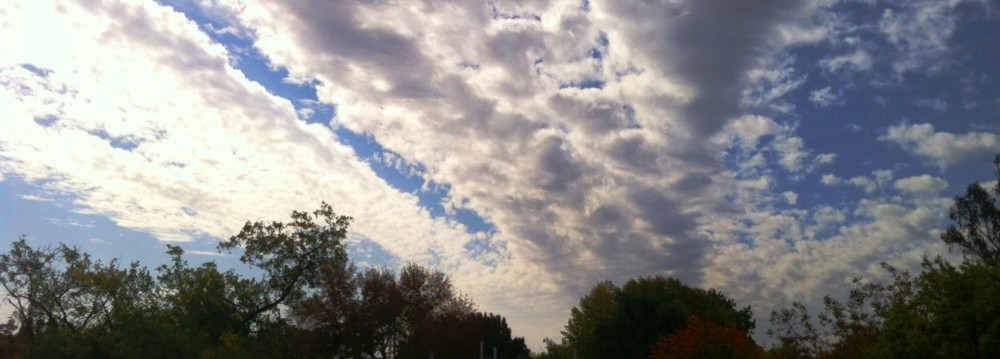
I imagine the vastness of that big cloud of all we don’t know, of all those invisible moments of meaning and connection and impact—both the ones I benefit from and the ones in which I affect others in some way. It’s a big cloud that stretches the expanse of the sky, like something Magritte would have painted. I take great comfort in dreaming about its possibility.
CLICK HERE TO DONATE TO SUPPORT ME & HOUSING WORKS FOR BRAKING AIDS® RIDE 2014.
 The Blue Streak
This was so very beautifully written; ‘We Don’t Always Know’ will stick with me. Thank you for sharing! Love you much! Barbara
Beautiful.
Thanks so much, Guinz. Means a lot, especially coming from you.