
It’s hard to believe that it is late July already. My last post on here was in March. It has been that sort of season. Busy but erratic. Insane weather that went from unseasonably cold to sweltering almost overnight.
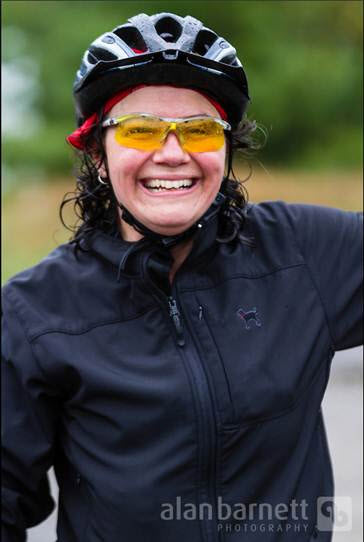
Me, wet and cold, but happy, on Day 1 of last year’s Braking AIDS Ride, Friday, Sept. 29, 2012. Photo by Alan Barnett.
In truth, though, I think I have postponed writing on this blog this season because I was struggling to figure out what I wanted to say. How my thinking about doing this 3-day, 285-mile bike-ride fundraiser and continuing to support this cause—the fight to end HIV/AIDS—in this way has evolved. This is going to be my sixth AIDS Ride, my fifth since 2008 with the Braking AIDS Ride group. I’ve ridden over 10,000 miles on a bicycle and raised almost $45,000, all in the name of supporting beneficiaries that offer crucial HIV/AIDS services. Isn’t that enough? Why am I still at it? What is the big deal about HIV? What’s changed since 1999? What’s different about the way I think about this in 2013? Why do I continue to fight this particular fight?
These questions are easy to ask, but authentic answers are elusive. I find that now that me asking for help to support this cause is no longer a novelty—just as the disease and the fight to end it are no longer new—I don’t always know what to lead with when I reach out to people about it. I am tired of HIV/AIDS, and even I am tired of doing what journalist Randy Shilts called “Talking AIDS to Death” in a 1989 Esquire article with that same title.

It’s official. According to the popular wisdom, AIDS has been old news for a decade and a half. This Esquire cover hit the stands in March 1999, six months before I did my very first AIDS bike ride.
What do I say to people today about AIDS, especially people I know who have heard so much of it, if not all of it, before? Where on earth do I begin? Do I lead with the good news? Everyone likes stories about progress. I, too, like stories that suggest we’re getting somewhere, that our efforts help. And we are making progress, no doubt about it. Or do I lead with the bad news? We are getting somewhere, but HIV/AIDS still affects countless people, and it remains a horrific, sometimes fatal disease, which is why we still need to keep up the work. Do I scare people to remind them that resting on our laurels and thinking the HIV/AIDS is now someone else’s problem—Africa’s problem, or Southeast Asia’s problem, or a Caribbean problem—is just about the worst thing we all can do?
Per usual, I decided to split the difference and do both. So, the good news and the bad news:
I fight this fight to end HIV/AIDS, and I ask for continued support for Housing Works from practically everyone I know year after year because HIV is old news. AIDS has now been around so long, it was considered old news even back in 1999, the year I did my very first AIDS ride, as beautifully illustrated by the March 1999 Esquire cover reproduced here.
In past years, I’ve usually set my fundraising goal at $5,000. Because AIDS is considered yesterday’s news, this year, I am doubling my efforts, and setting my fundraising goal at an ambitious $10,000.
Despite our progress, the battle against HIV/AIDS is far from over. My feeling is that one of the biggest growing challenges is reminding and in many cases, persuading people that HIV is still a big deal, a problem worthy of our time, our attention, and our financial support.
Yes, we have come a long way since the 1980s, when most people who contracted HIV died painful, ugly deaths that were both too long and too short. Too long in terms of the duration of suffering, for them and those who loved them. Too short in that the disease’s victims in those early days lasted a year or two, months, sometimes weeks. Today, in the nations where testing and treatment are affordable and readily available, the U.S. among them, HIV has become something you can live with for a very long time. That is the good news. And in contrast to 20 years ago, it is very good news.
The bad news, unfortunately, is exactly the same: that HIV has become something you can live with for a long time. The bad news is that people know that HIV is manageable, but what they have less knowledge about is what living with it entails.
Here are just a handful of reasons why complacency surrounding the fight against HIV/AIDS is so dangerous:
The statistics that demonstrate that HIV and AIDS are still a real problem continue to go up every year, even in the United States. 34 million people worldwide live with HIV today, 1.2 million in the U.S. alone. The global death toll exceeds 25 million. There is still no cure and no vaccine.
Since I rode my bike 285 miles last year for this same cause, some 50,000 Americans have become newly infected with HIV. That is likely to be the case next year as well. For a while now, the annual rate of new infections has become pretty stable in this country. Is this better than an infection rate that’s increasing, as it did for decades? Of course. But it is a low bar we’re setting, too low, when we convince ourselves that an annual, new HIV infection rate equal to half the population of Flint, Michigan, is good enough.

It’s supposed to be good news, but the truth is that the annual rate of new HIV infections in the United States is equal to half the population of Flint, Michigan. That’s 50,000 new people with HIV every year, for anyone who is counting.
 More disturbingly, one out of five Americans does not know his or her HIV status. About 1.2 million Americans have HIV, so that’s nearly one-quarter of a million people in this country who are likely to be spreading the virus unknowingly to other people.
Many kids in the U.S. aren’t learning about HIV in school. A startling 28 states in the U.S. do not have education requirements that mandate both sex education and HIV education. Irrespective of one’s religious beliefs or politics, that lack of access to health education is simply criminal. I was in high school from 1987‒1990. I still laugh when I recall the video on safe sex that we were forced to endure; the film was called Condom Sense, it was made in 1982, and in one scene, the narrator characterized wearing a condom as being like standing in a shower fully clothed with a rain slicker and rain hat on. We joked around in class when a banana was used to demo how to put a condom on properly.
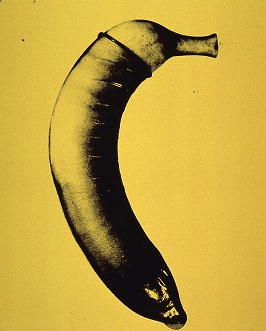
This is how sex education was taught in the 1980s when I was in high school. Image courtesy of the National Institute of Health.
But whatever else I can say about sex education during that period of time, I can say without hesitation that an awareness of and accurate knowledge about HIV and other STDs, as well as about safe sex practices, was an inherent and probably the biggest and most important part of what we learned. Even as fearless teenagers who believed we were going to live forever, we knew it was crucial to pay attention to information about HIV—because if we didn’t learn it, and understand it, and take it to heart by practicing safe sex when we became sexually active, it might kill us.
New HIV infections are highly concentrated in people between the ages of 13 and 24, an age group that is less likely to get tested and treated, possibly because those young Americans are too young to remember the days when HIV was a death sentence or—see previous paragraph—because they don’t have accurate knowledge about how you get HIV, how you prevent it, how you get tested for it, how you treat it, and how serious it is. These Centers for Disease Control stats make alarm bells go off in my head: Only 33% of Americans between age 17 and 24 were tested for HIV in 2012, and a scant 13% of high school students were tested for HIV in 2011. As a result, half of the Americans under the age of 24 do not know their HIV status.
A lot of people think HIV isn’t a big deal anymore. They’re wrong. HIV can now be manageable. That doesn’t mean it’s no longer a major health threat. HIV is not easy to live with and treat. Even with early diagnosis and proper treatment, managing it doesn’t mean you won’t get sick or suffer, and it doesn’t mean you won’t die. Jay Varma, representative of the NYC Department of Health and Mental Hygiene, summed it up best in a recent article on Bloomberg.com: “Even when someone with HIV is controlling it through medications, his or her immune system will never be fully functional.”
I hate having to type that last paragraph. I have more friends than I can count who have HIV. Many of them have lived with it for years. I’m glad to say many of them are healthy. They are stoic and optimistic about how they approach the disease. They are also brave. But they don’t just pop a pill that’s as benign as an Advil or a Vitamin C and call it a day. I plan to write another post that’s more about this aspect of the cause—because it’s worthy of that time and space.

Kyle Spidle, fellow rider and a PosPed (an HIV-positive rider), giving crew member Amy Hemphill a kiss for helping him fix a flat. Kyle was the first victim of the meningitis outbreak that began last year. He died a week before last year’s Braking AIDS Ride. He was 32 years old.
For now, I will leave you with this story: Last fall, a week before I traveled to Boston for the beginning of Braking AIDS Ride 2012, I got a message that my friend and fellow rider Kyle Spidle, who had been living with HIV since 2008, had passed away in his sleep. On Wednesday night, September 19, he went to bed early because he had felt slightly flu-ish. He never woke up. We didn’t know it at the time, but Kyle was the first victim to the current bacterial meningitis outbreak. That outbreak has since been widely reported. The part that tended to be under-reported is that the first victims of the meningitis outbreak were all HIV positive. HIV put them at greater risk across the board—of contracting meningitis, of having a more severe infection if they contracted it, and at greater risk of dying from a meningitis infection. Kyle was 32 years old.

Kyle Spidle, mugging for the camera, during the ride in September 2009. Don’t let the smile and the hot bod fool you. He wasn’t just a pretty face, and everyone who knew him misses him dearly.
As I said in my first, recent wave of solicitations to friends and family to donate to support me in the Braking AIDS Ride this September, I will ride this year in memory of Kyle and in memory of others like him. I will ride, as I do every year, in memory of Curtis and Daniel, two family friends whose deaths from AIDS in 2003 and 1987, respectively, I wrote about in previous posts on August 16, 2012, and August 29, 2012, and I will ride to support the many friends I have who are infected with HIV and for the countless others who are affected by this terrible disease.
The good news is that in the short time period since I sent out those calls for help, I’ve raised 32% of my fundraising goal of $10,000. If you’ve read this far, you already know what the bad news is.
WHERE YOU CAN DONATE TO SUPPORT ME IN BRAKING AIDS 2013:
Why, my fundraising page, of course! Donate early and donate often!
SOURCES:
Samuel Adams, “Meningitis Outbreak Spurs Effort Before Gay Pride Events,” Bloomberg.com, June 18, 2013.
Esquire AIDS Crisis issue, March 1999.
Tara Culp Ressler, “5 Things to Know in Honor of National HIV Testing Day,” June 27, 2013, Thinkprogress.org.
Randy Shilts, “Talking AIDS to Death,” Esquire, March 1989, p.123.
 The Blue Streak
You are a fabulous creature, Mika! I’m honored and excited to ride with you this year. Go girl go!